You have probably come across videos in recent weeks showing the drought and wildfires sweeping through England. Many of these clips shared on social media platforms like Tiktok have been accompanied by shocked reactions from people wondering how a country known for its famously rainy weather could be experiencing such severe drought.
Officials say 71.3 per cent of England is now in drought, after it recorded its driest July since records began in 1836.
While this is a shocking reality for some people, for many Kenyans, it is not. They have watched crops fail, water sources dry up and livestock die as droughts become longer and more frequent.
Currently, in northern Kenya, a situation reflected in many other parts of the country, water sources are drying, and harvests have dwindled, leaving farmers in debt and pastoralists in despair.
At the opening of the United Nations Convention to Combat Desertification (UNCCD) in Ulaanbaatar, Mongolia, this week, the UN body declared that countries are grappling with droughts that have increased by almost one-third since 2000 and generate at least USD 300 billion in annual losses.
"Land degradation and drought are no longer distant environmental concerns," UNCCD Executive Secretary Yasmine Fouad said. "They are already affecting the food we produce, the water we depend on, the resilience of our economies and the ability of communities to build secure futures. Healthy land is the foundation of healthy food systems, resilient economies and stable societies."
Drought and land degradation are estimated to cost the global economy US$900 billion every year, and they already affect up to 40 per cent of the world's land and 3.2 billion people.
"If the current rate of degradation continues, the area of degraded land could double by 2050," Saudi Arabia's Deputy Minister for Environment and adviser to the outgoing COP16 presidency, Osama Ibrahim Faqeeha, warned. "Today we are eight billion people and by 2050 it is expected we will exceed 10 billion people. We have two billion hectares of degraded land, or at least between 1.5 and 2 billion; the figures depend on reporting because 40 per cent of the countries are not reporting their land degradation."
It is the gradual degradation of land, where once-productive soil loses its ability to support crops, livestock and other forms of life, eventually taking on characteristics of a desert.
Climate change and human activities such as overgrazing, deforestation, and excessive irrigation can drive the process by depleting water resources and damaging soil.
As land becomes less productive, the consequences can extend beyond the environment, contributing to food insecurity, poverty, health problems, displacement and the loss of biodiversity.
The UN estimates that about half a billion people live in areas that have experienced desertification since the 1980s, while roughly two-fifths of the world's land is degraded.
And this is why the UNCCD, now in its 17th session, is a big deal. The conference builds on years of commitments and partnerships, bringing countries together once again to ask a crucial question: how do we turn those commitments into action that communities can actually see and feel? This year's theme captures that ambition: "Restoring Land. Restoring Hope."
Chief among Africa's priorities is combating severe droughts, desertification, scaling up land restoration and securing predictable financial flows that will protect its food systems.
Just like other COPs, over the next couple of days, negotiators from different regional blocs and civil society representatives will be engaged in heated negotiations, as they seek to hammer out agreements on drought, land restoration, financing and other key issues.
During the opening ceremony, Mongolia's Prime Minister Nyam-Osoryn Uchral urged participants to transform the meeting into a platform for solutions and turn commitments into tangible results/actions. UNCCD Executive Secretary Fouad urged Parties to make COP 17 about repairing ecosystems and restoring livelihoods, resilience, and hope in the multilateral system.
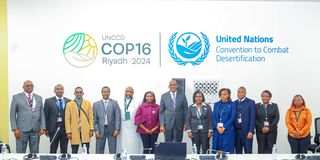
One of the most contentious issues on the table is the proposed global drought protocol, which remained unresolved at COP16 held in Riyadh, Saudi Arabia. Countries could not reach consensus on whether a legally binding agreement should govern the response to drought, a mechanism the African group of negotiators is advocating for.