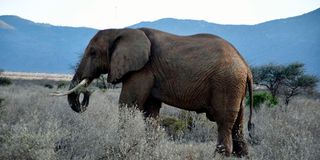
For years, farmers living alongside elephants have relied on everything from shouting and banging drums to chasing the animals away from their farms and homes.
But more than a decade ago, an observation in Samburu County offered a surprising alternative: bees.
“Residents would tell our Coexistence Director, Dr Lucy King, that elephants feared bees. At the time, King was conducting her PhD research in Samburu National Reserve, where she observed that during hot weather, bees would form colonies under large trees. It amazed the residents that elephants appeared to avoid these trees, an observation that caught King's attention and prompted her to investigate whether elephants were indeed afraid of bees," Derrick Wanjala, a Coexistence Project officer with Save the Elephants, shares.
In 2008, she led a team to install beehive fences around farms in Sagalla, Taita- Taveta County, next to Tsavo East National Park and monitored them over nine years.
The study, published in the journal Conservation Biology, recorded 3,999 encounters between African elephants (Loxodonta africana) and the farms.
Of these, 1,007 elephants broke through the beehive fences, while the fences deterred about 76 per cent of elephants from entering the protected farms. During peak crop-growing seasons, their effectiveness rose to between 78 and 86 per cent.
“In total, we have 47 beehive farms and more than 700 hives in Sagalla,” he says.
For farmers, the beehive fences offer more than just a way of keeping elephants out of their homes and farms. Beyond deterring elephants, the fences also offer an additional source of income through honey production. The study found that the beehive fences produced one tonne of honey, worth Sh291,150 (US$2,250).
But, there is one major problem; drought.
At the opening of the United Nations Convention to Combat Desertification (UNCCD) conference in Ulaanbaatar, Mongolia on August 17, the UN noted that droughts have increased by almost one-third since 2,000 and now generates at least USD 300 billion in annual losses.
“Land degradation and drought are estimated to cost the global economy nearly US dollars 900 billion every year and already affects up to 40 per cent of the world’s land and 3.2 billion people.”
The effects are not limited to people. As droughts intensify and water and food sources become scarce, wildlife is also forced to move farther in search of resources, bringing animals into closer contact with communities and increasing the risk of human-wildlife conflict. For farmers living alongside wildlife, this can mean more crop raids, damaged property and growing pressure on already fragile livelihoods.
“I remember the most difficult time we had was 2021-2022. Bees require enough forage and water. And we are in an area where if you don’t have enough forage for the bees, they will abscond. At one point, our bee colonies which are more than 300, went below 50 because of drought,” he explains.
While Kenya expects above average rainfall later in the year, some parts of the country are currently experiencing dry conditions, which could exacerbate human-wildlife conflicts as animals look for food or water.
The scale of the challenge is reflected in Kenya Wildlife Services 2024–2028 strategic plan, which estimates that about Sh3.8 billion is needed to protect both wildlife and communities.
For communities living alongside wildlife, however, the cost is often felt through damaged crops, destroyed property and lost livelihoods.
On August 13, Kajiado residents, where human-wildlife conflict remains rampant, petitioned Parliament to review the Wildlife Conservation and Management Act, 2013.
Kajiado West MP George Sunkuiya, representing the residents, argued that victims wait for a long time without receiving compensation. In his telling, the current compensation system is underfunded, ineffective and bureaucratic.
“The current compensation rates do not reflect the true economic value of the losses suffered by the affected communities.” They demand an increment of the compensation rates, clear timelines to process the claims and that approvals be made at the county level.
But for farmers using beehive fences, adaptation is also happening on the ground. As drought affects the availability of flowers and other plants that bees depend on for food, they are exploring ways of providing alternative forage to keep the bees healthy, fences functional and the elephants at bay.
“We train the farmers to feed the bees with sugar syrup. They mix sugar and water in the right ratio and feed them during the dry season. They have their own routine, working together with our field artisans to ensure the bee colonies are sustained during this period.
This is one of the most important things we do to maintain the colonies. Once the rains start, we stop feeding them because there is enough forage for the bees. During the dry season, the bees have to fly long distances in search of forage,” he says.
Agnes Mkanyika, a farmer whose land neighbours Tsavo East National Park, says drought has brought another challenge.
“Besides crops, when it is dry, elephants damage the water pipes and tanks as they look for water,” she says. On her farm, she has also planted pepper as another way of keeping the elephants away.
Wanjala says chilli offers farmers another low-cost deterrent, particularly when beehive fences become less effective during dry periods.
“During the dry season, you will find that not all hives are occupied and elephants are intelligent enough to know which hives are empty. Pepper, for instance, is not a palatable crop for elephants. Farmers can harvest the chilli and use it to make different deterrents. Some farmers, for example, use chilli briquettes. These are made by mixing dried chilli with elephant dung and then drying the mixture. When the briquettes are burned, the smoke produced contains chilli, which elephants avoid."