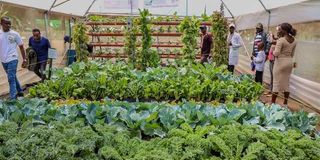
Walk into Wilson Ndung'u's greenhouse in Nanyuki and you would not immediately think agriculture is in crisis. Over a thousand blueberry plants stand in neat rows inside a 50-by-24-metre structure, fed through drip lines, shielded from the sun and the rain. Outside, the landscape tells a different story. The rains that once dictated the planting calendar are late some years, absent others. When they do arrive, they sometimes come all at once, flooding fields that took months to prepare.
Wilson Ndung’u at Lovington Herbs Stand during the Nairobi International Trade Fair 2023.
Photo credit: File
"It has been less of a trend and more of a survival strategy," he says, describing the shift he began making in 2023 towards what development experts call climate-smart agriculture. He reckons he is about 75 per cent through the transition. The other 25 per cent, he says, is mostly a question of money.
His journey sits at the centre of a transformation reshaping Kenyan agriculture, one that is working but is not yet reaching everyone who needs it. On World Environment Day 2026, with the United Nations Environment Programme calling on people everywhere to read the signals the planet is sending and act on them, Kenya's farms offer a complicated but ultimately hopeful answer to what that action looks like on the ground.
What climate-smart agriculture actually means
The UN’s Food and Agriculture Organisation (FAO) defines climate-smart agriculture (CSA) as farming built around three objectives: sustainably increasing productivity and incomes; adapting to and building resilience against climate change; and reducing or removing greenhouse gas emissions where possible. FAO introduced the concept in 2010.
Kenya is among only a handful of countries globally to have developed a dedicated national strategy around it. Agriculture accounts for roughly 28 per cent of Kenya's GDP and 65 per cent of the country's exports, according to data cited by Development Aid. The sector employs about 70 per cent of the rural population. Kenya's more than 7.5 million smallholder farmers produce approximately 75 per cent of the country's total agricultural output, according to the
International Fund for Agricultural Development. Any sustained climate shock to that system does not just hurt farmers. It hurts the country's food security.
In 2023 alone, Kenya experienced extreme temperatures, drought and flooding that left nearly three million people facing acute food insecurity, according to the UN. A recent study in the journal Frontiers in Sustainable Food Systems, drawing on Kenya Meteorological Department data, found drought and erratic short rains had pushed 2.15 million people into acute food insecurity in the period it examined, with approximately 265,900 in the most severe emergency category.
For Ndung'u, those numbers carry the faces of fellow farmers who lost seasons. Neighbours who walked away from their land. His own near-exit from farming before he decided to rebuild differently.
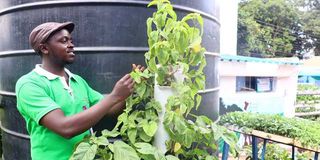
Before the greenhouses and the drip lines and the solar panels, Mazares Farm Limited looked like most farms in Kenya: rain-fed, labour-intensive and increasingly at the mercy of weather it could not control. Climate shocks kept disrupting production cycles. Ndung'u started reading about climate-smart systems, watching documentaries, researching online. Then, in 2023, he started spending. Today, the farm runs on automated drip irrigation, vertical gardens, container farming and a hybrid solar-and-grid electricity system.
He uses fertigation, a method where fertiliser is delivered directly through the irrigation lines, which means precise nutrient delivery without the extra labour. Irrigation time per block has dropped from about 20 minutes to roughly eight minutes. Across his roughly 196 acres, around 100 are now under some form of climate-smart management.
Ndung'u estimates he has invested around Sh5 million in irrigation infrastructure, solar systems and automation, including Sh700,000 for a single pump.
"Before I upgraded my farm to a medium-tech level, it was difficult for financial institutions to support me with credit," he says. "Lending institutions look closely at operating costs and capital requirements. One has to be clear on these to be considered for support."
He was trained in CSA approaches in 2022 and 2023. Since then, nobody has followed up.
"No one has ever come back to check on what I am doing. I have had to research online on how to improve the technologies digitally," he says.
Others finding their own way
In Musaalani village, Mwala Sub-county, Machakos, Urbanus Kamuti built an integrated farm combining water harvesting, biogas, fish ponds, zai pits and mixed crop-livestock production. Everything is designed as a closed loop where waste becomes input. It cost him over Sh1 million, partly supported through partnerships with SNV, World Vision, World Vegetables Center and the International Council for Research in Agroforestry.
"Rain-fed agriculture is no longer reliable. You either adapt or you lose production," he says.
In Nyamira County, Esbon Ogeto takes a different angle. His company, Nana Heals Enterprise, converts farm and market waste into organic fertiliser for smallholder farmers, and trains farmers, particularly women's groups, on soil management and production planning. He received a grant through the
"Earlier on I thought climate-smart farming would reduce costs immediately. But the reality is that the benefits are gradual. Soil improvement takes time, and farmers must invest before they see returns."
Then there is the data problem. Henry Mugai, founder of agri-data startup M-Research, has put around Sh700,000 into building a centralised agricultural data repository because he says Kenya simply does not have one.
"Data is fragmented and expensive to collect. But agriculture decisions depend heavily on accurate information," he says. He also points out that young agripreneurs face the same financing wall Ndung'u hit early on; lenders want proof of existing operations before extending credit, which shuts out farmers at exactly the moment they need support most.
Kenya has had a national policy framework for CSA since 2016. The strategy, which runs to 2026, envisioned a total implementation budget of KSh500 billion (approximately USD 5 billion) for adaptation and mitigation across the agriculture sector, according to UNDP documentation. The World Bank-funded Kenya
Research published in February 2026 in the journal Regional Environmental Change, one of the most current peer-reviewed assessments of CSA uptake in Kenya, shows adoption varies widely. A study in Laikipia found rates as high as 87 per cent for crop diversification and 83 per cent for crop rotation. A separate study across Embu, Nakuru, Nyeri and Siaya found only 37 per cent had adopted crop diversification and just 16 per cent had adopted agroforestry. The authors note there are no longitudinal studies of CSA adoption in Kenya, so nobody reliably knows whether the gap is closing or not.
An agricultural extension officer in Machakos County, who asked not to be named, estimates uptake in his ward had reached around 70 per cent by 2025. He serves more than 7,000 farmers, using WhatsApp groups and SMS alerts alongside field visits.
"Training is done, but follow-up is not always possible. That affects adoption and long-term impact."
Survival in the driest counties
Simon Muya in Turkana County lost approximately 120 goats in the 2022 drought, one of the worst the Horn of Africa had seen in decades. Through the IMARA programme, implemented by World Vision Kenya with funding from Sweden's development agency Sida, he was introduced to moringa as livestock feed and a recovery crop.
"Through the programme, we were introduced to moringa which has since helped me rebuild myself. I bought animals again and fed them with moringa. It worked," he says.
The seven-year IMARA programme, valued at SEK 211 million (approximately Sh3.22 billion), reached about 73,000 people across nine ASAL counties and supported restoration of more than 23,000 hectares of degraded land and over 1.24 million trees, according to World Vision Kenya's own programme reporting.
Its model also had limits built in from the start. Access required belonging to a registered group and having relationships with local government administrators. Many of the most vulnerable farmers never qualified.
The gap between technology and access
Joshua Musyoka, branch manager at Plum Agri Irrigation, which designs and installs irrigation systems for farms across different scales, says the technology itself is not the constraint.
"Irrigating farms is the secret to addressing food insecurity. But it must be done using quality systems installed correctly after proper site assessment," he says. What holds people back, he acknowledges, is the upfront cost of drip systems, pumps and solar integration.
"Smallholder farmers, especially in rural areas, account for over 75 per cent of food production in Kenya," he says. "But because many operate at low-tech levels, they are often locked out of climate-smart agriculture services."
The World Environment Day 2026 campaign notes that climate resilience could unlock USD 18 trillion in economic opportunities globally.