From guesswork to precision: Smart fishing technology offers lifeline to Coast fishers
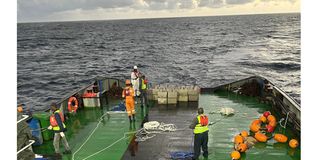
The advanced fishing gadgets known as Anchored Fish Aggregating Devices (aFADs) being anchored in Vanga-Jimbo in Kwale County.

For decades, Mr Lali Shee has relied on instinct, ocean landmarks and sheer luck to find fish in the Indian Ocean.
Mr Shee is used to waking up at 4am daily, firing up his petrol-powered outboard engine and spending hours trolling in vast, empty deep seas. But rising fuel costs and dwindling catches have made his traditional methods increasingly unsustainable, pushing him and other artisanal fishers to the brink.
There is, however, a ray of hope as a new technology promises to replace that uncertainty with precision and better returns. This is after an advanced fishing technology was rolled out this week for the fisherfolk in Lamu and Kwale Counties.


The gadget, known as Anchored Fish Aggregating Devices (aFADs), is used for pelagic fish (migratory) like tuna.
Also Read: Want to produce more fish? Here’s how
The technology, supported by international development agencies, works by creating an ecosystem that attracts fish, as it favours the growth of fish food in a particular area of the ocean, hence attracting small fish, which subsequently attract big fish.
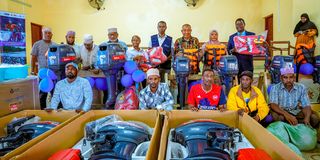
Lamu fishermen after receiving equipment from FAO on Tuesday, April 28, 2026.
The joint Food and Agriculture Organization of the United Nations (FAO) and United Nations Environment Programme (UNEP) initiative focuses on sustainable fisheries, crab and prawn farming, and post-harvest value addition. It is funded by the Swedish International Development Cooperation Agency (Sida) and is also being implemented in Mozambique and Tanzania.
“We spend Sh4,200 just on fueling our boat engine before venturing to sea. Sometimes we would return with nothing as we used to guess the fish locations. But we’re happy having received the gadget. We anchored them at the Zinyika area in the deep sea. We’re hopeful that after a few weeks or months, we shall start seeing the fruits,” said Mr Shee.
In Kenya, the project specifically targets fishing communities in Vanga Jimbo in Kwale County and Mkomani, Matondoni and Mokowe villages in Lamu County, where livelihoods have long been threatened by declining fish stocks, post-harvest losses and limited access to markets.
Speaking during the official equipment handover ceremony in Lamu, Dr Joseph Othieno, who represented FAO Kenya Country Representative Farayi Zimudzi, explained that fishers can use the device either by ensuring it is floating or submerged in the water. The device borrows from fish behaviour of being attracted to any floating object.
“This technology will help our fishermen, especially those undertaking small scale fishing, to get access to more fish and lower their cost of fish production while at the same time increasing their incomes and nutrition,” said Mr Othieno.
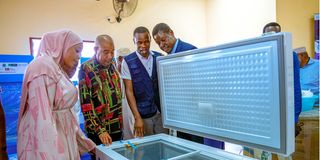
Lamu County Government officials, including Lamu Governor Issa Timamy (centre), receiving cooler boxes and other fishing equipment from FAO officials on Tuesday, April 28, 2026.
So far, six aFADs have been installed in Kwale while five have been deployed in Lamu County.
Dr Othieno added that the devices are placed some distance offshore to also aid deep-sea fishing. The location is decided in consultation with the Beach Management Unit (BMU) members and based on scientific requirements of water depth, which normally needs to be between 140 and 200 metres.
On how fishermen share the available catch or whether there is any set limit for each of them, he said aFADs are under the management of BMUs, hence they coordinate fishing as per the regulations of their various groups.
“BMUs are always the ones that determine access to the aFADs. The devices are submerged in the water and the fishermen pick the GPS coordinates of the site,” said Mr Othieno.
Lamu Governor Issa Timamy expressed expectations that gadgets like aFADs will directly improve incomes for the fishing communities in the region. Mr Timamy noted that the earnings of fishermen were dwindling due to the use of traditional techniques in their daily activities at sea.
More than 70 fishers and community members in Lamu and Kwale counties have so far been trained on monitoring, control and surveillance of aFAD use. To curb post-harvest losses, the project invested in cold chain infrastructure.
The fishermen were also trained in modern fishing gear assembly, data collection, safety at sea and proper handling of catches, alongside essential equipment such as outboard engines, solar freezers, cooler boxes, fishing gear kits and safety gear.
Follow ourWhatsApp channel for breaking news updates and more stories like this.


