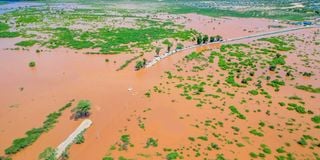
Kenya’s fragile infrastructure, education, health, food systems and essential services are heading into a potentially punishing October-November-December (OND) season as enhanced rains threaten to unleash floods, landslides and disease outbreaks.
The extreme weather is expected to disrupt national examinations, cut off communities, destroy crops and livestock, and cripple critical transport and water networks.
The threat comes as the economy enters the rainy season after recording broad-based growth, with some of the sectors driving that expansion among those most exposed to extreme weather.
According to the Kenya National Bureau of Statistics (KNBS) Economic Survey 2026, Kenya’s real Gross Domestic Product (GDP) grew by 4.6 per cent in 2025, marginally slower than the 4.7 per cent recorded in 2024, with all sectors recording positive growth. The nominal size of the economy rose from Sh16.23 trillion in 2024 to Sh17.58 trillion in 2025.
Kenya Meteorological Department Deputy Director Charles Mugah during the launch of the 13th National Climate Outlook Forum at Mövenpick Hotel in Nairobi on August 26, 2026. The forum presented the October–December 2026 climate outlook, with above-average rainfall forecast across about 80 per cent of the country amid prevailing El Niño conditions.
Photo credit: Wilfred Nyangaresi I Nation Media Group
Agriculture, Forestry and Fishing expanded by 3.1 per cent and accounted for 23.2 per cent of GDP, while Transportation and Storage contributed 11.8 per cent and grew by 3.7 per cent. Construction rebounded from a 0.7 per cent contraction in 2024 to grow by 6.8 per cent, while Wholesale and Retail Trade expanded by 3.6 per cent. Accommodation and
Excessive rainfall could waterlog farms, wash away crops and livestock, and disrupt access to markets, while flooded roads and damaged bridges could choke the movement of people and goods. Construction projects could be delayed, while hotels, restaurants and other businesses could suffer if transport, electricity and water services are disrupted.
The impact could ripple through supply chains, household incomes, food prices and business activity, while increasing government spending on rescue, evacuation and infrastructure repairs. GDP per capita rose from Sh309,609 in 2024 to Sh329,594 in 2025.
Kenya has experienced the destructive power of El Niño rains before. The 1982–1983 episode brought severe climate extremes and flooding, while the 1997–1998 El Niño remains one of the most devastating weather events in the country’s recorded history, causing widespread flooding, landslides, destruction of infrastructure and loss of lives. The 2015–2016 cycle also brought powerful enhanced rains across parts of East Africa. More recently, the 2023–2024 floods affected 42 counties, displacing communities and destroying homes, roads, bridges, farms and businesses.
It is against this history that stakeholders at the 13th National Climate Outlook event warned that the coming OND season must be treated as both an opportunity and a risk.
Kenya is emerging from periods of drought and water stress, making the expected rains potentially valuable for agriculture, water resources and livestock. But excessive rainfall could overwhelm infrastructure and services already vulnerable to extreme weather.
Jesse Ithau, data officer at the National Disaster Operations Centre (NDOC), feared that the first and most immediate concern is the potential loss of human life as floods, landslides, mudslides and rockfalls expose communities to drowning and travel accidents.
“Our greatest concern is the loss of lives. When the rains intensify, communities living along rivers, on unstable slopes and in flood-prone areas will be on the frontline,” Ithau warned. The danger is expected to be greatest for communities living along rivers, on unstable slopes and in flood-prone settlements.
“They will be facing the threat of drowning, landslides and potentially fatal travel accidents as the rains intensify,” Ithau said.
However, the threat is not limited to floods themselves. Waterlogging creates conditions for disease outbreaks, with NDOC warning of increased risks from water-related diseases. “Standing water and high humidity could increase breeding of mosquitoes and other vectors,” Ithau explained, “raising the risk of malaria and other infections.”
The health sector is preparing for a potentially wider disease burden. According to Rosa Mokaya, from the State Department for Public Health, enhanced rains could increase cases of vector-borne and waterborne diseases, including malaria, Rift Valley fever (RVF), yellow fever, chikungunya and cholera.
“Disease outbreaks are among the major negative impacts expected during the OND season,” she said. “There is need for epidemic preparedness, disease surveillance and pre-positioning of medical commodities.”
The danger is compounded when flooding displaces families. Overcrowded temporary shelters can make it easier for communicable diseases to spread, particularly where water, sanitation and hygiene services are inadequate.
The OND rains are expected to coincide with the national examination period, creating the possibility of flooded schools, washed-away access roads and disrupted transportation of examination materials.
Stakeholders in the education sector expect vehicles carrying examination materials to break down or become unable to reach centres, while some examination centres could be cut off completely.
“National examinations cannot be postponed or delayed at any examination centre,” said Col (Rtd) David Samoei, Director at NDOC, “because they must be administered simultaneously across the country.”
School infrastructure is also vulnerable. Classrooms, examination centres, laboratories, kitchens, offices and sanitation facilities could be damaged or submerged. In addition, there is a threat to the continuity of learning from sickness and disease outbreaks, including malaria, cholera and dysentery.
Agriculture faces contradiction
Agriculture too faces the same contradiction. Enhanced rainfall could provide farmers with longer growing seasons, better soil moisture and opportunities for multiple harvests. But excessive rainfall could turn productive farmland into waterlogged fields.
Agriculture officials warn that lowland areas could experience flooding, soil erosion and nutrient leaching, damaging soil health and degrading arable land. Swollen rivers could wash away crops and livestock, while fertiliser applied after rainfall could be lost through runoff. High humidity could accelerate crop pests and diseases, while produce exposed to excessive moisture could rot or become contaminated. In highland areas, landslides could displace communities and damage farms.
The livestock sector faces similar risks. Flooding could cause livestock deaths and displacement, while disease outbreaks could increase. Excessively green pasture could also cause digestive problems, including bloating and diarrhoea.
Yet farmers could also be among the biggest beneficiaries if the rains are well distributed. The season could improve agricultural performance, increase food production and raise household incomes. More food could improve nutritional security, while increased production of fodder could allow farmers to conserve hay and silage for later use.
Forests opportunity amid risk
But amid the mounting risks, the enhanced rains are seen to offer Kenya’s forests a rare opportunity for recovery, with increased moisture providing favourable conditions for tree establishment and ecosystem restoration.
Patricia Kitheka of the Kenya Forest Service (KFS) said the season could accelerate afforestation, reafforestation and forest restoration efforts, helping the country expand its tree cover.
“Enhanced rains could support widespread afforestation and reafforestation and improve forest and tree cover,” Kitheka said.
The sector expects widespread afforestation, reafforestation and restoration activities as rainfall improves conditions for tree establishment. The rains could also create business opportunities for tree nurseries, improve forest biodiversity and reduce forest fire risks. Communities could also benefit through livelihoods linked to agroforestry, beekeeping, non-timber forest enterprises and carbon markets. However, excessive rainfall carries its own threats to forests. Flooding and waterlogging, landslides, soil erosion, siltation, pests and diseases could damage forest ecosystems and infrastructure.
Transport sector braces for disruption
Extreme rainfall, strong winds and flooding could disrupt aviation, marine and ground transport. According to Michael Muchiri of the transport sector, aircraft operations could be affected during landing, take-off and refuelling, while ferries and marine operations could be disrupted by high waves and strong winds. “Enhanced rains will put significant pressure on transport operations, from the skies to the roads and waterways,” Muchiri warned.
On the ground, roads and railways could be affected by flooding, waterlogging and aquaplaning.
“Continuous monitoring of weather, especially extreme events,” he explained, “will be necessary to identify safe windows for aviation and marine operations.”
Passengers could face delays, cancellations and diversions, while businesses could suffer from interruptions to the movement of goods. As a result, the transport sector fears that the consequences could extend to food prices. “If roads become impassable, food and other essential supplies may not reach markets on time, creating shortages and inflationary pressure,” Muchiri said.
Water sector: Recharge versus destruction
For the water sector, enhanced rainfall could recharge aquifers, increase reservoir inflows and improve water availability. It could reduce water-use conflicts and provide communities with greater access to water.
But the same rainfall could overwhelm water infrastructure. The sector expects possible damage to pipelines, water intakes, boreholes and treatment facilities, as well as flooding and failure of sewerage and sanitation systems. Heavy rainfall is feared to increase siltation and contaminate water sources through agricultural runoff and poor sanitation.
The enhanced rains could become a major test for Kenya’s economic recovery, with the potential benefits of higher agricultural output and improved water availability set against the risk of widespread disruption to businesses, supply chains and critical infrastructure. After periods of drought, enhanced rainfall could replenish rivers, reservoirs and underground aquifers, easing pressure on households, farmers and livestock keepers while supporting industries and hydropower generation.
But excessive runoff can damage pipelines, water intakes and boreholes, while carrying silt, chemicals and waste into rivers and reservoirs. Sewerage systems can also be overwhelmed, and damaged sanitation facilities can contaminate water sources and increase the risk of waterborne diseases such as cholera.
Ruth Mwathi from the Central Bank of Kenya (CBK) said the enhanced rains could produce significant economic gains if the benefits outweigh the disruption.
“Improved crop and livestock production could increase agricultural growth and incomes,” Mwathi explained, “while supporting related sectors such as agro-processing, manufacturing, wholesale and retail trade.”
Recharged reservoirs and aquifers are said to sustain hydroelectricity generation and water supply. In addition, increased food and electricity availability are expected to help reduce inflationary pressure.
However, flash floods and landslides could destroy property, crops and infrastructure, while disruptions to transport and trade could interrupt supply chains. The government could face increased expenditure on search and rescue, evacuation and infrastructure repairs, even as revenue collection falls because economic activity is disrupted.
Government says it is prepared
The government says it does not intend to wait for floods before responding. Principal Secretary for Climate Change, Festus Ng’eno, said the government was determined not to wait for disasters to occur before responding, arguing that early warning must translate into early action.
“We are prepared for those contingency measures,” Ng’eno said. “We don’t want El Niño rains to catch us flat-footed.” Education authorities are preparing alternative vehicles, coordinated rescue operations and, where necessary, airlifting examination materials and using speed boats in flooded areas.
“We are putting contingency measures in place to ensure examination materials reach every centre despite disruptions caused by flooding,” Samoei said. “This includes deploying alternative vehicles, coordinating rescue operations and, where necessary, airlifting materials or using boats to reach centres cut off by floodwaters.”
They are also considering decentralised examination arrangements and alternative routes to ensure learners can access centres.
The timing makes the preparations especially critical. A flooded access road that might inconvenience an ordinary school day could have far greater consequences when examination papers, candidates and examination officials have to arrive at a specific place at a specific time. The sector is also preparing for disruptions to school meals.
Flooded roads could delay food deliveries, while existing stocks could be destroyed or contaminated. Officials plan to pre-position food supplies before the rains and improve storage and handling of school meals.
Insurance and economic resilience
Mwathi said strengthening crop and livestock insurance, including instruments such as ‘De-risking, Inclusion and Value Enhancement of Pastoral Economies’ (DRIVE) and activating disaster-risk financing mechanisms will be important.
“We need to strengthen crop and livestock insurance programmes such as DRIVE and ensure that disaster-risk financing instruments can be triggered when these shocks occur.”
Other measures include supporting climate-resilient industries, strengthening food distribution channels and considering tax deferrals and emergency credit facilities for enterprises affected by extreme weather. “We also need to promote economic diversification by supporting climate-resilient industries so that the economy is less exposed to seasonal weather shocks,” she said.
Disaster response preparations
NDOC is planning to pre-position rescue teams and equipment and issue early warnings. “We will issue early warning advisories, community sensitisation and evacuation from high-risk areas, while rescue teams and equipment are to be repositioned ahead of the rains,” Ithau said. He added that flood simulation exercises are also being undertaken to test response capacity.
According to the Ministry of Interior and National Administration, unclogging and desilting of drainage systems, culverts and other water channels are ongoing to improve water flow and reduce the risk of urban flooding. Choke points along specific drainage systems have already been identified, with relevant agencies, including the Kenya Urban
Agencies responsible for infrastructure and disaster preparedness are continuing to clear drainage systems and water channels in areas at risk of flooding.
“Solid waste and garbage management is also being strengthened, including through Climate Work,” the Ministry of Interior said, “while ensuring that workers involved in these operations have the necessary equipment to undertake their duties safely.”
The health sector is preparing medicines, surveillance systems and emergency services. Schools are preparing alternative examination arrangements.
“The health sector leads in hygiene promotion, provision of personal protective equipment, temporary shelters with adequate ventilation and active disease surveillance in affected areas,” Mokaya said.
She further added that facilities could become inaccessible, supply routes disrupted and routine services interrupted just as demand for healthcare increases.
“The health sector is therefore preparing mobile clinics, medical camps, outreach services, alternative supply routes and buffer stocks of medical supplies,” she said.
Farmers advised to prepare
Farmers are being advised to prepare early, conserve fodder and adopt climate-smart practices. They are also strengthening surveillance of crop and livestock diseases and encouraging vaccination, livestock insurance, feed conservation, water harvesting and rehabilitation of dams and boreholes.
Water authorities are monitoring dams, reservoirs and drainage systems, while transport agencies are identifying vulnerable routes and alternatives.
But the effectiveness of these measures will depend on whether they are implemented before the first major floods rather than after communities are already stranded.
The government says teams led by NDOC and the Ministry of Interior are already moving around the country to identify and map safe areas where people can be relocated if flooding becomes severe.
PS Ng’eno said the government had spent the past two to three months preparing for the forecast rains after the Kenya Meteorological Services Authority (KMSA) raised the alarm over the possibility of an El Niño event.
He said early warning information was being used to map communities at risk and determine the number of households that could require assistance before the rains arrive.
“The government is very prepared this time round,” Ng’eno said. “The county teams are already working with communities in areas considered vulnerable to flooding.”
The approach, he said, was intended to minimise the cost of responding after disasters had occurred by moving vulnerable populations to safer areas in advance.
“Early warning will give us early action,” he said.