Super El Niño beckons but officials cagey on floods control
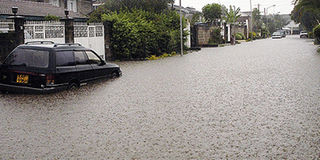
A flooded residential area in Nairobi after heavy rainfall in the past. In 1997/98, El Nino rains in Kenya caused heavy flooding and landslides that displaced thousands. Several international agencies have pledged to support the El Niño mitigation plans. FILE PHOTO | NATION MEDIA GROUP

What you need to know:
Rain has become a difficult subject for Jane Nyambura, a mother of three. Oftentimes, she still pauses whenever conversations drift towards the weather.
“It took so much from me,” she says.
Until May 2024, Nyambura and her children lived in Kibera, a place she had called home for more than a decade. Until the night of April 30, heavy downpours meant flooded footpaths, water shortage, and occasional colds, but somehow, life always returned to normal.
But that night, the floods came. Water tore through her neighbourhood with a force she had never witnessed before, leaving her house badly damaged and much of what she owned destroyed.
“We had to seek shelter at my sister’s place in Huruma. For two months, two of my school-going children had to stay at home, and I had to depend on well-wishers to buy their uniforms and other school supplies. That flooding took me back to zero,” she says. “Rebuilding has been slow.”
She is not alone.
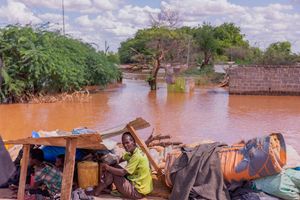
Thousands of Kenyan families are still living with memories of the devastating El Niño rains that pounded across the country late 2023 and early 2024. The heavy rains, which scientists say were exacerbated by climate change, unleashed one of Kenya’s worst flood disasters in recent memory. Rivers burst their banks, highways disappeared beneath brown water and entire villages woke to find their homes swallowed overnight. By the time the floodwaters retreated, more than 200 people had lost their lives, thousands of families were left displaced and billions of shillings worth of infrastructure and properties were destroyed.
Now, the Kenya Meteorological Department (KMD) says conditions are once again aligning for another possible El Niño later this year during the October-November- December rainy season. The latest seasonal outlook projects depressed rainfall in the highlands west of the Rift Valley. That includes the western Lake Victoria area, the south rift, the central rift valley, and the north rift. This pattern, scientists say, precedes El Niño.
This context is important because they are warning that this will be a “Super El Niño.”
Frankline Komolkori, a principal meteorologist in charge of the National Meteorological Centre at KMD headquarters, explains what this means. “When we talk of enhanced rainfall, we talk of rainfall that is more than 50 millimetres within 24 hours. During such heavy rainfall, some stations report up to 180 millimetres within that time frame. So, we look at that impact. What will that do? Definitely, it’s going to flood. And if it rains in a mountainous area, there is a high possibility we might have landslides and mudslides. It is no longer what the weather will be, but what the weather will do,” he explains.
“Generally, when you talk of Super El Niño, we have what we call the El Niño index. An index which is more than two degrees means that it is going to be a very strong El Niño. Normally, it starts around 0.5, which is a weak El Niño. We are giving an 82 per cent probability of the El Niño phenomenon later in the year.
This is not simply Kenya's assessment. The WMO and ICPAC, the regional climate centre that supports countries in the Greater Horn of Africa with seasonal forecasts, have also pointed to evolving climate conditions that favour the development of El Niño.
Kenya is no stranger to this phenomenon. The country experienced it in 1965, 1997, 2015 and most recently in 2023. However, forecasters say this year’s event could be stronger. Current climate projections suggest the index could rise above 2.6, meeting the threshold for what meteorologists classify as a very strong event.
El Nino 2023
For many Kenyans, rain has become a language of contradiction. It is the promise of a good harvest, and the possibility of another disaster. It revives pastures, replenishes rivers and enhances livelihoods. But it also kills, floods homes and upends lives.
The country has lived both realities.
Recent rains
Yet, each heavy downpour appears to expose the same familiar weaknesses of deaths, flooded roads, overwhelmed drainage systems, displaced families and a response often criticised as too little, too late. During the March-April -May rain season, the heavy rains triggered floodings in different parts of the country. The same cycle was repeated; deaths, displacements and destruction of properties.
Already, human organisations appear to be planning not for the possibility of need, but for the likelihood of it. The Food and Agriculture Organisation (FAO) and the World Food Programme (WFP) have launched their first ever joint anticipatory action appeal to raise 26.2 billion (USD 202) to protect lives from the potential impacts of el nino.
Kenya is among the 22 priority countries to receive humanitarian help.
“Experience consistently shows that early action is more effective and less costly than responding after a crisis has escalated,” says FAO Deputy Director-General Beth Bechdol. "We have the data, the tools and the evidence to identify risks before they become emergencies.”
Online, and in private, however, Kenyans are criticising the government’s lack of preparedness and slow response. What, many ask, is the country’s preparedness?
According to Komolkori, Kenya met has already done their part. “During those heavy rains that happened in the recent past, we have been giving advisories. Because the mandate of KMD is to give the forecast and give the warnings. Then other government agencies and the non-state actors also pick from there. And that is why we are giving right now an early warning of what we are anticipating in October, November, December. What are the stakeholders supposed to do? Can we prepare before that period?
The early warning, the official says, is intended to buy stakeholders valuable time to prepare, mobilise resources and put measures in place before rains begin.
Nation has seen a Weather and Climate Preparedness Checklist that sets out recommended actions for government agencies and other stakeholders across sectors such as health, agriculture, transport and disaster risk management.
To establish what preparations are underway, Nation contacted various government ministries and agencies expected to play a key role in El Niño preparedness, including those responsible for disaster management, transport, water, health and agriculture. Despite repeated follow-ups over several days, they did not respond to questions on the measures being put in place ahead of the anticipated rains.
Government Spokesperson Isaac Mwaura said the government has already activated a multi-agency response through the National Disaster Operations Centre to prepare for the anticipated El Niño rains.
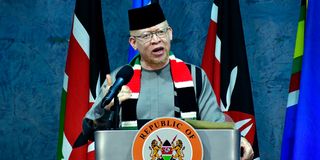
Government Spokesperson Dr Isaac Mwaura briefs media on December 19, 2025.
Mwaura, however, did not provide details of the specific interventions being undertaken. He said the government “will be giving further information in due course”.
The effectiveness of these preparations will ultimately be measured on the ground, particularly in places that have repeatedly borne the brunt of flooding. Few illustrate that challenge more starkly than Nairobi County.
In recent years, heavy rains have routinely transformed parts of the capital into flood-prone landscapes, disrupting transport, damaging homes and businesses, and displacing residents.
Nation contacted Nairobi County to establish what measures had been put in place to reduce flood risks ahead of the anticipated El Niño rains. The response came in the form of a checklist detailing preparedness activities that had either been completed or were still outstanding. Beyond that, however, the county offered no further explanation on the interventions or how they would address the city’s recurring flood challenges.
Follow our WhatsApp channel for breaking news updates and more stories like this.