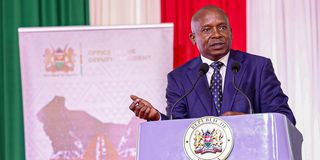
Deputy President Kithure Kindiki chaired the 30th Ordinary Session of the Intergovernmental Budget and Economic Council yesterday at his official residence, ending speculation that the role had been transferred to the office of the Prime Cabinet Secretary.
The meeting prioritised tackling counties’ pending bills and preparing for El Nino. In his speech, Prof Kindiki said the council was increasingly becoming a results-oriented institution, where decisions are followed through and translated into interventions that benefit Kenyans.
As the country continues to implement measures to mitigate the impact of the anticipated downpours towards the year-end, he stated that about 18 counties would be affected. The Deputy President called on county governments to collaborate with the national government on prevention measures.
“We must, therefore, prepare for the possibility of above-normal rainfall, flooding, flash floods, landslides and disruption of critical infrastructure, while recognising that the actual impacts will vary from county to county and that forecasts will continue to be refined as we approach the October–December season,” Prof Kindiki said.
He mentioned that 18 counties, alongside urban centres such as Nairobi, Mombasa and Kisumu, have been identified as particularly vulnerable. “We must act now, before the rains begin, to safeguard lives, livelihoods, infrastructure and essential services.”
Prof Kindiki—reiterating the need to activate disaster preparedness and response plans—urged the counties to clear and maintain drainage systems, identify and protect vulnerable communities, pre-position essential supplies, and strengthen emergency response teams.
He also warned governors and government officials about the mounting pending bills, which he said affect service delivery.
As of June 30, the total payable amount in the 47 counties was approximately Sh156.84 billion, with Nairobi accounting for the largest share at Sh81 billion.
According to the Deputy President, some counties had made improvements in addressing the issue. He added that with the approval of Sh34.46 billion from the Office of the Controller of Budget, the counties should now focus on reducing their bills.
“I commend the counties that have taken steps to verify, prioritise and settle eligible pending bills. However, this remains an area requiring sustained attention. Accumulation of pending bills undermines service delivery, damages the credibility of government and adversely affects businesses that depend on government contracts,” he said.
On affordable housing, Prof Kindiki said the government had made progress in processing land and titling for the project, and that 14 out of 26 project sites had acquired base titles.
He said the National Treasury had disbursed all the amount of money due to county governments as part of the equitable share by the close of the financial year, adding that it demonstrates the commitment of President William Ruto to ensuring that the county governments are in full operation.