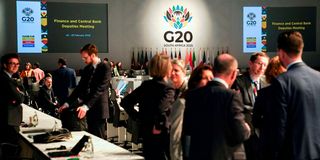
For the first time, G20 leaders gathered on African soil to reshape the global climate and development agenda. The outcome: ambitious commitments on early warning systems, clean cooking, and critical minerals. But there's a catch. Activists are already warning that declarations alone won't drive the real transformation Africa needs.
At the Johannesburg summit held on November 22 and 23, G20 leaders reaffirmed their commitment to accelerating disaster resilience and early warning systems. They recognised that increasingly extreme weather is becoming an existential threat to development gains across the continent. The summit itself reflected the African Union's new status as a full G20 member, having joined the group just last year under India's presidency.
"We reiterate the urgent need to protect all countries through universal coverage of early warning systems and highlight the importance of the call for the implementation of the UN Early Warnings for All Initiative by 2027," the declaration stated.
The G20 specifically commended South Africa for being the first country to launch its roadmap under the initiative. This emphasis on early warning systems hits home for Kenya and East Africa. These regions have been periodically ravaged by droughts, floods, and extreme heat.
The G20 leaders acknowledged that "disasters and shocks, which are increasing in frequency, intensity and geographic extent, hinder progress towards sustainable development and strain both national capabilities and the international system's ability to respond." They highlighted that vulnerable countries, particularly Small Island Developing States and Least Developed Countries, bear disproportionate impacts and "cannot afford the costs of adaptation, disaster mitigation, preparedness and recovery."
World Meteorological Organisation Secretary-General Celeste Saulo welcomed the declaration. She called it "the culmination of sustained engagement throughout the 2025 G20 cycle." But more than that, she said early warning systems represent something beyond just technical infrastructure.
"WMO stands ready to support all countries through science, innovation, solidarity and capacity development to ensure that no community is left unprotected," Saulo said. She described the Early Warnings for All initiative as having become a global brand of solidarity against extreme weather challenges.
The initiative was launched by UN Secretary-General António Guterres in 2022 with an ambitious target: ensuring that everyone has access to life-saving early warnings by 2027. It's now at the halfway stage and is co-led by WMO and UNDRR, in partnership with the International Telecommunications Union and International Federation of Red Cross and Red Crescent Societies. The G20's backing gives it significant political momentum.
The summit also reaffirmed the importance of the Sendai Framework for Disaster Risk Reduction 2015 to 2030. They acknowledged "strong synergies between the SFDRR, the 2030 Agenda for Sustainable Development, the United Nations Framework Convention on Climate Change and the Paris Agreement." They called for accelerated progress "particularly in Africa."
But beyond disaster preparedness, the summit tackled something even more critical for Africa, energy poverty. This is a crisis that kills people every day across the continent.
"Over 600 million Africans have no access to electricity. An estimated one billion people in Africa lack access to clean cooking. Two million Africans lose their lives each year due to the absence of clean cooking fuels in households," the declaration said.
Energy is tied to everything: healthcare, education, manufacturing, and poverty reduction. Without it, countries struggle to industrialise and create jobs.
Here's where things get interesting. Rather than pushing liquefied petroleum gas as the primary solution (like many organisations have done), the G20 took a different approach. They embraced decentralised renewable solutions. The declaration welcomed "the Voluntary Infrastructure Investment Action Plan to Accelerate the Deployment of Clean Cooking Solutions," noting commitment to create a conducive policy environment for accessible and affordable clean cooking technologies, infrastructure and fuels, emphasising decentralised and inclusive energy solutions, grid expansion, and enabling policy frameworks.
Mohamed Adow, director of Power Shift Africa, picked up on this shift.
"This declaration breaks with the dangerous myth that clean cooking equals gas," he said. "The G20 declaration recognises that the one billion Africans still without clean cooking can be served through decentralised renewables and expanded grid infrastructure. Initiatives such as Mission 300 show that Africa can leapfrog the fossil fuel pathway, not repeat it."
The summit welcomed Mission 300, a platform led by the World Bank Group and the African Development Bank aimed at connecting 300 million people to electricity across Africa by 2030. If that target is hit, it would be transformational progress for the continent. It represents a deliberate shift away from the centralised, fossil fuel-dependent energy models that characterised 20th century development.
The declaration further endorsed the G20 Critical Minerals Framework, positioning Africa's vast mineral wealth as central to global climate transitions rather than as raw material for extraction. This matters as the world transitions away from fossil fuels. Solar panels, wind turbines, electric vehicles, and battery storage all require critical minerals like lithium, cobalt, nickel, and rare earth elements. Africa holds significant reserves of these materials.
"The Framework is designed to respond to the urgent need for international cooperation to secure sustainable, transparent, stable and resilient critical minerals value chains that underpin industrialisation and sustainable development," the declaration stated. It aims to unlock investment in mineral exploration, promote local beneficiation at source, and strengthen governance for sustainable mining practices while "fully preserving the sovereign right of mineral-endowed countries to harness their endowments for inclusive economic growth."
This means processing minerals locally rather than exporting raw ore, which keeps more value and jobs in Africa rather than shipping them to wealthy nations for processing.
For Adow, this marks a watershed moment. "The Critical Minerals Framework is a milestone for Africa. It lifts Africa from the status of raw material exporter towards a future of industrialisation and value creation. Even if voluntary, it sends an unmistakable signal: Africa will no longer accept a colonial role as mere supplier to wealthy nations," he said.
The framework also addresses a real problem. The G20 acknowledged that the benefits associated with critical minerals have not been fully realised.
"Producer countries, especially in the developing world, are confronted with challenges of underinvestment, limited value addition and beneficiation, lack of technologies, as well as socio-economic and environmental issues," the document read.
Still, the activists aren't ready to celebrate just yet. While Adow praised the framework's signal, he emphasised that: "warm words mean little without structural reform. Africa does not need sympathy; it needs non-voluntary concessional finance from rich countries to drive real transformation."
There's also the concern of what's been promised versus what can actually be delivered. The G20 called for accelerated progress on the Sendai Framework and Paris Agreement "particularly in Africa," yet many African nations face fiscal constraints that limit their ability to invest in early warning infrastructure, renewable energy deployment, or the institutional frameworks needed to govern critical mineral extraction sustainably.
The declaration did address financing challenges to some extent. Leaders recognised that "a high level of debt is one of the obstacles to inclusive growth in many developing economies, which limits their ability to invest in infrastructure, disaster resilience, healthcare, education and other development needs." They reaffirmed their commitment to supporting low and middle-income countries in addressing debt vulnerabilities and backed efforts to strengthen the implementation of the G20 Common Framework for debt treatments. But whether this translates into sufficient new financing for climate and energy infrastructure remains unclear.
The summit also reaffirmed climate commitments. Leaders pledged to "intensify efforts to achieve global net zero greenhouse gas emissions/carbon neutrality by or around mid-century" and recognised that the impacts of climate change "will be much lower at the temperature increase of 1.5 degrees Celsius compared with 2 degrees Celsius."
They committed to supporting developing countries' just energy transitions and called for catalysed and scaled up investment from all financial sources to bridge the funding gap for sustainable energy transitions globally.
2025 marks the 80th anniversary of the United Nations, and leaders emphasised multilateralism as essential to addressing shared global challenges including geopolitical tensions, conflicts, deepening inequality, and climate change.