The European Union continues to export pesticides it has banned from use within its own borders, with African nations importing 122,000 tonnes in 2024—a 50 per cent increase from the 81,000 tonnes in 2018.
Kenya has emerged as a significant destination, importing 473,000 kilogrammes of active ingredients from European suppliers, including three chemicals already restricted for use in the country.
The revelations come from an analysis by civil society organisations Public Eye and Unearthed, which reviewed hundreds of export notifications—documents companies must file before exporting any chemicals prohibited within the EU.
According to the organisations, the surge in pesticide exports to African nations has been driven largely by the EU’s own policy changes. Dozens of pesticides have been banned in Europe since 2018 and added to the list requiring “prior informed consent” before export.
This resulted in a “mechanical” increase in declared export volumes, since as the EU prohibited their use domestically, it still allowed their production and export.
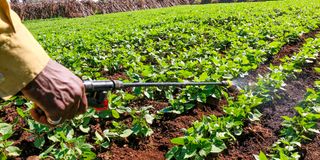
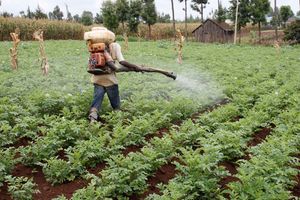
A farm worker sprays a potato farm with pesticides and herbicides in Elburgon, Nakuru County on November 17, 2022.
Photo credit: John Njoroge | Nation Media Group
Among the most exported banned chemicals is 1,3-dichloropropene (1,3-D), a soil fumigant classified as a likely carcinogen by United States authorities and banned in the EU since 2007. More than 20,000 tonnes were notified for export in 2024.
Other major exported pesticides to Kenya include glufosinate, a weed killer banned in the EU in 2018 due to reproductive toxicity, and mancozeb, banned in 2020 for being toxic to reproduction and an endocrine disruptor.
Despite being banned on European farms since 2019 over “unacceptable” risks to pollinators, the EU continues to export chemicals it has simultaneously outlawed in food imports.
In 2024, these banned pesticides were exported to 93 countries, 75 per cent of which were low- and middle-income countries with weaker regulatory systems. United Nations agencies warn that the use of highly hazardous pesticides poses the greatest risks in such nations.
The single largest importer of pesticides is the US, where legislation is more permissive than in the EU. Brazil—the world’s biggest pesticide market—follows closely.
Data seen by the Nation shows that Kenya’s imports came from Belgium, the Netherlands, Germany, Bulgaria, Spain, France, Italy and Austria. They included 1,3-dichloropropene, mancozeb, thiamethoxam, imidacloprid, epoxiconazole, indoxacarb, carbendazim, glufosinate, alpha-cypermethrin and chlorothalonil, among others.
Imidacloprid and iprodione are currently restricted in Kenya, while mancozeb is under review. Imidacloprid is one of the active ingredients in Thunder, a widely used pesticide for tomatoes, French beans, wheat, coffee and cotton.
“Restriction of use of imidacloprid-based pest control products for indoor (greenhouse) uses and NOT for use in open fields,” a notice by the Pest Control Products Board (PCPB) Chief Executive Officer Fredrick Muchiri to agents dated November 6 reads.
Iprodione is found in iprode, a fungicide commonly used on vegetables and ornamentals. Mancozeb remains a staple ingredient in many fungicides used particularly in potato farming.
Toxic pesticides have major implications for climate, ecosystems and human health. They are linked to cancers, reproductive harm, endocrine disruption, DNA mutations and nerve damage.
A farmer sprays pesticides to his fall armyworm-infested maize crop at his farm in Sobea Nakuru County on June 9, 2025.
Photo credit: Boniface Mwangi | Nation Media Group
Imidacloprid is widely used to control pests like aphids, termites, fleas and whiteflies. It works by interfering with the central nervous system of insects, causing paralysis and death, but concerns exist about long-term human exposure. Systematic reviews have found associations between chronic neonicotinoid exposure and congenital heart defects and neural tube defects, although more research is needed.
Iprodione, though considered low in acute toxicity, has been flagged for potential long-term health effects. Mancozeb breaks down into ethylenethiourea, a compound associated with thyroid damage and developmental toxicity.
Pesticide Action Network Europe reports that the EU is the world’s leading exporter of pesticides, shipping 714,000 tonnes worth Sh987 billion (€6.6 billion) in 2022, not including trade within Europe. Of this, 81,615 tonnes were pesticides banned for agricultural use within the EU.
In low- and middle-income countries, banned EU pesticides accounted for up to 71 per cent of total pesticide imports from the bloc in 2018. A ban on their export, the organisation says, would significantly reduce availability and spur the adoption of safer alternatives.
Data from the European Chemicals Agency shows that the pesticides banned within the EU are often the most toxic—and are the same ones exported to less regulated markets. This poses grave risks for countries like Kenya, where pesticide oversight remains weak.
A 2020 study showed that half of the pesticides used in Kenya were already banned in the EU. It also showed that only one in six Kenyan farmers uses protective gear. Farmers applied 3,068 tonnes of pesticides that year, spending Sh9.4 billion. Of the 310 pesticide products used, 63 per cent contained one or more highly hazardous active ingredients.
Mr Muchiri yesterday defended the imports, saying the EU and Kenya follow different regulatory philosophies. He argued the EU focuses on hazard (the toxicity of a substance), while Kenya assesses actual risk (toxicity plus likelihood of exposure).
“A product might be carcinogenic (the hazard), but if users wear appropriate protective clothing (exposure factor is reduced to zero), then the overall risk of using the product becomes negligible,” Mr Muchiri told the Nation.
“A ban is a total prohibition of both production and use. What the EU has done is render certain products not allowed for use domestically. The EU’s prohibition is only on use within their own territory, allowing EU producers to manufacture the chemicals for export to other countries, including Kenya,” he added.
Mr Muchiri said that Kenya maintains its own independent registration and import-control system. He further explained that the prior informed consent procedure is simply a notification mechanism, not a restriction instrument and is mainly crucial for countries lacking regulatory capacity.
Mr Muchiri dismissed the universal applicability of EU restrictions on imidacloprid, arguing that bee species differ across regions, as does susceptibility to chemicals.
He confirmed that importation of registered pesticides is handled by local agents such as Kenyan subsidiaries of multinational companies. PCPB, he said, reviews and authorises all applications before products enter the country.
Asked to disclose Kenya’s pesticide import volumes for 2024, Mr Muchiri said the data was not immediately available and requires more time to compile.
In 2022, the Africa Centre for Corrective and Preventive Action filed a petition seeking a total withdrawal of hazardous pesticides from the Kenyan market. Environmental lawyer Kelvin Kubai, a co-petitioner, argued that many pesticides used locally contain harmful ingredients and that farmers and consumers lack adequate information about their health and environmental impacts.
Mr Fredrick Otieno, programme officer at Centre for Environment Justice and Development, told the Nation that 38 per cent of pesticide active ingredients used in Kenya are banned in the EU.
He argued that nothing prevents Kenya from restricting them, and accused the government of failing to invest in sustainable pest management.
“The EU’s continued export of banned pesticides undermines Africa’s efforts towards safer agriculture. If the EU stopped exporting them, African countries would be pushed toward safer solutions,” he said.
Civil society groups are calling for the EU to ban such exports entirely. France and Belgium have already done so nationally.
Mr Otieno said Kenya should also enforce the Business Laws (Amendment) Act, 2024, which prohibits the importation of products banned in their country of origin. He also called for a revision of Kenyan pesticide law to include this protection.
Leon Zantinge is a Dutch freelance investigative journalist focusing on agriculture, public health and the climate crisis. He exposes what lies beneath the surface and holds power to account.