Garissa braces for floods as residents question disaster preparedness
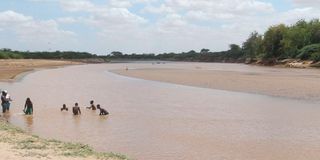
Residents of the Mororo slums swim in the dried-up River Tana on September 16, 2026. The river floods when it rains, causing havoc in the area. Residents have refused to move out of the slum before the anticipated heavy rains begin.

What you need to know:
- According to the Kenya Red Cross local office, at least 150,000 people, or 89,000 households, will be displaced by the anticipated heavy rains in Garissa.
The sky over Garissa remains clear and scorching, but along the banks of the Tana River, fear is rising as fast as the water is expected to.
With news that El Nino rains are expected, residents are unbothered as they go about their daily activities. Pastoralists continue crisscrossing the county in search of pasture and water, while traders carry on with business in Garissa town.
The administration of Governor Nathif Jama has set up a committee, and at the county disaster office, a tattered contingency plan that failed in 2023 is being dusted off.


With the Kenya Meteorological Department warning of heavy El Nino rains in October, Garissa County is racing against time to prepare for a disaster that is yet to come. But on the ground, many say preparedness is still only on paper.
Bernard Katana, a resident, said little has been done in the name of disaster preparedness in Garissa town. “We should be talking of clear waterways and drainage in this town, but that is yet to happen. Areas prone to flooding have remained the same when we expected proper drainage and bush clearing,” he said.
According to the Kenya Red Cross local office, at least 150,000 people, or 89,000 households, will be displaced by the anticipated heavy rains in Garissa.
Mohamed Dubow Aden, director of Special Programmes and Disaster Management in Garissa County, said a system has been put in place to respond to any eventuality.
“We are very well prepared and our plan is in order. We have issued advisories to the community and stakeholders. Our response plan is ready, and within the next two weeks we shall have shared our anticipatory action,” he said.
According to Aden, Garissa has identified areas to host residents who will be displaced by the heavy rains in the coming weeks.
“We have about five areas ready to host those who will be displaced by the floods in Garissa town, while those outside the town will be hosted at sub-county and ward headquarters.”
He revealed that the county government has a budget of Sh113 million for anticipatory plans and another Sh1.3 billion for response plans.
Rev John Mwaura of Full Gospel Churches and chairman of the Garissa Pastors’ Forum said flooding has always been a disaster for his ministry.
“We started a church here in 1992, but we have always been frustrated by floods. We are always forced to vacate whenever Garissa becomes flooded,” he said.
The optimistic reverend said the construction of a stretch of road linking Tana River and Garissa counties is a relief, as it has more waterways.
“We never used to have culverts on the main road to allow excess water from the Tana River to flow, and that used to cause a lot of flooding on our side. I am optimistic the situation will be different when it rains.”
During the 2023 floods, the same section of road was washed away, and an unknown number of travellers were killed after an overloaded boat capsized as it ferried people between Tana River and Garissa.
He called on both levels of government to involve grassroots leaders and past flood victims in disaster management planning.
At Garissa Full Gospel Church, the administration has raised part of the church building to be used when the area becomes flooded.
Rev Mwaura decried poor disaster response mechanisms by both levels of government.
“You will hear of funds for disaster response, yet the same does not reach us on the ground. We should have a clear channel to benefit the victims,” he said.
At Mororo slums, residents said they are used to floods and that, as a forgotten group, they always become each other’s keeper.
Osman Wako, the Mororo village headman, said floods come with many challenges for residents.
“Our lives are always disrupted during floods. Whenever there are floods, people are displaced from their homes. We set up temporary shelter on the main road while others move into IDP camps.”
He added: “We suffer a lot whenever there are floods. Our properties are stolen, homes washed away. Houses are filled with mud. Life becomes complicated at that moment.”
Houses are broken into, some are demolished and construction materials stolen by youths idling in the area. “The home you left is broken down. We are never supported in the camps. Life is never the same during such a time,” he said.
Wako is opposed to the government’s plan to place affected locals in temporary camps.
Maka Bolu, a resident of Mororo slums, said they are always abandoned at such moments.
“Nobody is bothered with our crisis when this place becomes flooded. Nobody comes to our rescue. We don’t get support from any government.”
Sheikh Awath Hassan, an imam at Masjid Maryam in Mororo, said just like the churches around, the mosque is also filled with mud whenever the area is flooded. Situated about 100 metres from the Tana River, Masjid Maryam is always filled with mud, causing damage to carpets used for prayers.
“We always miss prayers in this mosque for about three weeks. Carpets are damaged due to mud left behind.” He urged the government to dig trenches to redirect water into the Tana River and avoid flooding in residential areas.
Hamis Barisa, a landlord in Mororo, said he has always moved to the main road during floods.
“Our mud-built houses are washed away, denying us a source of income. The government has to find a way of redirecting floods into the river channel,” he said.
John Cheruiyot, Garissa County Commissioner and Chairman of the County Steering Group, said development partners have been mobilised ahead of the rains.
“We are ready and sensitisation is underway. We are targeting people residing along the river. We have mapped the county and realised we shall be affected along the river, and some roads within shall also be affected.”
He said NCPB stores are ready to keep whatever shall be donated or purchased by the government. He assured residents of their security during and after the anticipated rains in Garissa.
While the county commissioner pledged a swift and secure response, the Kenya Red Cross local office said first aiders and rescuers have been trained in rescue, search and recovery.
“Our team is prepared and ready for the task ahead. We have a speed boat and even a helicopter for air rescue,” Daud Ahmed, Red Cross coordinator in Garissa, said.
He added: “We have also done pre-positioning of non-food items such as mosquito nets and blankets, and we have evacuation centres ready.”