Hello

Your subscription is almost coming to an end. Don’t miss out on the great content on Nation.Africa

Ready to continue your informative journey with us?

Hello

Your premium access has ended, but the best of Nation.Africa is still within reach. Renew now to unlock exclusive stories and in-depth features.

Reclaim your full access. Click below to renew.

How farmers and scientists are decoding climate change to save drylands

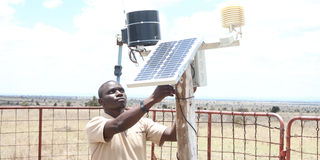
The station is collecting data on greenhouse gas emissions with a focus on the foreseeable future. PHOTO/Richard Maosi

What you need to know:

  • The semi-arid range lands of Kapiti Plains stretch wide and open, where cattle and wildlife coexist, and where a growing body of scientific research is challenging how the world understands livestock, climate change, and Africa’s role in both the problem and the solution.

Victor Kyallo has learned to read the land the hard way. From his small farm in Katumani, Machakos County, barely ten kilometres from the Kapiti Plains, he can tell when the rains will fail long before the clouds disappear.


“The soil hardens sooner than it once did, maize wilts faster under the sun, and pastures thin out before livestock have had enough to graze.”


For him, and for many farmers across Kenya’s dry lands, climate change is not an abstract idea discussed in conference halls, but a daily reckoning over what to plant, when to graze, and how long their animals can endure.


“Katumani is dry most of the year,” Kyallo says. “We grow drought-tolerant maize and beans because most ordinary crops don’t survive well here. Even then, there are seasons when nothing comes up.”


Just a few kilometres away, the landscape tells a slightly different story. The semi-arid range lands of Kapiti Plains stretch wide and open, where cattle and wildlife coexist, and where a growing body of scientific research is challenging how the world understands livestock, climate change, and Africa’s role in both the problem and the solution.


Managed by researchers and conservationists, the area now hosts climate-monitoring systems and an Eddy Covariance Tower designed to measure how gases move between the land and the atmosphere.


To the untrained eye, the steel tower rising above the savannah appears incongruous against the backdrop of giraffes, zebras, antelopes, and the occasional hyena or lion. But for scientists, it represents something significant, as data from the ground, collected in real time, under African conditions.


“This tower tells us whether the ecosystem is absorbing greenhouse gases or releasing them,” says Nehemiah Kimengich, Head of Kapiti Research Station and Wildlife Conservancy.


Use of data
Every few seconds, day and night, throughout the year, sensors capture information that reveals how grazing, vegetation, and climate interact.


“As the sun comes up, our work begins with checking the system. We then clean sensors, verify data, and make sure everything is running correctly. The tower operates automatically, so our role is to ensure accuracy and consistency,” Kimengich explains.


Kapiti was chosen precisely because it mirrors much of Kenya’s semi-arid rangelands, where livestock, wildlife, and natural vegetation coexist. “It offers an opportunity to study not just emissions, but productivity, resilience, and adaptation,”adds Kemingich.


When such data is carefully collected and preserved, it helps farmers prepare for various challenges, including prolonged droughts and seasonal changes. By understanding their environment, residents can make better decisions regarding livestock management and investments.


Professor Raphael Mrode, Principal Investigator at the International Livestock Research Institute (ILRI), says African livestock systems are frequently misunderstood. “Livestock in Africa account for about 18 per cent of global livestock methane emissions,” he notes. “Cattle alone contribute roughly 70 per cent of emissions in Sub-Saharan Africa.”


But even with this, Africa’s overall share of global livestock emissions remains relatively small, measuring around 10 percent. The danger, Prof Mrode warns, lies in the future. “If productivity does not improve and climate-smart practices are not adopted, emissions could triple as demand for animal-source foods grows.”

Findings from Kapiti complicate the dominant narrative. Preliminary data suggest that free-ranging cattle in well-managed rangelands may have a smaller climate footprint than animals raised in intensive feedlots.

“Natural vegetation here actively absorbs carbon that can partially offset emissions from grazing livestock. This challenges the assumption that all cattle systems are equally damaging,” Kimengich says.

According to Prof Mrode, diet is a key factor. “Cattle feeding on native grasses and browse, often rich in tannins, tend to emit less methane than grain-fed animals. Also, seasonal changes in forage quality also influence emission levels, a clear indicator of the importance of rangeland management rather than blanket solutions,” he adds.

The tower’s value extends beyond climate accounting. By tracking carbon and water exchange, it can detect vegetation stress well before it becomes visible. In a drought-prone region like Machakos, this information could transform how farmers and herders respond to looming crises.

“It gives us an early warning. Days or even weeks before vegetation shows signs of stress, we can already see it in the data,” Kimengich explains.

However, the technology has its limitations. “The tower measures gas exchange within a specific footprint, which can change with wind direction and terrain. Separating emissions from livestock, soil, and vegetation also requires careful analysis of animal movement and grazing patterns, Kimengich says, adding that the science is complex, and the findings must be interpreted with caution.

But compared to traditional methods that rely on feedlot data or controlled laboratory chambers, the Eddy Covariance approach offers a direct, ecosystem-level view of how African rangelands function in reality, which is rare.

For Victor Kyallo, the science unfolding at Kapiti carries real stakes. As rainfall becomes less predictable and land pressure intensifies, small-scale farmers and pastoralists are often blamed for environmental degradation, despite the fact that they are also among the most exposed to climate shocks.

Findings from Kapiti suggest that the answer may not be to abandon livestock altogether, but to manage them more wisely. “By aligning grazing practices with ecological conditions, restoring vegetation, and recognising the role rangelands can play in sustaining livelihoods while reducing emissions, the research points toward a more balanced path for both people and the climate,”explains Prof Mrode.