When Lake Turkana’s water levels rose, they did more than flood beaches.
The swelling waters swallowed hotels and campsites, forcing the county government and the hospitality industry to rethink tourism as an economic lifeline.
For decades, the lake’s beaches anchored northern Kenya’s tourism, defined by quiet camps, modest hotels, foreign charter flights and vast waters stretching to the horizon.
Nicknamed the Jade Sea for its turquoise waters, Lake Turkana was a leading tourist destination. Its white sandy beaches and Central Island — home to three crater lakes that breed crocodiles, flamingos and tilapia — attracted large numbers of visitors, while nearby resorts hosted international guests.
But the lake no longer respects old maps. Nearly 90 per cent of the beachfront has been lost, leaving resorts and lodges abandoned. Some have relocated to cliff tops, dunes and escarpments, creating new tourism experiences away from the shoreline.
As rising waters destroyed key attractions, disrupted livelihoods and wiped out major investments, operators and visitors turned to desert safaris. New adventure trails and expeditions — from dune bashing and off-road excursions to motorcycle rides and cliff-top retreats — are reshaping Turkana County’s tourism identity, once defined by sandy beaches and calm waters.
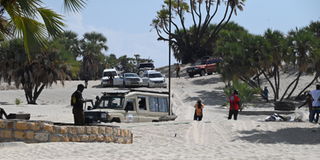
Some of the 51 vehicles in the Great Drive XI convoy that roared through Turkana. The Turkana Challenge, which took place from December 5 to 7, 2025 with visitors enjoying the beauty of Turkana landscape and Lake Turkana beaches.
Photo credit: Sammy Lutta | Nation Media Group
Resorts have moved to higher ground, embracing the desert beyond the lake. The shift has ushered in a new wave of adventure tourism, putting Turkana back on the tourism map.
For seven years until 2020, James Ekitela hired a taxi every Christmas to camp along the lake’s shore, waking to sweeping dune views and exploring Central Island.
He recalls pristine beaches, palm groves, natural springs and a serene atmosphere that offered rare privacy and relaxation.
“As a native, I often heard of foreign tourists flying in to relax on the beaches, swim, fish, explore the geology and immerse themselves in Turkana culture,” Mr Ekitela said.
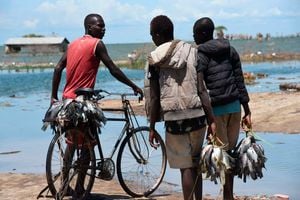
That changed from 2020, when rising waters submerged campsites, hotels and even homesteads.
Eliye Springs, a resort long favoured by international visitors, lost nearly 90 per cent of its property, including Sh15,000-a-night bomas, boats and beachfront infrastructure.
“We chose not to give up. We relocated to higher ground and created Eliye Cliff Lodge, with cliff-top cabins, a bar and an aquarium showcasing Lake Turkana’s fish,” said managing director Rolf Gloor. “Visitors now enjoy open skies, uninterrupted lake views and an immersive experience with nature.”
Lake Turkana glimmers amid the rolling hills sorrounding Loiyangalani town in Marsabit County.
Photo credit: Pool
Other resorts are adapting. Cradle Etau Beach Resort along Long’elech Island now offers dune bashing, quad-bike rides and camping, with plans to add 10 luxury tents.
“Turkana can offer desert safari experiences that rival international destinations,” said Wanjiku Ndung’u, CEO of Cradle Hotels and Resorts. “You no longer need to travel to Dubai for dune bashing. Turkana offers some of the best, and we work closely with the county government to ensure high-quality services.”
Adventure tourism has expanded beyond resorts. Convoys of four-wheel-drive vehicles, motorcyclists and cyclists now traverse desert trails, escarpments and remote valleys once considered inaccessible.
Abandoned temporary shops in Kalokol town that were submerged by the rising waters of Lake Turkana.
Photo credit: Sammy Lutta | Nation
Organised tours such as the Great Drive XI and the Tour of Karamoja blend adventure, cultural immersion and charity, introducing visitors to Turkana’s pastoral communities and dramatic landscapes.
Last December, 51 vehicles — including Toyota Land Cruisers, Ford Rangers, Mitsubishi Shoguns and BMW X6s — took part in the Great Drive XI: The Turkana Challenge, tackling deserts and rocky terrain in what participants described as a rugged, thrilling experience.
Motorcyclists and cyclists are also discovering the region. Riders in the Uganda-based Tour of Karamoja cross rivers, deserts and remote communities, navigating poor infrastructure, limited mobile coverage and harsh terrain.
A view of the white sandy beaches, palm trees and Lake Turkana at the newly established Cradle Etau Beach Resort.
Photo credit: Sammy Lutta | Nation Media Group
Local guides say the expeditions create income through dune guiding and sand-based activities, while boosting domestic tourism.
“With the lake now calm, desert activities offer visitors new ways to engage with the landscape. Tourist arrivals have steadily increased, and partnerships with the Kenya Tourism Board have improved visibility,” said Ekutan Omar of Turkana Tours and Guide Limited.
The shift has spurred innovation. Resorts and tour operators now offer guided desert walks, visits to lake breeding sites, and cultural exchanges with pastoralist communities.
Visitors can watch traditional Turkana ceremonies, learn desert survival skills, or join conservation efforts, blending adventure with culture.
Tourist Edna Ronoh recalls the years before rising waters submerged hotels and homesteads. “I enjoyed campsites and cottages fully booked in December, with stunning lake views,” she said, praising hotels that relocated to higher ground and new establishments offering fresh experiences. She spent her New Year at Cradle Etau Beach Resort on Long’elech Island, where sand dunes provide an ideal setting for dune bashing.
Visitors enjoying their New Year holiday at the newly established Cradle Etau Beach Resort, located on the shores of Long'elech Island. They interacted with locals selling basketry products.
Photo credit: Sammy Lutta | Nation Media Group
Governor Jeremiah Lomorukaisaoid said the county is banking on tourism as a driver of growth, committed to unlocking Turkana’s potential and creating local opportunities.
The county promotes over 50 attractions, including South Turkana National Reserve, Sibiloi National Park, the Kenyatta Cells, and the Turkana Boy monument at Nariokotome. The annual Tobong’u Lore festival also draws local and international visitors.
A major project underway is the Kenya Home of Human Origins Museum and Science Park near Namortunga, Kalokol. The 16.19-acre site, near Lodwar Airport, Lake Turkana and Eliye Springs, aims to preserve the region’s archaeological, cultural and geological heritage while attracting global tourism and research.