Looking out across the ever-expanding expanse of Lake Turkana, Mike Ekusi no longer sees the tranquil waters that once sustained generations of his people.
Instead, he sees a force of nature that has destroyed homes, ruined livelihoods and driven entire communities to the brink of disaster.
A father of five from Apokorit village, he has been forced to relocate more than ten times since 2020 due to the rising waters of the lake.
“We have been displaced from our ancestral land. Fishing was all we had, but now it is almost impossible. All we want is food and a safe place to live,” he tells the Daily Nation, appealing for urgent relief aid.
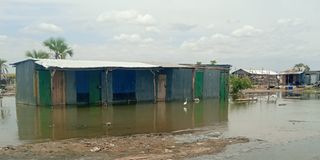
Abandoned temporary shops in Kalokol town that were submerged by the rising waters of Lake Turkana.
Photo credit: Sammy Lutta | Nation
Hundreds of families living along the shores of Lake Turkana share Ekusi’s plight. In recent years, the lake has steadily grown, submerging villages, schools and government facilities. The floodwaters have brought hunger, fear and uncertainty.
In Kerio Delta Ward, entire villages, including Ng’imuriae, Ekwar, Apokorit, Nayanaekaton and Nang’itony, have been flooded, forcing residents to flee to higher ground. Their new settlements are located on barren land more than five kilometres inland and lack water and basic amenities.
Residents say they have rebuilt their homes time and again, but the rising lake levels have left them with no choice but to leave.
Turkana North Deputy County Commissioner George Orina said that more settlements and government facilities, such as the Kenya Coast Guard Service operations base in Lowareng’ak, have been submerged. Several villages in the Lake Zone Ward and the Nachukui, Katiko and Kataboi sub-locations have also been affected.
“The government has advised communities to move to higher ground, and many have complied. The Coast Guard base at Lowareng’ak is also being relocated,” said Mr Orina.
As if displacement were not enough, residents now face a new threat: crocodiles. The rising waters have disrupted the reptiles' natural habitats, forcing them into human settlements in search of food and territory. Four attacks have been reported in the past month alone.
James Ekutan, a resident of Namukuse village, said that attacks had become more frequent in July and August, although many incidents involving fishermen go unreported due to poor communication networks.
“On August 2, a man in his 30s was attacked while watering his livestock. Another incident happened on July 16. Areas between Lokirenoko and Lokwaar Gulf have become too dangerous,” he said.
Displaced fishermen operating in crocodile-prone areas say they are continuously exposed to attacks resulting in death, permanent injury and lost livelihoods. Despite raising the alarm with the Kenya Wildlife Service (KWS), they claim that little has been done.
Local leaders report that more than ten people have been killed or injured in recent months, yet none of the families have received compensation.
Some of the houses in Kalokol that have been submerged by the rising waters of Lake Turkana since July 2024.
Photo credit: Sammy Lutta | Nation
A recent fact-finding mission by the Turkana County Assembly Committee on Agriculture, Livestock and Fisheries revealed grim findings. The committee chair, William Etubon, who is also the MCA for Katilu Ward, said that they had documented 11 crocodile attacks in Lowareng’ak village alone, resulting in four deaths and four people being left permanently disabled.
"Many families have been left destitute. Those who have tried to claim compensation for survivors and relatives have faced a slow and frustrating process. In some cases, bodies were never recovered,” said Mr Etubon.
He urged KWS and other agencies to step up monitoring, provide rapid response, and improve access to safer fishing areas.
KWS officer Elijah Chege confirmed that rising lake levels had displaced crocodiles from their traditional breeding zones, leading to increased human-wildlife conflict.
“This is their breeding season which makes them more aggressive,” he explained.
Mr Chege said KWS has deployed rapid response teams to high-risk areas such as Todonyang, Lowareng’ak, Namukuse and Long’ech villages and are also running community awareness campaigns on crocodile behavior, safety and emergency response.
“We strongly advise against children taking part in fishing. Livestock should also not be left unattended near the water,” he cautioned.
He added that investigations are ongoing in line with the Wildlife Conservation and Management Act, and that efforts are underway to safeguard lives and support affected families.
The rising waters have also affected schools. In Long'ech village, mass displacement has disrupted enrolment at Long'ech Comprehensive School.
The school administration confirmed that backflow from the lake has reached the school grounds, submerging a quarter of the fence and the Early Childhood Development Centre's latrines. A nearby dormitory was recently damaged by strong winds and rain.
Head teacher Akwanyang Longole has appealed for two new classrooms and new latrines for girls, as well as for the renovation of the girls’ dormitory.
“About three-quarters of our land, nearly eight acres is on higher ground. We can relocate facilities there but we need help,” Mr Longole said noting that enrollment has already dropped as families flee.
A 2021 report by the United Nations Environment Programme (UNEP) warns that the flooding in Lake Turkana could become a permanent reality for the people living along its shores.
The report, “Sustainable Development in Lake Turkana and its River Basins,” predicts heavier rainfall over the lake’s inflows—particularly Ethiopia’s Omo River—due to climate change. Since Lake Turkana has no natural outlet, increased inflows raise the risk of catastrophic flooding.
UNEP urged stronger cooperation between Kenya and Ethiopia in managing the Omo River to reduce vulnerability and prepare for the likelihood of more frequent and severe floods.