Impact of AI on environment to feature at UNEA
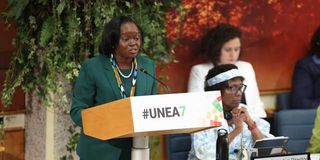
Kenya's environment Cabinet Secretary Dr Deborah Barasa give a speech at the Seventh Session of the United Nations Environment Assembly (UNEA-7) in Nairobi on December 8, 2025.


You will probably use a form of artificial intelligence to get a summary of this article, or to understand why delegates from 193 countries are in Nairobi this week to attend the United Nations Environment Assembly (UNEA).
UNEA is the world’s highest decision-making body on matters environment. This year, among other draft decisions and resolutions, the impact of artificial intelligence on the environment, will be discussed in detail.
Draft resolutions and decisions are proposals submitted by one or more representatives from a member state or different groups.


Meeting in Nairobi’s United Nations complex, delegates will discuss 15 draft resolutions and three draft decisions that speak to the theme of advancing sustainable solutions for a resilient planet. This year’s session will also include the approval of the United Nations Environment Programme’s (UNEP) Medium-Term Strategy for the years 2026-2029, a key document that will shape UNEP’s strategic direction and collective environmental action for the years ahead. This, against dwindling financial support.
According UNEA President Abdullah Bin Ali, there has been communication with member states in order to encourage them to increase their donation to cover the financial gap that is currently crippling some functions of the United Nations.
Artificial intelligence
Apart from the resolution on sustainable artificial intelligence systems, Kenya, through the Ministry of Environment, Climate Change and Forestry, is backing resolutions on sustainable solutions through sport, environmental decisions on antimicrobial resistance and an amplification of the international response to address environmental crimes.
Environment Cabinet Secretary Deborah Barasa told delegates during the opening session yesterday that this year’s theme, “Advancing Sustainable Solutions for a Resilient Planet”, speaks powerfully to the moment we find ourselves in.
“The time for small, cautious steps has passed; what we need now is bold, integrated and inclusive action,” she said.
“A resilient planet is much more than protecting ecosystems; it means using our resources wisely, building just and inclusive societies, ensuring that economic growth respects the boundaries of our planet, and embracing innovation to foresee and prevent harm before it happens,” she added.
Evidence from scientific publications is already showing that the world is facing triple planetary crises, which encompass climate change, biodiversity loss and pollution. CS Barasa says that these challenges are unique yet deeply intertwined and are made worse by other factors, including political instability. “These crises cannot be tackled in isolation,” she said.
Strategic plan
Dr Barasa told representatives from member states that Kenya looks forward to constructively contributing to UNEP’s strategic plan finalisation, ensuring that it reflects ambition, science-based policy, equity and opportunities for innovation, especially for developing countries.
Some of the draft resolutions and draft decisions to be discussed include those calling on countries to protect fast-disappearing glaciers, better manage the production of minerals and metals, and end the scourge of seaweed blooms, which are swamping beaches around the world.
During the opening plenary, UNEP executive director Inger Andersen said that this year’s Assembly must draw on its history of unity to deliver sustainable solutions for a resilient planet.
“This Assembly must dig deeper than ever, because environmental challenges are accelerating. The rise in average global temperatures will likely exceed 1.5 degrees Celsius within the next decade, bringing escalating consequences with every fraction of a degree,” she said.
“Ecosystems are disappearing and land is degrading. Dust storms are intensifying. Toxins continue to pollute our air, water and land,” she added.
Coming just a few weeks after COP30 in Belem, Brazil, Mr Ali told delegates that the success of UNEA-7 is anchored on commitments that “must translate into projects, investments, legal frameworks and measurable gains.
Second, we need solidarity, because resilience is built together or not at all. Third, we need to be guided by science – because the reports issued by the United Nations Environment Programme show clearly that the challenges we face — on climate, on nature and biodiversity, and on pollution — although immense, they are surmountable,” he said.
President Ruto is expected to address the delegates on Thursday.
Follow our WhatsApp channel for breaking news updates and more stories like this.


