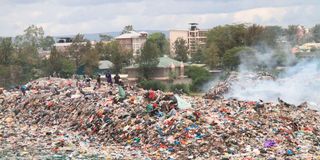
For two decades, the Kitengela Noonkopir Landfill in Kajiado County has stood as a symbol of both air and solid waste pollution, much to the dismay of dozens of families living in the surrounding middle-class estate.
Years of contention between the county government and residents have led to the dumpsite being temporarily shut down several times in the past. Frustrated homeowners have persistently pushed for the relocation of the sprawling dumpsite, but with no success, prompting many to move out of the area altogether.
In 2017, the National Environment Management Authority (Nema) raised concerns and ordered the closure of the landfill, but the directive was never implemented.
Now, in a bid to address the persistent waste problem, the Kitengela Municipality management has set aside Sh15 million for the construction of a municipal gasified incinerator. The project aims to improve solid waste management at the congested dumpsite.
Municipality Manager Josephine Sane told Climate Action that the new technology, sourced from Taita Taveta Technical University, will involve the installation of a gasified incinerator capable of burning 20 tonnes of waste per day.
"Waste will be subjected to temperatures of up to 1,800 degrees Celsius, with no smoke emitted. This will be a game changer in addressing the high levels of air and solid pollution that have plagued the area for years," said Sane.
A gasification incinerator is an advanced waste treatment technology that thermally decomposes materials using heat and limited oxygen in a primary chamber to produce combustible gas, known as syngas. This gas is then fully combusted in a separate secondary chamber at high temperatures of about 800°C, ensuring complete destruction with minimal emissions, odours, and dioxins.
The process removes coatings and other materials from waste, enabling the recovery of metals and precious metals from the resulting ash.
Sane added that simply relocating the landfill would only transfer the problem to another part of the municipality’s jurisdiction.
"The municipality is aware that residents have been pushing for the relocation of the landfill, but the use of technology is the best solution," added Sane.
At least 50 trucks dump waste at the Noonkopir landfill daily, paying between Sh1,500 and Sh2,000 depending on the size of the vehicle, serving the entire densely populated town and surrounding estates.
A Climate Action spot check on March 9 revealed that the two-and-a-half-acre site was overflowing with waste. The perimeter wall had long collapsed, and massive heaps of garbage stood out conspicuously across the neighborhood, strewn with single-use plastics and other refuse. The waste had also spilled over into a neighbouring Muslim
At the top of the ‘garbage hill’, hundreds of marabou storks and dozens of pigs have made a home, scavenging through the waste. Below, a stream of highly odorous wastewater flows freely from the dumping site.
According to a 2021 World Bank report, an estimated 2,400 tonnes of solid waste are generated daily in Nairobi, with 20 per cent comprising plastic. Poor waste management, compounded by rising urban pressure, has heightened the risks of environmental degradation.
Of the waste generated in the city, only 45 per cent is recycled, reused, or converted into a form that yields economic or ecological benefit, far below the 80 per cent target set by Nema.
This trend is replicated across the metropolitan region, including Kajiado County's satellite towns of Kitengela, Ong'ata Rongai, and Ngong.