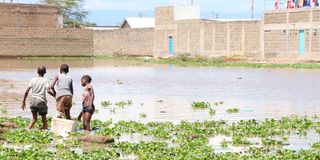
As world leaders debate the planet’s future at the ongoing COP30 climate summit in Brazil, the devastating effects of climate change are already unfolding in Kenya’s Rift Valley.
For thousands of residents along the shores of Lakes Naivasha, Nakuru, and Baringo, the crisis is not abstract; it is a reality of submerged homes and shattered livelihoods.
New Content Item (1)
Photo credit: Francis Mureithi I Nation Media Group
At Lake Naivasha, a once-serene freshwater haven known for its flowers, fish, and flamingos, rising waters have transformed beauty into heartbreak. The swelling lake has swallowed homes, businesses, and farms, displacing thousands of residents who now live in the cold.
Some hotels along the shoreline are keeping a round-the-clock watch on the rising waters as sections of their properties vanish beneath the water, leading to job losses and the destruction of the rich biodiversity that once defined Naivasha’s prosperity.
Here, climate change is the water creeping past doorsteps, drowning memories, and leaving a trail of destruction.
In Kihoto slums, 38-year-old Anastacia Njunge wades through the flooded compound that was once her family’s home. “We used to sleep here,” she says softly, pointing a half-submerged mattress. “Now the lake sleeps in our house.”
Like her neighbours, Anastacia survives on aid and uncertainty, forced to move to higher grounds.
New Content Item (1)
Photo credit: Francis Mureithi I Nation Media Group
To her, the summit in Brazil hosting leaders from over 190 countries, climate activists, and industry experts feels a world away. "I'm completely in the dark about what is happening there. My immediate attention is survival," she says.
Yet, unaware to Anastacia and many other residents of Kihoto, the outcome of the Brazil summit will determine whether their children will ever have a safe place to call home again.
“These rising waters were furious. Kihoto will never be the same,” says Irene Kwamboka, a casual labourer at a flower farm. “My family's earthly belongings have been washed away. I now live from hand to mouth.”
James Ndegwa, a landlord, describes the crisis as a natural calamity. “The waters will never recede, and many landowners are counting huge losses running into millions of shillings.”
The damage extends beyond homes. Fishermen battle dangerous waves where waters were once calm, and flower farm workers—the backbone of the local economy—have lost their jobs as greenhouses vanish.
Some of the once thriving lakeside hotels have also been swallowed by the rising waters, leaving behind half-submerged buildings and shattered dreams.
Abandoned boats lie stranded on flooded compounds, and hundreds of young people in the tourism sector have been rendered jobless.
In a surreal twist, water birds and hippos now wander through the flooded ruins of luxury hotel rooms, a haunting reminder of nature reclaiming its space.
But to some old guards in Kihoto, the rising waters did not come as a big surprise. Seventy-two-year-old Josiah Kamore recalls a story passed down through generations: when white settlers left, they established beacons to mark the boundary between the lake and riparian land, a safeguard for both man and nature.
But decades of greed and ignorance have blurred that line, and the riparian land has been subdivided into plots and farmland.
“My late father used to tell me that all the land along South Lake Road; where most of the posh hotels now stand, including Kihoto area, was once riparian land,” he says, adding: “I remember him telling me how a white man showed the surveyor exactly where to place the beacon separating private land from the lake’s territory. But many landowners and hotel investors ignored that warning. Now the lake is slowly reclaiming its space, viciously and dangerously.”
He cites encroachment on the riparian zones, unregulated construction, and disregard for environmental laws. “What was once seen as progress -– the rise of luxury lodges, flower farms, and lakeside estates — is now a scene of loss and reckoning.”
“It seems environmental justice is slowly taking place, but in a brutal way. The painful truth is that when nature seeks justice, no one is spared.”
Ironically, a past parliamentary report recommended relocating and compensating Kihoto's 5,000 residents, but it was never implemented and is still gathering dust as the residents continue to suffer.
“The government originally surveyed Kihoto, allocated it for agriculture, and approved the subdivisions. Later, they approved the change to residential use. This is a mess created by past regimes, and it is unjust for the innocent residents of Kihoto, who are now suffering and in need of urgent humanitarian aid, to bear the consequences,” says
A visit to shoreline hotels reveals the widespread impact: several luxury hotels are counting major losses as rising water submerges them, serving as a direct consequence of construction on the riparian zone.
Elegant destinations preferred by tourists now have executive rooms swallowed by murky, hyacinth-choked water.
Abandoned boats float on a mat of water hyacinth, their silence broken only by the croaking of frogs and the haunting cries of displaced birds; the sole witnesses to the destruction within the flooded hotel rooms. For the hundreds of young people who once relied on this lake, the rising waters have swept away more than livelihoods; they have drowned all hope.
“I was a boat rider in one of the hotels, but since the waters swallowed a section of the hotel, I have been rendered jobless,” says a former employee, his story a direct human consequence of the lake's expansion.
Environmental experts have long warned that Lake Naivasha’s rising levels are a natural reminder that ‘nature never forgets’.
The experts warn the lake's rise is part of a wider pattern affecting Rift Valley lakes, a phenomenon the Kenya Meteorological Department attributes to erratic rainfall and shifting catchment flows. These natural shifts have been severely compounded by poor land use, deforestation, and global warming.
“All the Rift Valley lakes have been rising. Kenya is not unique; we’re seeing this phenomenon from Ethiopia to Zambia. Every country with Rift Valley lakes is experiencing the same crisis: rising waters that are submerging community lands and displacing populations,” says Prof Erustus Kanga, director general of the Kenya Wildlife Service. He cites erratic rainfall, deforestation, and global warming as compounding factors.
David Kanyi, a resident of Kihoto in Naivasha, Nakuru County on November 6, 2025 shows how swelling waters of Lake Naivasha have submerged his water well and displaced tenants who had occupied his 42 rental houses.
Photo credit: Boniface Mwangi | Nation
He adds: “The rising waters in all Rift Valley lakes, both in Kenya and across the continent, are devastating thousands of surrounding communities.”
Dr Patrick Omondi, an ecologist and CEO of the Wildlife Research Training Institute, notes that scientists are urgently researching the rising water levels in lakes Naivasha, Nakuru and Baringo.
“A phenomenon that once occurred every 30 years is now continuous," says Dr Omondi, an expert in species conservation. “This is our primary focus, and we require different experts to nail down the cause for proper planning.”
As nations discuss urgent strategies to combat the global climate crisis and prepare their commitments at COP30, the cries of the residents of Kihoto and Mwariki on the shores of Lake Nakuru may not be heard in climate negotiation tables, but their stories of anguish, suffering and pain stand as a silent plea for urgent action.
Environmental activist James Wakibia warns that the stagnant and contaminated waters pose a serious risk of disease outbreak. He laments that the crisis has become a ‘cheap political platform’ instead of spurring a coordinated response.
"The water is spreading rapidly, and behind every statistic about rising temperatures are families from Kihoto and Mwariki who are suffering. Their voices are going unheard, both at home and at global forums like the COP30 summit. Kihoto has become a disaster zone, and we need help from all quarters."
He adds: "The crisis has sadly become a cheap political platform. While residents cry for a coordinated response and climate justice, leaders are using our suffering for their own mileage."
From the flooded shores of Naivasha and Nakuru, the message is clear: the world can no longer wait.
“The time to act — to protect nature and humanity alike — is now before the waters rise any higher,” says Tom Arege, a resident of Kihoto. “Kenya should be at the centre of COP30 because what is happening here is happening across the Rift Valley.”