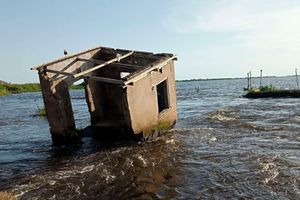
Naivasha, long celebrated as one of Kenya’s premier tourism destinations, is reeling from the devastating impact of surging water levels in Lake Naivasha over recent months.
The once tranquil lakeside town, popular with both local and foreign tourists, now finds itself at the centre of a crisis that has submerged hotels, cut off access roads, and forced evacuations in some facilities, threatening its economy.
Water levels in Lake Naivasha have recently risen dramatically, pushing beyond historical boundaries and creeping into properties that once stood safely inland.
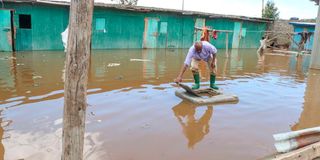
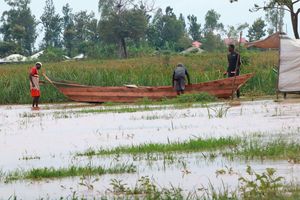
Young men use a makeshift boat to help residents of Kihoto village in Naivasha, Nakuru County move their household items from their partially submerged houses on November 6, 2025.
Photo credit: Boniface Mwangi | Nation
Stakeholders in the tourism sector are counting losses running into millions of shillings, even as many remain reluctant to speak openly, fearing further damage to their already struggling businesses as the peak holiday season approaches.
Along the shores of the lake, several hotels and lodges have lost large sections of their compounds to rising waters. Yet, despite the visible devastation, hotel owners and managers are choosing to remain silent for fear that media coverage may deter visitors during December bookings.
“It’s not that we are hiding anything, but tourism is a very sensitive industry. Publicly announcing that we are partly submerged could push away the very customers we need to survive,” said an official from one of the affected hotels, requesting anonymity.
However, even as some operators hope to quietly manage the situation, the lakefront tells its own story.
Hoteliers have been forced to improvise, relocating guest services to higher ground and, in some cases, shutting down entire sections of their hotels.
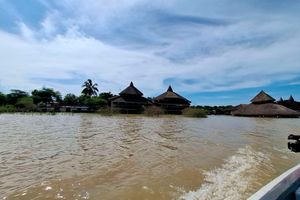
What was once a sandy stretch of recreational space outside Hippo Boat Safaris Hotel is now under water. Parking spaces and walkways are submerged, with only the rooftops of lakeside cottages still visible.
Residents of Kihoto village in Naivasha, Nakuru County on November 6, 2025 walk to their partially submerged houses after Lake Naivasha waters flooded the area.
Photo credit: Boniface Mwangi | Nation
Mr David Mwangi, the chairperson of the Nakuru County Tourism Association, said that the hotels near South Lake have been affected, though not as severely as they were affected during the 2021–2022 flooding, which caught many unprepared.
“Hoteliers have been monitoring the water levels, and no operation has been affected. Only some lake activities have been slightly disrupted, but normal operations continue,” he said.
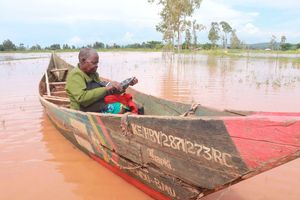
Jetties and boat operators who rely on tourism for income are among the hardest hit, with their earnings falling sharply.
“This time of year, we usually get so much business that we barely rest. Now, tourists are not even booking lake trips because the waters are unpredictable," said boat operator James Kappe.
In Kihoto, the number of families displaced by the rising waters has reached about 4,000, with fears that the figure could rise due to ongoing rains.
A motorcycle rider manoeuvres past a submerged tarmac road in Kihoto village in Naivasha, Nakuru County on November 6, 2025.
Photo credit: Boniface Mwangi | Nation
While several families have relocated, others remain trapped in submerged homes, exposed to the looming threat of waterborne diseases.
For months, they have been wading through contaminated floodwater mixed with human waste and sewage.
During her visit to the affected families on Thursday, Governor Susan Kihika said that the county government will create a multi-agency team to coordinate emergency operations in Kihoto Estate.
She said that a team comprising county officials, NGAO officers and clergy will oversee the evacuations, provision of shelter, and food distribution for the affected families.
The governor said that rescue operations have been intensified with more boats, tippers, and lorries deployed. She added that so far, more than 2,000 people have been evacuated and relocated to safer grounds.
“I appeal to churches and schools to host displaced families, especially candidates sitting their national exams. Corporate partners should also step in to support the ongoing humanitarian efforts. I urge leaders to stop politicising the tragedy. We shall all come together for unity and long-term measures to curb flooding around Lake Naivasha,” Ms Kihika said.
Residents have raised concerns about health and sanitation, citing the heightened risk of disease outbreaks. Essential amenities, including schools, churches, and other facilities, have also been affected.
Swelling waters of Lake Naivasha flood houses.
Photo credit: Boniface Mwangi | Nation
Kariuki Wachira, a resident, said they faced a similar problem in 2020 when they were forced to move and rent houses. After rent subsidies ended, they returned to the area.
Now, he said, he has again moved his family into a rental unit that has become increasingly unaffordable as landlords double or triple rents due to flooding.
“The government keeps saying it will relocate us but then goes silent. We wonder if they are waiting for the water to come for the fourth time and people to die before they act. Landlords are taking advantage of the situation to raise rent,” he lamented.
David Kanyi, a resident of Kihoto in Naivasha, Nakuru County salvages some of his household items on November 6, 2025.
Photo credit: Boniface Mwangi | Nation
Mr David Kanyi, a landlord whose eight-bedroom house and 46 rental units have been submerged, questioned why there are claims that people acquired title deeds illegally yet they were issued by the government.
“This is too much. I have moved my family to Kinamba but stayed behind to protect our property since some people are stealing at night. Tenants have moved to safer places. The government should intervene. We don’t even have washrooms, and we are told to move without being shown where to go,” he said.
David Kanyi, a resident of Kihoto in Naivasha, Nakuru County on November 6, 2025 shows how swelling waters of Lake Naivasha have submerged his water well and displaced tenants who had occupied his 42 rental houses.
Photo credit: Boniface Mwangi | Nation
In an earlier interview, Naivasha Deputy County Commissioner (DCC) Josiah Odongo said the government had launched investigations to identify people who have illegally encroached on the lake, with the aim of reclaiming riparian land.
He said flooding results from both natural causes and human activities around the lake, including invasion of the riparian zone.
Mr Odongo added that some residents, mostly landlords, possess title deeds and have put up houses for rent in affected areas.
He said that Lands Cabinet Secretary Alice Wahome visited the area two months ago and instructed the Directorate of Survey to demarcate riparian boundaries in Kihoto.
Surveyors were tasked with establishing beacons for the riparian section of Lake Naivasha before determining who has breached riparian laws.
“The survey is ongoing. Before anyone puts up a house, it has to be approved by the county government. We will ask for a report showing which buildings were approved and under what circumstances. Once beacons are established, it will be clear who breached riparian laws,” Mr Odongo said.
He noted that multiple agencies, including the Kenya Maritime Authority, the National Environment Management Authority, and the Directorate of Survey are working to determine the extent of encroachment and find a lasting solution.
“This is not a foreign issue; it is a natural phenomenon affecting several Rift Valley lakes, worsened by human activity. Anyone with fake title deeds will have them cancelled,” said Mr Odongo.
Residents of Kihoto village in Naivasha, Nakuru County on November 6, 2025 salvage household items after their houses were partially submerged by swelling waters of Lake Naivasha.
Photo credit: Boniface Mwangi | Nation
He said that, if necessary, notices would be issued to those occupying riparian land to vacate the area—but only after verifying ownership documents. Without valid titles, he added, relocation or compensation will not be considered.
Mr Odongo said that failure to respect these boundaries has worsened flooding in Kihoto and neighbouring areas.
A 2021 report on rising water levels in Rift Valley lakes indicated that six people died of depression in Kihoto following the 2020 flooding, while more than 1,500 households were displaced.
At Lake Naivasha, the affected areas include Kihoto Settlement and Kamere Beach, where a substantial number of properties and several power transformers have been submerged, posing hazards to the community.