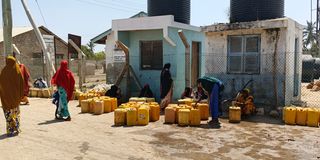
In Lamu’s Kiunga Village on the Kenya-Somalia border, drought and saltwater intrusion once brought immense suffering to the community. Locals, particularly mothers and children, spent hours walking several kilometres just to fetch contaminated and saline water from boreholes,and sometimes even from the ocean, for domestic use.
Today, that story has changed.
Solar panels at the Kiunga Solar-Powered Water desalination plant.
Photo credit: Pool
A Sh48.9 million solar-powered desalination plant set up four years ago has transformed the border village. Launched in July 2022 by the Lamu County Government in collaboration with the Water Sector Trust Fund, the project now provides safe, centralised drinking water to at least 4,500 residents of Kiunga, located in Lamu East
The plant incorporates desalination technology and reverse osmosis, operating silently and using solar energy to purify saline groundwater extracted from wells. Unlike in previous years, fetching water is no longer a marathon trek. Today, residents walk only a few minutes to the village kiosk to access a reliable supply of clean, safe, fresh water flowing from taps.
Mwanaumi Haji, a resident and community advocate in Kiunga, told Climate Action that the project has brought a sense of relief and security. "Even our children, who once suffered from diarrhoea and skin diseases caused by drinking salty, unsafe water, are now healthier because the water is purified by the solar system here," said Haji.
Lamu won the Best Community Impact Project Award at the Water Transversality Global Awards 2026, held in New Delhi, India, from March 6 to March 7.
The Kiunga Water Desalination Plant has significantly improved access to clean water for households, schools, and public institutions in this fragile coastal border area, which has long suffered from drought and saltwater intrusion. Beyond addressing water scarcity, the project has also promoted peacebuilding in an area long battered by insecurity linked to Al-Shabaab insurgents. It has advanced peacebuilding through shared water governance among host communities, refugees, and security agencies.
The solar-powered initiative also represents a critical step in reducing reliance on fuel-powered water systems and strengthening climate resilience in one of Kenya's most vulnerable coastal communities.
Lamu County was represented at the award ceremony by Ambassador Mary Mutuku, deputy head of mission at the Kenya Embassy in India, who received the prize on behalf of Kiunga residents. The recognition underscores how an intervention addressing basic needs can evolve into an important platform for peacebuilding and social cohesion in a sensitive border region.
Through structured community dialogues, host communities, refugee populations, local leaders, and security agencies agreed on equitable water access and rationing arrangements. This cooperation has transformed water from a potential source of conflict into a shared resource that promotes stability.
The peacebuilding integration component of the initiative was implemented by Shee Kupi, the Lamu County director of Disaster Management and Peace Building under the Department of Public Service Management.
"In Kiunga today, access to clean water has become more than a basic service. It has become a bridge for peace, bringing together host communities, refugees, and security agencies around a shared resource," said Kupi.
Lamu County Chief Officer for Public Service Management Khadija Fumo noted that the Kiunga Solar Desalination project has been particularly transformative for women and girls, who previously travelled long distances in search of water.
Fumo said residents now have safer and more convenient access to clean water, while improved water availability has supported better learning conditions and increased school attendance for students.
"This global recognition affirms the commitment of the Lamu County Government to pursue innovative and sustainable solutions that not only address water scarcity but also strengthen peace, resilience, and social cohesion in our communities.”
Lamu County Government Chief of Staff Mohamed Abdulnasir expressed appreciation to the Kenya Embassy in India for representing the county at the international ceremony. He reaffirmed the county's commitment to expanding sustainable water solutions that improve livelihoods and strengthen resilience across the region.
"The moment the idea was presented, we recognised its strategic value. Providing water while strengthening peace in a fragile border region was exactly the kind of innovative approach we needed, and that is why we moved swiftly to authorise its implementation," said Abdulnasir.
Lamu East Deputy County Commissioner Philip Muoki noted that the sharing of resources like water has historically been a source of tension in some parts of the country.
He said that since the establishment of the project and the agreed water rationing system, they have seen a significant improvement in trust between the community and security agencies.
"When people share a resource in an organised and fair way, it strengthens cooperation and information sharing. This has helped improve stability in this place and even weakened the environment that violent groups often exploit," said Muoki.