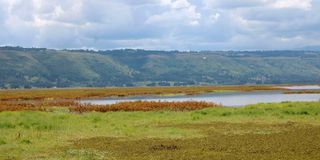
Lake Olbolosat in Nyandarua County is facing a fresh threat from encroachers, despite years of sustained restoration efforts by the local community.
At more than 80 per cent water-level recovery, the lake's beauty is back, as are the birds, hippos, and vegetation, with no more human-wildlife conflict. The serene environment is attracting tens of tourists, effectively creating a conducive environment for investors in the hospitality industry.
About two years ago, the lake's water level had dropped to less than 10 per cent, causing human-wildlife conflict.
Massive encroachment at lake Olbolosat in Nyandarua County, the only highlands lake in the region.
Photo credit: Waikwa Maina | Nation Media Group
When the Climate Action team visited the lake, we found some demarcations already done, with some beacons installed from the riparian land to some metres inside the swelling lake.
What worries the community most is that two water breathers, one suspected to be connected to Lake Naivasha in Nakuru County and a second one said to have originated from Olbolosat Forest, are within the grabbers' demarcated area.
“These breathers are crucial to the community; they don't dry up. They are also fortune tellers; we have for decades relied on them to know if it's about to rain and the amount of rain expected. The amount of water from the breathers guides us on how much rain to expect,” says a resident neighbouring the lake, Mr Kanda Gachinga.
Furthermore, a notable feature on the targeted land is a historical well, a major tourist site famed for swallowing livestock and wildlife.
“The most notable thing about the swallowing well is that no livestock or wildlife goes anywhere near it; it remains a mystery how the animals detect the well, yet it's covered with natural vegetation. No animals go to drink water from that well; it's avoided by hippos, no matter how thirsty an animal is,” says Gachinga.
Residents lament that if the grabbers have their way, the historical sites will be taken over by private developers or, worse, destroyed.
“These wells never dry up even during the worst drought; they supply us with clean water for domestic use. The water from the wells is so sweet, has a unique taste, and does not require any treatment. We have tourists who visit and carry containers of water from the wells; we don’t know why or to where,” says Mahugu.
Mr Thomas Macharia at a historical well at Lake Olbolosat on June 20, 2026.
Photo credit: Waikwa Maina | Nation Media Group
Also targeted by the grabbers is a 16-acre community land, which has a colonial cattle dip that serves farmers in three neighbouring villages.
Residents say this is not the first time grabbers have targeted this parcel of land due to its high potential in the hospitality industry.
The first attempt was made in 2001, but it stopped following the intervention by C.A. Omolo, the then Nyandarua District Commissioner, who wrote to the director of Lands Adjudication and Settlement, protesting the attempted grabbing of the land.
On October 3, 2001, then Nyandarua District Lands Adjudication and Settlement Officer James Kamau responded to the DC’s letter, indicating that the grabbing was a result of confusion during a land subdivision. He confirmed that the area was community land.
Since then, several attempts have been made by different individuals to grab the piece of land.
Mr Thomas Macharia, director of the Community Organisation for Positive Impact, Care and Development (COPICAD), whose organisation is involved in protecting and conserving the lake, says that if the encroachment is not stopped, it will have a very negative impact on the lake.
“The land demarcation covers more than 15 acres of the lake's riparian land. It affects the water sources of the lake. The wells that are part of the land intended for grabbing are very important sources of water for the lake; some of the wells are underground inlets of the rivers from Nyakariang’a and Ex-Burton Hills. Downstream all the way to Nyahururu, the lake is supplied by streams and rivers from Olbolosat Forest and other catchment areas, which we are rehabilitating,” says Mr Macharia.
Nyandarua Woman Representative Faith Gitau during a tour ofLake Olbolosatt in Nyandarua County.
Photo credit: Waikwa Maina | Nation Media Group
Apart from the riparian land, eight more acres adjacent to the lake, which belong to the community, are also affected by the subdivision, leaving the cattle dip area with about an acre, he added.
The subdivision has affected conservation projects around the lake, including some youth conservation projects.
“We had youth groups involved in conservation agriculture and beekeeping. They were also engaged in growing tree seedlings to be planted around the lake and distributed to the lake-neighbouring community, but the activities have stopped until the youth are guaranteed the project’s safety,” said Mr Macharia.
Unless the activities are stopped, the farmers will not have access to the lake for domestic water use, as well as access for their livestock that rely on water from the lake.
“The subdivision and encroachment will also bring back the human-wildlife conflict between the hippos and human beings,” said Mr Macharia.
Massive encroachment at Lake Olbolosat in Nyandarua County.
Photo credit: Waikwa Maina | Nation Media Group
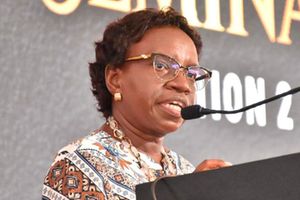
Tourism and Wildlife Cabinet Secretary Rebecca Miano assured the community that the government is committed to protecting the natural asset.
She says the lake is gazetted under the National Environment Management Authority, under the Ministry of Environment, making it a public property that cannot be subdivided or encroached on.
Ms Miano said her ministry is working with other stakeholders, including the Nyandarua County government, to have the lake gazetted as a reserve. The move, she said, would give both the ministry and the county government a clearer mandate to protect and conserve the site, while also promoting it as a tourist attraction.