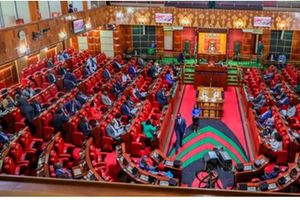
When a private company arrived at a beach in Mbita, Homa Bay County on May 25 this year to seek community approval for an asbestos disposal site on the lakeshore, it did not get the answer it was looking for.
Residents and environmental groups at the public participation meeting in Gembe West Location rejected the proposal outright, forcing Lakers Consultancy Limited to abandon the site and look elsewhere.
The government banned the importation, manufacture and use of asbestos in 2006. In March 2025, then Environment Cabinet Secretary Aden Duale, now in the health docket, issued a 90-day ultimatum ordering the removal of asbestos from all public and private buildings. But with tens of thousands of tonnes of the material still sitting on rooftops across the country, the question of where it all goes has no clean answer.
"We have contracted 15 companies that handle safe disposal of asbestos. They have identified disposal locations which have been approved by Nema. These 15 companies are service providers. If you have asbestos that you want to dispose of, you contact them, they dispose and you pay," he told the Nation .
He added that compliance since the directive has been significant. "Since the directive was issued last year, most of the culprits have complied," he said.
But the events in Mbita suggest the system is under strain. Lakers Consultancy Limited is one such licensed operator. On May 13, 2026, the company wrote to Mbita Deputy County Commissioner Peter Mutiso, notifying him of its intention to hold a public consultation meeting for an environmental and social impact assessment for a proposed asbestos disposal site in Kasgunga East Sub-location, on land next to the lakeshore. The backlash was immediate.
Activists Evance Oloo and Eugine Obisa wrote to the company objecting to the plan. Mr Oloo described the proposal as environmentally dangerous, socially irresponsible, medically hazardous and constitutionally unacceptable.
"The proposed project exposes the people of Suba North and neighbouring regions to possible contamination through floods, water runoff, airborne asbestos fibres, and soil seepage. Any leakage or environmental accident would have devastating long-term effects on aquatic life, public health and biodiversity within the Lake Victoria Basin," the activists wrote.
They argued the project would violate the constitutional right to a clean and healthy environment, the right to the highest attainable standard of health, and protections for ecologically sensitive areas. They also cited the Environmental Management and Co-ordination Act, which regulates hazardous substances and requires proper environmental impact assessment and public participation before any such project proceeds.
"Asbestos is globally recognised as a hazardous carcinogenic substance associated with fatal diseases including lung cancer, mesothelioma and asbestosis. The World Health Organization and International Labour Organization have consistently warned against unsafe asbestos handling and disposal," they wrote.
They asked the Deputy County Commissioner to reject and halt the project immediately and called on the government to identify disposal sites away from water bodies, fishing zones, residential settlements and ecologically sensitive areas.
Willis Omullo, an environmentalist in Homa Bay who leads a group called Aluora Makare, goes further. He argues that landfilling asbestos anywhere near Lake Victoria is the wrong approach entirely, and that the material should instead be destroyed and repurposed.
"Instead of dumping them in a wetland or any other ecosystem, they can be turned into something useful," he said, proposing that asbestos fibres be neutralised through thermal or chemical destruction, with the resulting by-products such as glass or cement alternatives recycled into new construction materials.
"The same materials will end up on our table and in the body when fish feed on them before the fish is caught and cooked. We are against any attempt to dump asbestos anywhere in the county," he said.
In Homa Bay, asbestos is present in buildings at Tom Mboya University, Asumbi Teachers Training College, the county teaching and referral hospital, nurses quarters, Homa Bay High School, and residential houses belonging to county and national government officials, according to ministry records.
"If you have asbestos roofing tiles, you can also encapsulate by painting both the top and the bottom, and the asbestos is sealed for up to 100 years," he said.
Encapsulation is a recognised asbestos management method, though it is generally considered a temporary measure dependent on the paint coating remaining intact over time.