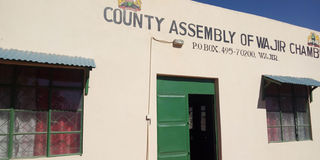
Members of the Wajir County Assembly pocketed millions of shillings in mileage allowances they did not deserve, in a scheme that saw some legislators claim money for journeys they never made, the Office of the Auditor General has revealed.
In its latest audit of the County Assembly, the Auditor General flagged irregular payment of Sh112 million in mileage allowances to MCAs during the 2024/2025 financial year, raising questions about how public funds are managed.
According to the report, the Assembly paid the allowances without proper supporting documents, including approved work programmes, motor vehicle logbooks, and attendance registers to prove that the MCAs travelled for official duties.
The statement of financial performance reflects employee costs of Sh639 million, including Sh275 million in respect of personal allowances paid as part of salary.
The amount included mileage allowances to MCAs totalling Sh111,520,140.
“However, review of the claims records revealed that the distances indicated from Wajir Town to the respective wards were at variance with the actual distances provided by the Ministry of Transport and Infrastructure,” Auditor-General Nancy Gathungu said in the report.
The MCAs received payments above the allowable amounts by Sh52 million after applying mileage at the rate of Sh109 per kilometre instead of the approved rate of Sh77.35 per kilometre, contrary to the Salaries and Remuneration Commission Circular Vol. CXXV—No. 177 dated 9 August, 2023.
“In the circumstance, the regularity of mileage claims amounting Sh52,290,590 could not be confirmed,” Ms Gathungu concluded.
Auditor-General Nancy Gathungu during a past event.
Photo credit: File | Nation Media Group
The Auditor-General further observed that the Assembly failed to maintain a proper mileage claim register, making it impossible to verify who travelled, where to and how much they were entitled to.
The lack of controls, the report says, created a loophole that allowed double payments, with some MCAs receiving both mileage allowances and transport facilitation for the same trip.
The findings have placed the clerk of the assembly on the spot, with the Auditor-General questioning why the payments were approved despite a clear breach of the Public Finance Management Act and the SRC circulars governing mileage claims for state officers.
In the same period, the Auditor-General reported that the county assembly engaged ward partisan staff for the elected and nominated Members of County Assembly (MCAs), contrary to the law.
Review of the ward staff for the month of June 2025 payroll revealed that the county assembly employed 257 staff for the wards against the recommended limit of 134 for the 45 elected and nominated MCAs.
This was contrary to Commission on Revenue Allocation Circular Number CRA/CSO/CMG//9/VOL V/59 dated 21 October, 2020, which recommended a maximum number of three staffs to be attached to each Member of County Assembly both elected and nominated, each earning a minimum salary of Sh30,341.
Thus, the assembly exceeded the maximum number of staff by 123 and paid a monthly salary ranging from Sh8,000 to Sh68,000 instead of the minimum of Sh30,341 recommended by CRA.
A review of the County Assembly’s Human Resource Information System (HRIS) revealed that the assembly had 179 employees against the recommended 100, surpassing the limit by 79 employees.
Of the total employees, 173 come from the dominant ethnic community in Wajir. The National Cohesion and Integration Act of 2008 stipulates that all public establishments shall seek to represent the diversity of the people of Kenya in the employment of staff and that no public establishment shall have more than one third of its staff from the same ethnic community.
At Wajir County Assembly, only six staff are persons living with disabilities, contrary to the requirements of Section 5(1)(e) of the Persons with Disabilities Act, 2025.
A review of the payrolls revealed that three employees received net salaries that were less than one-third of their respective basic salaries.
This was contrary to Section 19(3) of the Employment Act, 2007, which stipulates that without prejudice to any right of recovery of any debt due and notwithstanding the provisions of any other written law, the total amount of all deductions made by an employer from the wages of his employee at any one time shall not exceed two-thirds of such wages.