Hello

Your subscription is almost coming to an end. Don’t miss out on the great content on Nation.Africa

Ready to continue your informative journey with us?

Hello

Your premium access has ended, but the best of Nation.Africa is still within reach. Renew now to unlock exclusive stories and in-depth features.

Reclaim your full access. Click below to renew.

Nairobi floods: A governance crisis, not a climate accident

Floods

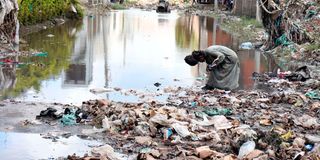
A man rummages through a flooded section of Sai Road in Nairobi’s Industrial Area on March 9, 2026 following heavy rains in the city.

Photo credit: Bonface Bogita | Nation Media Group

What you need to know:

  •  The Kenya Meteorological Department issues warnings and alerts, yet clogged drainage systems, poor urban planning, and weak enforcement of building codes ensure that these warnings translate into catastrophe rather than preparedness and response.
  • Nairobi's drainage systems, designed decades ago for a much smaller city, are now overwhelmed by rapid urbanisation and unregulated construction.

Kenya is once again experiencing rains that have caused widespread havoc in the capital city, Nairobi, as well as in other parts of the country. The images are painfully familiar: commuters and motorists stranded on submerged highways, families wading through knee-deep water in informal settlements, vehicles stalled in rising floods, and businesses forced to shut down. As the city and other regions drown, the pressing question is whether this is a case of unprecedented rainfall, or a case of human disaster and unpreparedness.

The raging floods are not merely a natural disaster; they demonstrate a governance failure and serve as a stark reminder that Kenya's early warning systems are yet to evolve into sustainable mechanisms capable of providing timely alerts for building resilience against predictable climate risks and shocks.
The anatomy of a preventable disaster

It is becoming a trend: with almost every rainy season, the same cycle repeats. The Kenya Meteorological Department (KMD) issues warnings and alerts, yet clogged drainage systems, poor urban planning, and weak enforcement of building codes ensure that these warnings translate into catastrophe rather than preparedness and response. Nairobi's drainage systems, designed decades ago for a much smaller city, are now overwhelmed by rapid urbanisation and unregulated construction. Informal settlements along riverbanks and low-lying areas bear the brunt, with families displaced and their properties destroyed.

What is the status of the Early Warning for All Initiative?

On May 21, 2025, Kenya launched the "Early Warning for All" (EW4ALL) initiative, a groundbreaking programme introduced in 2022 by the United Nations with an ambitious goal: to ensure that everyone on Earth is protected by multi-hazard early warning systems against extreme weather or climate events, and can access disaster alerts by the end of 2027. The initiative, led by the Kenya Meteorological Department and partners, uses Artificial Intelligence, mobile technology, and data to provide timely, localised alerts for floods, droughts, and other disasters.

However, the recent floods and their devastating impacts signal just how far we are from realising the EW4ALL vision. The critical question is whether the weekly alerts issued by KMD actually reach the most vulnerable,and when they do, whether the message is clear, timely, and accessible. All too often, warnings are too generic, arrive too late, or are simply inaccessible to communities that lack internet connectivity, mobile phones, or the ability to understand alerts due to language barriers.

The initiative's failure to deliver intended outcomes is rooted in systemic weaknesses: outdated meteorological equipment, fragmented coordination among agencies, and a lack of community-centred design. Furthermore, women, youth, and persons with disabilities, who are disproportionately affected by disasters, remain excluded from planning and decision-making processes. As a result, EW4ALL risks becoming another well-intentioned but underperforming global programme.

What must change

Early warning systems (EWS) are a proven, efficient, and cost-effective tools for building resilience, safeguarding lives and livelihoods and supporting long-term sustainability. Four key pillars of effective EWS include disaster risk knowledge, monitoring/forecasting, communication, and preparedness. Accelerating investments in EWS is urgently needed as climate change is a reality causing more frequent and intense extreme weather events, resulting in widespread adverse impacts and related losses and damages to nature, infrastructure, people and their livelihoods. 

As a call to scale up national action, EW4ALL can play a crucial role in accelerating investments to address Kenya’s vulnerability to climate change by improving EWS and enhancing resilience. To this end, four urgent steps are critical:

Investment in resilient infrastructure

 Nairobi needs modern drainage systems, flood barriers, and climate-resilient urban planning. Informal settlements must be upgraded with basic services to reduce vulnerability.

Localised early warning systems

Alerts must be actionable, community-driven, and accessible in indigenous languages. Local communication channels, including radio broadcasts, community leaders, and local networks should complement digital platforms. Local leaders and organisations must be actively involved in designing and disseminating warnings to ensure alerts are culturally appropriate and accessible.

Strengthened governance and accountability

Floods should trigger audits of county preparedness, not just emergency relief. Agencies must coordinate under a unified national disaster framework with clear lines of accountability.

Inclusive planning

Vulnerable groups must be part of designing disaster response systems. Their lived experiences are critical to building solutions that work in local contexts.

The recurrent floods in Kenya's "Green City in the Sun" serve as a stark wake-up call. Climate change is intensifying risks, but the real disaster lies in the failure to prepare and respond. Kenya's leaders must recognise that resilience is not a luxury but a necessity for safeguarding lives, livelihoods, and development gains.

Dr Kalele is a seasoned agriculture and climate change and adaptation specialist. She serves as a board member in the Africa Science and technology Advisory Group on Disaster Risk Reduction  of the African Union commission


