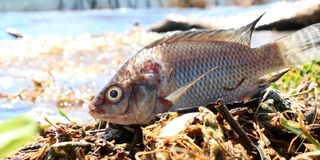
The tilapia pulled from Lake Nakuru's expanding waters looks ordinary enough. It is cheap, it is plentiful, and according to Kenya's government agencies, it could be quietly poisoning the people who eat it.
A new report by the Kenya Fisheries Service (KeFS) dated April 13 has confirmed what scientists, conservationists and public health officials have been saying with increasing alarm since 2020: fish from Lake Nakuru are not safe for human consumption. The findings include lead levels in some samples nearly 2.5 times the internationally accepted safety limit, detectable cadmium across multiple sampling points, and parasites on every single fish examined.
On March 31, Kenya's Standing Committee on National Security, Defence and Foreign Relations summoned KeFS to answer questions about the alleged forced disappearances of young fishermen at the lake. During that session, KeFS initially deflected, telling the committee that "Lake Nakuru National Park is a protected area managed by the Kenya Wildlife Service, and that the Kenya Fisheries Service does not licence fishing activities within the lake." The committee was not satisfied. It cited Section 9(m) of the Fisheries
Management and Development Act, which places fish safety squarely within KeFS's mandate regardless of where the fish originates, and noted that "despite the prohibition of fishing activities within Lake Nakuru National Park, illegal fishing is still ongoing and fish from the lake may be entering the market for public consumption." The committee directed KeFS to test the fish and report back by April 14.
KeFS, working alongside KWS and fishermen from Naivasha's Karagita Beach Management Unit, collected tilapia specimens from four points around the lake on April 6. The team targeted roughly one kilogramme of fish per sampling point, corresponding to "an average of four individual Oreochromis niloticus (tilapia) specimens per site."
"Samples were sent to Bureau Veritas laboratory in Mombasa, an ISO/IEC 17025:2017 accredited facility, for analysis against EU regulatory thresholds under Regulation (EU) 2022/931," the report says.
Arsenic came back clean across all eight samples, below 0.01 mg/kg against a permitted limit of 0.3 mg/kg. The report noted, however, that "surveillance needs to be done on a regular basis in the lake to continuously ascertain the health of the lake's ecosystem."
Then there is cadmium. It is a naturally occurring heavy metal that exists in the earth's crust, most commonly alongside zinc and lead deposits. The human body has absolutely no use for it. It gets into water systems through agricultural fertilisers, specifically phosphate-based ones that farmers apply to crops upstream, and through the disposal of batteries and industrial waste. Rain carries it off fields and roads and into rivers, and rivers carry it into lakes. In Lake Nakuru's case, the main highway is River Njoro, the lake's primary inflow, which drains a heavily farmed catchment above the town.
What makes cadmium particularly dangerous is what happens once it gets into a fish's body, and then into yours. Fish absorb it from the water faster than they can excrete it, so it concentrates in their muscle tissue. When you eat the fish, the cadmium moves into your kidneys, where it accumulates over years because the human body is extremely bad at clearing it.
"Cadmium is a cumulative toxicant with a long biological half-life and no known safe level of exposure. Prolonged dietary intake can lead to kidney dysfunction, impaired bone metabolism and other systemic effects, with risks increasing through continuous or repeated exposure over time," the KeFS report states.
While samples technically remained within the EU's ceiling of 0.05 mg/kg, several came right to that limit. The agency flagged that some samples exhibited concentrations approaching the regulatory threshold.
"This underscores the need for sustained surveillance and strengthened control measures to prevent potential exceedances," KeFs adds.
Being within the limit is not the same as being safe. It means the risk from occasional exposure is considered manageable by regulators. For someone eating this fish three times a week because it is the cheapest protein available, the calculation is entirely different.
Lead is a different metal with an even longer history of causing harm. It enters water bodies through mining, vehicle exhaust residue in urban runoff, old paint, scrap metal, and unregulated garages and workshops that discharge waste without treatment. Nakuru town, which has grown rapidly and whose industrial and automotive waste drains toward the lake, is a significant contributor. Unlike cadmium, which tends to arrive via agriculture, lead is more urban in origin. The KeFS report described it as "more strongly associated with urban runoff, transport-related pollution and localised anthropogenic activities."
Like cadmium, lead accumulates in the tissues of fish that absorb it from contaminated water, and it moves up the food chain when humans eat those fish. Also like cadmium, it has no safe level.
"Lead is a bioaccumulative toxicant with no known safe level of exposure. Chronic dietary intake, even at low concentrations, may result in neurological impairment, reduced cognitive development in children and adverse effects on kidney function, cardiovascular health and reproductive outcomes in adults," the report says.
Mercury results, which would test for yet another heavy metal known to cause severe neurological damage, were still pending from a sub-contracted laboratory in Italy at the time the report was signed.
What compounds the contamination problem is the nature of the lake itself. Lake Nakuru sits in the East African Rift Valley and has no outflow. It is a closed basin. Whatever enters stays, and concentrates over time. The lake's famous alkalinity and salinity are themselves products of this dynamic. It means every season of agricultural runoff, every drain from Nakuru's garages and workshops, every load of phosphate fertiliser washed off a hillside by rain, adds to a toxic inventory that has nowhere to go. The KeFS report described the overall contamination profile as a diffuse, catchment-driven pollution system. Every fish examined was also carrying parasites. Inspectors found external flukes which latch onto the gills and skin, often using specialised hooks, as well as zoonotic flukes including Haplorchis and Centrocestus, which can be transmitted to humans if the fish is eaten raw or undercooked, potentially causing intestinal issues.
"The batch of fish sampled and tested is not safe for consumption and the presence of a massive number of parasites on each fish might constitute a real threat to the consumers," KeFS concludes.
Mary Koech has been selling fish here for years. She has heard the government warnings before but thinks nothing of it.
"I have eaten this fish for many years and it has not harmed me," she said. "So I don't believe that it is poisonous. I suspect even the President himself has eaten it. This fish is even exported and we are yet to hear that anyone has been poisoned. And no one has fallen ill either. To us who live around here, we consider fish as medicine."
Julius Otieno has lived near the lake since 2021.
This is precisely what makes heavy metal contamination so difficult to communicate as a public health threat. Unlike food poisoning, which announces itself quickly, cadmium and lead do their damage slowly and silently. The kidney dysfunction and neurological impairment they cause accumulate over years of regular exposure, and by the time symptoms appear the damage is already done. There is no dramatic moment of collapse that anyone can point to.
"In Lake Victoria there is no fish," Victor Ochieng said. "There is a serious shortage. This is the only fish available right now, so how can they say that we should not eat it?"
The roots of the crisis trace back to 2020, when rising lake water levels displaced hundreds of residents in surrounding areas, including Mwariki, Lake View and Barut.
The warnings themselves have been piling up for years. In 2020, researchers found high levels of nitrate in the lake raising initial safety concerns. In 2021, KMFRI declared the fish unfit after reports of accelerated decay. A 2022 peer-reviewed study confirmed organochlorine pesticide residues in water, sediments and Nile tilapia, despite most of those pesticides being banned in Kenya. In January 2024, Cabinet Secretary Salim Mvurya officially confirmed the fish was unsafe, citing high arsenic levels.
By March 2026, KWS Director General Erustus Kanga was saying this before the Senate: "A lot of fish is leaving Nakuru and getting distributed across the country. People are taking fish that has been declared unfit for human consumption, and it is freely being distributed. We are killing Kenyans."
Nakuru County's Chief Officer for Environment Ken Barasa acknowledged that it was "environmentally very difficult" to arrest toxins flowing into the lake.
"Industrial waste and metals washed away from uncontrolled garages will finally, in one way or another, find their way into the lake ecosystem," he said at the time.
The KeFS report closes by reiterating "to the public that fishing in Lake Nakuru is illegal and that fish harvested from the lake should not be consumed," and reminding traders that valid health certificates are required before any fish reaches the market.