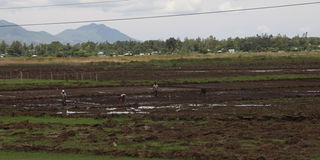
Once in a while, migratory birds would fly hundreds of kilometres before temporarily nesting in a swamp in Rachuonyo North, Homa Bay County, where they would feed and breed before moving on.
The migration of birds to Ondago wetland in the Kanyadhiang area was a wonderful spectacle, attracting bird watchers and wildlife photographers from far and wide. The area, covered with green papyrus reeds, would turn pink when flamingos flocked to the marsh in search of food and mates.
Flamingos flew from Lake Nakuru to Homa Bay primarily in search of food and suitable habitat, driven by fluctuating water levels and declining food sources in the Rift Valley lakes. Changes in lake salinity, pollution, or overcrowding reduced the blue-green algae that the birds consume, prompting them to move to other alkaline lakes for better feeding conditions.
As some flocks settled at Ondago swamp, others flew about two kilometres away and settled at Lake Simbi, an alkaline water body near the shores of Lake Victoria. Flamingos were accompanied by other birds such as wild ducks and grey crowned cranes, locally known as ongowang, which is now an endangered species.
This continued until both habitats started experiencing ecological changes, which disrupted wildlife migration.
The 48-acre swamp, gazetted in 1997 by the national government and recognised as a national bird sanctuary, is no longer habitable for most birds, which now fly over it as they search for suitable environments to feed and reproduce.
Experts say climate change plays a major role in altering bird movement by disrupting the timing, routes, and distances of their journeys, often leading to dangerous mismatches with food availability. Warmer temperatures cause birds to arrive at breeding grounds earlier or depart later, while habitat loss, extreme weather, and changing food cycles threaten their survival.
Today, the vital seasonal sanctuary for hundreds of flamingos in Homa Bay is dying, and the effects of climate change are clearly visible.
Papyrus reeds that once covered the area are turning brown due to environmental stress, making them highly flammable and prone to wildfires on hot days.
Their dry nature is a sign of water loss in the marsh, attributed to high temperatures and excessive sunlight.
According to Jonathan Bolo, a local, the wetland used to have plenty of fish and reptiles and was rich in diversity.
“We even have snakes in the wetland. The number of animals has, however, reduced, and it now takes weeks before encountering one, unlike before when it was definite that you would see them when you went to the swamp,” Bolo says.
The harsh environment has caused the animals to either die or migrate. Climate change has also made the swamp shrink.
Another resident, James Tindi, notes that the wetland was reserved for a variety of wild animals, and no one interfered with them. He adds that although people stayed away from wildlife, residents would occasionally encounter them, and this sometimes led to conflict.
“We have lived well with the animals. We expect to be educated on conservation efforts to protect both the swamp and the animals found in it,” Tindi says.
Ondago Swamp is moving towards a point where it will no longer serve the purpose nature designed for it, mirroring what other wetlands across the country face. Some are drying up due to human activities and severe drought induced by climate change.
Parts of the wetland in Rachuonyo North have been encroached upon, with significant portions lost to drying, cultivation, and settlement. The Lake Basin Development Authority (LBDA) is undertaking a project around the swamp where land has been cultivated for rice production. Some of this land used to hold water during the wet season, providing feeding grounds for wading birds. All of it is now being used to grow rice.
Joshua Olang, a farmer, says Ondago Swamp has little economic value to them. He argues that allowing farmers to cultivate the land will cause no harm to the birds.
“We need to benefit from the land alongside the birds. We need to benefit from the wetland,” Olang says.
However, environmentalists in the region maintain that farmers should not interfere with the wetland and the animals that depend on it.
Willis Omullo, chairman of Aluora Makare, an environmental community-based organisation in the region, says there needs to be good coexistence between farmers and animals.
“A lot of people engage in anthropogenic activities which interfere with wetlands. At Ondago, farmers set reeds on fire to get rid of mongooses and snakes which hunt their poultry. Others set fire to the marsh to create space for cultivation,” Omullo says.
Kenya is one of the signatories to the Ramsar Convention, an intergovernmental treaty adopted in 1971 in Ramsar, Iran, focusing on the conservation and sustainable “wise use” of wetlands. It provides a framework for national action and international cooperation, protecting over 2,500 sites globally as of 2026, including marshes, rivers, lakes, and coastal areas.
“The fact that farming is ongoing around Ondago Swamp should not in any way interfere with the local ecosystem. Destroying the swamp will have a long-term negative effect on the local environment,” he says.
According to the environmentalist, the community around the marsh is not well versed in ecological and climate-smart agriculture.
“We need to conserve wetlands as one key area of climate change mitigation, adaptation, and disaster risk reduction. We have to be custodians of the environment as listed in the Constitution. We have a right to a clean and safe environment and an obligation as communities to ensure we make the environment safe and clean,” Omullo says.
Officials from the Kenya Wildlife Service (KWS), Fisheries Department, National Environment Management Authority, and other environmental conservation agencies met farmers on March 12 to discuss ways in which the swamp can be protected.
KWS Warden Jackson Kibor says wetlands play a critical role in promoting tourism. He notes that they need to be protected since they attract visitors who support grassroots economies.
Damaris Kisha, senior field officer in charge of Homa Bay and Kisumu at the International Crane Foundation, says there is a need to conserve wildlife habitats, with communities engaging in collaborative environmental conservation. The organisation works to protect grey crowned cranes from harm.
Kisha explains that the bird is important in the ecosystem. She describes it as a keystone species in wetland conservation.
“The presence of grey crowned cranes indicates wetland health. Whenever we see them, it indicates that the wetland is in good condition,” the conservationist says.
According to the organisation, the population of grey crowned cranes has declined over the past four decades, with wetland degradation blamed for the reduced numbers. Kisha notes that there has been an 80 per cent decline in the species over that period.
The International Crane Foundation conducted two censuses on the bird in Homa Bay in 2019 and 2023, identifying 809 and 364 grey crowned cranes respectively. The data shows a decline in population. This was attributed to migration in and out of the county. Environmental challenges were also identified as potential threats that could have led to the decline.
“This calls for all of us to reduce the threats that face the bird so that we can realise its importance, as well as that of other wildlife,” she says.
Kisha says converting a wetland to an agricultural field has both negative and positive effects on the birds. It leads to habitat loss when areas that cranes used to nest in are converted to cropland, which can affect their population. However, rice production can also increase food availability for the birds.
“The birds use reeds to establish their nests and raise their chicks, as well as providing areas where they can feed. Converting a wetland to an agricultural field will deny the birds space to breed. But agricultural fields can also turn into feeding grounds for the cranes,” the wildlife conservationist says.
Kisha is also concerned about the use of chemicals on rice fields, which can affect the birds.[email protected]