In the scorching heat of Maai Mahiu, Nakuru County, a group of women in headscarves move steadily across a wide, open drying bed. Their feet turn heaps of sawdust, pushing it forward, pulling it back, folding it over itself, and spreading it thin. The motion repeats, again and again, under the sun.
This is systematic drying. By constantly turning the sawdust, they ensure moisture trapped beneath the surface rises and evaporates evenly. Only when fully dry can it be pressed into briquettes.
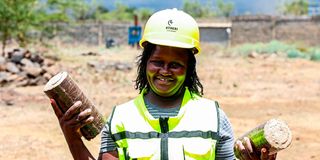
Different sizes of eco-friendly briquettes at Utheri Energy Solution Limited in Maai Mahiu.
Photo credit: Lucy Wanjiru I Nation Media Group
Nearby, truckloads of fresh, damp sawdust arrive from timber yards. Once offloaded, the mounds are spread across the drying bed.
When dry, the sawdust is bagged, weighed, and fed into a compression machine. Minutes later, dense cylindrical briquettes emerge: compact, smooth, heavy. They are stacked, loaded onto trailers, and transported to factories, where they burn in industrial boiler furnaces to power production. This is the daily rhythm at Utheri Energy Solutions, where since October 2022, forest and agricultural waste has been turned into sustainable fuel, providing energy while supporting local communities.
Photo credit: Lucy Wanjiru I Nation Media Group
“We are really happy when the sun is shining,” says Esther Njeri, co-founder and chief finance officer. “If it rains, production slows down.”
Speaking to Climate Action , Njeri traces Utheri’s journey back to her childhood in Kiambu. “I remember watching my mother compress sawdust into a jiko to cook meals like githeri that had to simmer slowly over low heat. It was efficient and sustainable. It made me realise, even then, that waste could have value,” she recalls. What began as a household routine would later inspire a vision far beyond the kitchen.
Across Kenya, manufacturing plants rely heavily on fossil fuels, driving carbon emissions. For Njeri, the contrast was striking. If sawdust could sustain a family’s cooking for hours, could agricultural and forest waste be scaled into a cleaner industrial fuel? She remembers asking herself: “What if compressed sawdust could scale beyond household use?”
With limited capital to invest in advanced infrastructure, the facility operates without an industrial dryer or an enclosed, climate-controlled warehouse. Instead, the women turn the sawdust repeatedly under the sun, exposing damp layers to heat and airflow. Moisture meters are used to test when it is ready.
According to Njeri, fresh sawdust can have a moisture content above 30 per cent; for briquetting, it must drop to single digits.
Once sufficiently dry, the sawdust is packed into sacks, weighed, and transported to the briquetting machine. The machine itself is industrial but modest, compressing the material under high pressure and heat. No chemical binders are added. The lignin naturally present in the wood softens under heat and acts as a binding agent, fusing the particles into dense logs. "What the machine does is just compress the sawdust," explains Floor Manager James Opanda. "Nothing is added. Just heat and pressure."
Utheri Energy Solution Limited Founder Esther Njeri (left) and Director Martha Mwihaki display finished fire briquettes at their Maai Mahiu workshop.
Photo credit: Lucy Wanjiru I Nation Media Group
The briquettes vary in size depending on customer specifications. Some industrial boilers require 16-inch logs, while others, such as those in oil refineries, prefer shorter, four-inch pieces.
According to Opanda, the difference is not aesthetic but mechanical. Boiler grates are designed differently, and the burnt ash must fall through specific openings. If a briquette is too large, it may not combust efficiently or could clog the system.
On optimal days, production reaches 24 to 28 tonnes, roughly one trailer load. The company sells its briquettes for between Sh14,000 and Sh15,000 per tonne.
"Large industrial customers can require up to 600 tonnes in open orders," says Martha Mwihaki, non-executive director. "To hit those numbers, however, the machine must be pushed to its limits. It's like forcing it to its utmost."
She points to spare parts scattered during maintenance as evidence of the strain. Production is frequently paused to replace worn components.
Made from waste materials like sawdust, the briquettes are promoted as a low‑carbon alternative to heavy fuel oil and firewood in industrial settings. They are often considered carbon‑neutral because the carbon released during combustion is part of a short‑term biological cycle, unlike fossil carbon that has been locked underground for millions of years.
Utheri's management estimates that every tonne of briquettes used displaces approximately one tonne of carbon emissions that would otherwise come from fossil fuels.
Carbon accounting for briquettes is complex. The emissions saved depend on the fuel being replaced. Swapping out heavy fuel oil shows clear reductions, while replacing sustainably harvested wood is less certain. Transport distances, combustion efficiency, and even the moisture content of the briquettes all influence energy yield and net emissions.
For industrial firms facing increasing scrutiny over their carbon footprint, briquettes offer a pragmatic bridge. Boilers can often switch fuels without major retrofitting. Compared to full electrification or a complete redesign of industrial processes, switching to briquettes carries a relatively low transition cost.
"For many small and medium-scale industries, this is one of the few practical ways to cut carbon without shutting down operations or overhauling their entire system," says Opanda. In Kenya's industrial sector, where heavy fuel oil continues to dominate energy use, even partial substitution with cleaner alternatives is emerging as a practical pathway to cut emissions, while broader structural reforms gradually take effect.
Utheri's founders received technical support from the Kenya Climate Innovation Center in 2025, which helped them formalise operations, strengthen bookkeeping systems, secure certifications, and develop the firm's standard operating procedures.
"All briquettes must meet Kenya Bureau of Standards requirements before they can be sold, ensuring safety and consistent quality for industrial use," says Njeri.
Such institutional backing is common among climate start-ups in their early stages, but support rarely extends far enough to solve capital bottlenecks. Setting up facilities requires significant investment in equipment, storage, and processing infrastructure, yet investors often hesitate due to perceived risks and long payback periods.
Limited access to affordable financing forces many entrepreneurs to start on a small scale, relying on manual processes and makeshift facilities. This, in turn, slows production and limits their potential impact.
For Utheri, the most pressing need is an industrial dryer. "If we had a dryer, even when it rains, we would still be doing production," Njeri says.
Rain is more than an inconvenience. It halts the drying process entirely. Wet sawdust cannot be compressed efficiently, and orders are delayed. Without sufficient funding, scaling operations, improving efficiency, and reaching broader markets becomes difficult, even when the environmental and social benefits of such projects are clear.
According to Njeri, an industrial dryer would stabilise output, smooth cash flow, and allow expansion into wetter seasons. Securing that financing, however, remains beyond the company's current means.
Maai Mahiu has long carried a reputation as a place where women, facing limited employment opportunities, are vulnerable to exploitation, including being coerced into transactional relationships with truck drivers to make a living.
"For years, Maai Mahiu has been reduced to a single story: one that paints its women as victims of circumstance, trapped between poverty and exploitation," Njeri says.
This has fuelled negative social perceptions and marginalised the community further. "But that narrative ignores the deeper issue," Njeri explains.
"Limited economic opportunities have left many with few choices. Survival should never be mistaken for consent or character."
By providing casual work and training in processing sawdust into briquettes, the firm is offering women a legitimate source of income and a chance to reclaim their livelihoods.
"Our goal is to change the story around women in Maai Mahiu. Instead of being seen as vulnerable or exploited, they are now earning a living, gaining skills, and showing that they can contribute meaningfully to the local economy,” adds Njeri.
Lucy Jambi, who joined the company in January, is one of those women. She now earns a living processing sawdust. "You sweat the whole day, but at least you have a place to work."
"If we close down, they will have to look for something else. Climate solutions are inseparable from livelihood strategies,” reflects Opanda.