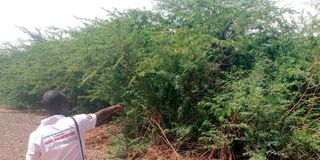
A dense thicket of Prosopis juliflora , known locally as mathenge weed, has encroached on the Sh266.8 million Nadoto Irrigation Scheme in Turkana Central over the past four months, choking a project meant to address chronic food insecurity.
James Echapan, a resident, had hoped the scheme, implemented by the National Irrigation Authority, would help tackle food insecurity in a village where residents largely depend on relief aid. “Pastureland has also been invaded by matheng e, crippling pastoralism. I am now left with a painful choice: migrate far from my ancestral home in search of pasture or watch my livestock perish,” he said.
Mr Echapan’s one-acre plot, where he planned in January to grow maize, sorghum, vegetables, and watermelon, is now part of the more than 1.1 million hectares of land across 22 counties aggressively invaded by this toxic plant.
Originally introduced for land rehabilitation and erosion control, the weed has become one of Kenya’s most aggressive invasive species. Research led by the Kenya Forestry Research Institute (Kefri), the Kenya Forest Service, and development partners confirms that unmanaged mathenge displaces indigenous vegetation and weakens dryland ecosystems.
In response, the government has launched two landmark policy instruments aimed at transforming Kenya’s arid and semi-arid lands (ASALs) and strengthening climate resilience.
During the launch, Environment CS Deborah Barasa explained that the strategy authorises the controlled and exclusive utilisation of mathenge weed while protecting indigenous species, strengthening governance, and creating green jobs through products such as briquettes, bioenergy, and biochar, a material used for soil improvement and livestock feed. “Turkana will serve as a regional demonstration and learning hub for integrated invasive species management, dryland commercial forestry, community-led restoration, and climate-resilient livelihood models,” she said. “Lessons learned here will inform implementation across other affected counties.”
Scientists at Kefri are also exploring the use of insects for the biological control of Prosopis juliflor a. The plant was originally introduced in Kenya in the 1970s to combat desertification, provide shade and pasture for livestock, and supply wood fuel. The thorny mesquite tree, characterised by yellow flowers and long pods containing about 20 seeds each, spreads rapidly and has severe impacts on livelihoods. It is already being controlled in South Africa using Algarobius prosopis, a seed-feeding beetle.
Patrick Mwenja, assistant regional director at Kefri Turkana, explained that the insects target the seeds, limiting the plant’s reproduction and spread.
“Seeds are primarily dispersed by livestock. When ingested, the animal’s digestive system breaks the seeds’ dormancy, allowing them to germinate within a week under favourable conditions. Without this process, the seeds can remain viable in the soil for more than 10 years,” he said.
Mr Mwenja noted that biological control has achieved reasonable success in southern Africa, where dense stands of Prosopis consume vast amounts of water and eliminate grazing land. “This biological control strategy is a critical component of the county Prosopis juliflora management plan that Kefris developing with the Turkana County government,” he said. “The effort is supported by the International Labour Organisation under the PROSPECTS programme, funded by the Government of the Netherlands.”
Kakuma, Pelekech, Lopur, Nasinyono, Lokangae, Morung’ole, Letea, and Loritit in Turkana West have been identified as the areas most severely impacted by mathenege invasion.
The county has approximately 361,787 hectares of grazing rangelands, rivers, wetlands, and groundwater systems now at risk of degradation.
Mathenge has proved notoriously difficult to control. Locals often attempt to clear it by damaging stems without removing stumps, which causes the trees to resprout into dense, multi-stemmed growth that produces even more flowers and seeds.
Scientists said the launch of these strategies marks a defining moment in Kenya’s environmental, economic, and land restoration efforts in ASAL counties, which have long borne a disproportionate burden of land degradation, invasive species, and climate shocks.