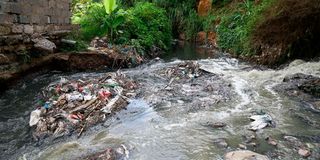
The recent heavy deluge witnessed in the country not only left a trail of destruction, but also saw single-use polythene bags strewn along River Athi, exacerbating already severe industrial pollution choking the river.
In Athi River township, Machakos County, a stretch of the iconic river between the Namanga Highway bridge and Kinanie downstream exposes the country’s soft underbelly in solid and liquid waste management. An assortment of plastic bags washed away by floods from Nairobi and other satellite towns has been trapped downstream.
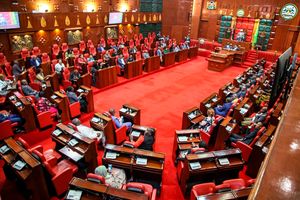
Severally, the National Environment Management Authority (Nema) has raised a red flag over effluent discharge from dozens of companies operating within the industrial town of Athi River. This coincides with the National Assembly Public Participation Committee report approved on 11 April 2024, which observed that the heavy pollution was largely caused by both industrial and domestic waste from companies upstream and from the Mavoko Industrial Zone.
However, single-use plastic bags have added another layer to the cocktail of pollution affecting the iconic river that meanders through the Lower Eastern region. With the rains having subsided, large volumes of plastic bags remain trapped on vegetation growing along the riverbed.
The nationwide ban on single-use plastic bags was introduced by the national government in 2017, aiming to reduce the environmental impact of plastic pollution.
However, despite stringent measures put in place by Nema, the country is still grappling with a formidable plastic pollution challenge.
According to the United Nations Environment Programme (Unep) more than 966,000 metric tonnes of plastic waste are generated in the country annually, with plastics accounting for about 20 percent of the total waste volume.
Under the law that came into effect in 2017, manufacturers and users of banned single-use plastic bags are liable to punitive penalties, risking a fine of not less than Sh2 million and not more than Sh4 million, or imprisonment, if found in possession of even a single polythene bag.
However, the proximity of partly peri-urban Kajiado and Machakos counties to Nairobi, as well as the porous Kenya–Tanzania border, is said to slow down the fight against plastic bags.
A cartel of unscrupulous traders allegedly sneaks plastic bags into the country from neighbouring countries through the porous borderline.
Kajiado County Environment Chief Officer James Ngugi told Climate Action that the resurgence of plastic bags in major towns was alarming, claiming the devolved unit lacks manpower to crack the whip.
"Ideally, the county is supposed to collaborate with Nema on environmental pollution matters. The vast peri-urban county has only two gazetted environment officers who can arrest and prosecute an offender against populous urban centres," Said Ngugi.
He added: "After the rains, the single use plastic bags are washed into the rivers. This has turned out to be a catastrophe, considering apart from the single-use bags being sneaked into the country, we have intelligence of local companies manufacturing the same."
A Climate Action spot check in Athi River, Mlolongo and Kitengela towns indicated that usage of plastic bags remains regular, especially in retail shops and roadside eateries that specialise in fast foods. Heaps of garbage in towns, including landfills, are characterised by both old and freshly used plastic bags, signifying the resurgence of banned products.
At least nine years after the government imposed a ban on single-use plastic bags, the bags remain one of the most pervasive sources of pollution countrywide.