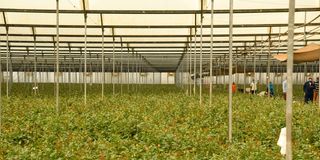
In late 2025, a manager at a flower farm along Lake Naivasha watched the water come. Not in a single catastrophic flood, but steadily, week by week, greenhouse by greenhouse. By the time the rains finally eased, four of the farm's greenhouses were submerged. It was, the manager told the media at the time, the highest water level the farm had recorded since it began operations.
It was not an isolated incident. All along the shores of Lake Naivasha, the heart of Kenya's flower-growing industry, the water has been rising since 2011, a phenomenon that has come to be known as the rising lakes. In previous media interviews, Prof Simon Onywere, who teaches environmental planning at Kenyatta University, described the lake as "engulfing three-quarters of some flower farms." Scientists widely link the trend to shifting rainfall patterns associated with climate change, though researchers note that land use change and deforestation in the catchment are also contributing factors.
The lake is just the most visible symptom of a broader disruption. Across Kenya's flower growing regions, rising temperatures, erratic rainfall, and an emboldened pest load are quietly rewriting the conditions under which the industry has thrived for decades. The sector's response is serious. But it is also racing against a clock that does not stop.
A sector with a lot to protect
Kenya's floriculture industry recorded export earnings of Sh81.3 billion in 2025, up from Sh72.1 billion in 2024, according to the Agriculture and Food Authority. Export volumes grew from 102.5 thousand tonnes to 130.6 thousand tonnes over the same period. The sector contributes about 1.5 per cent of GDP, accounts for 62 per cent of total horticultural exports by value, and supports over 150,000 direct and indirect jobs, with women making up a significant proportion of the workforce. Kenya exports flowers to 143 destinations worldwide, with roughly 70 per cent going to the European Union. Kenya supplies approximately 38 per cent of EU rose exports, according to the Kenya Plant Health Inspectorate Service (KEPHIS).
The Rift Valley's altitude, year-round sunshine, and proximity to freshwater have long given Kenyan growers natural advantages that European competitors cannot replicate. But climate change is eroding those advantages from multiple directions at once.
The lake that keeps rising
Naivasha's rising waters are part of a wider Rift Valley pattern. Lakes Baringo, Nakuru, and Turkana have all been rising steadily for roughly 15 years. A study published in the Journal of Hydrology found that lake surface areas across East Africa increased by 71,822 square kilometres between 2011 and 2023. By 2021, more than 75,000 households had been displaced across the Rift Valley, according to a study commissioned by the Kenyan Environment Ministry and the UNDP.
In previous media interviews, Richard Muita, acting assistant director of the Kenya Meteorological Department, points to rainfall and temperature changes as the primary drivers, though he acknowledged competing scientific explanations. What is not in dispute is what it means for flower farms.
The Kenya Flower Council does not yet have precise data on how much farmland has been lost to the rising water. According to Lina Jamwa, the council's Membership Engagement and Communications head, the Kenya Flower Council (KFC) and other floriculture stakeholders are currently developing a baseline assessment. That gap in the data itself tells a story about how fast the situation has moved.
"In areas such as Naivasha, particularly around Lake Naivasha, water levels have continued to rise since 2015, affecting production zones," Jamwa says.
Heat, drought, and a moth that has been watching its moment
Flooding is not the only front. Higher temperatures and shifting rainfall are disrupting growth cycles and increasing pressure on irrigation systems. The False Codling Moth, a pest native to sub-Saharan Africa, has emerged as one of the most serious threats to Kenyan rose farms, its spread widely linked to changing climatic conditions. Crop protection experts say the moth incidence has increased sharply over the last two years as weather patterns have shifted, with the pest now infesting more than 100 host plant species. The EU classifies the moth as a quarantine pest, meaning farms where it is detected are barred from selling to the European market. Its presence in exported roses has resulted in bans lasting up to two weeks or longer.
"We are living at a challenging time of climate change. The issue of False Codling Moth we are addressing today wasn't there some years ago; it is an emerging pest with a changing behaviour," an officer at the Kenya Plant Health Inspectorate Service says.
In response, KEPHIS says it has developed the Rose False Codling Moth Systems Approach, a comprehensive farm-level management framework that has strengthened compliance for exports to the EU, UK, and South Korea, involving active surveillance, farm inspections, and integrated pest management.
Regional offices in Naivasha, Timau, Nakuru, Eldoret, and JKIA have been strengthened to provide on-the-ground technical support.
Isdorah Odundo, the principal market and products development officer at the Agriculture and Food Authority, says the pressures are forcing growers to rethink water management as well. Climate change, she notes, is "already reshaping production patterns, driving drought stress, flooding events and new pest outbreaks," pushing growers toward water harvesting, storage systems, and more efficient irrigation technologies. "The pests are becoming more widespread due to climate variability, making integrated pest management and stronger surveillance systems essential," she says.
Breeding a way out, slowly
The industry's central long-term bet is on climate-resilient flower varieties. New varieties are being developed to withstand heat stress, water scarcity, erratic rainfall, and the pest and disease outbreaks intensifying under climate change. For Jamwa, this shift is no longer a side strategy.
"They are helping growers maintain quality and consistency even under increasingly unpredictable weather and climatic production conditions," she says. "The shift towards climate-resilient flower varieties comes at a time when Kenya, the continent and the world at large are experiencing increasing climate shocks."
Roses still dominate at about 69 per cent of exports, but Calistus Kundu, acting director general of the Agriculture and Food Authority, says diversification is already happening.
"Summer flowers and carnations are steadily gaining importance as growers diversify into varieties better suited for changing climatic conditions and shifting market demand," he says.
Dr Isaac Macharia, KEPHIS's director of Phytosanitary and Biosecurity Services, says regulatory systems have been strengthened to support new variety introductions without compromising market access. By enforcing international Plant Breeders' Rights, Kenya has created conditions in which climate-resilient genetics are being introduced directly to Kenyan growers. Digital tools including e-Phyto certification and automated export permits have improved the process, creating what Macharia describes as "a more predictable environment for exporters introducing new varieties."
There is, however, a hard constraint that no amount of innovation can shortcut. Developing a single new flower variety can take up to 25 years of research, testing, and regulatory approval before commercial release, according to KEPHIS. That timeline sits in uncomfortable tension with a disruption that is already here.
"The sector's resilience is anchored in long-term investment in breeding, sustainability standards and innovation systems that allow gradual but steady adaptation to climate realities," Jamwa says.
The climate challenge has not arrived alone. Geopolitical disruptions, particularly fuel supply disruptions linked to conflicts in the Middle East, have hit the sector at a moment when margins were already tight. The Kenya Flower Council has described the situation as "a nightmare" for exporters.
"The Kenyan flower sector is currently operating in one of the most challenging environments since the Covid-19 pandemic," Jamwa says. "We have faced severe pressure arising from geopolitical tensions in the Middle East, global supply chain disruptions, escalating fuel prices and rising input costs."
Air freight costs have risen from approximately $3.10 (Sh400) per kilogramme to nearly $5.00 (Sh645) per kilogramme, an increase of more than 60 per cent.
Freight now accounts for between 40 and 60 per cent of total export costs during peak periods, putting approximately $4 million (Sh516 million) worth of flower exports at risk every week. Fertiliser prices have risen by about 25 per cent, production costs by between 20 and 30 per cent, and some farms have reported revenue declines of up to 75 per cent due to shipment delays and perishability losses.
"For a highly perishable sector that depends entirely on efficient air logistics, this is a major economic shock," Jamwa says. The KFC is pushing for the release of pending VAT refunds, currently estimated at Sh10 billion, to sustain cash flow and protect jobs, alongside tax relief on farm inputs.
Despite the challenges, export volumes are growing and new growers continue to enter the market, a sign that long-term confidence in Kenya as a production base remains intact. But the convergence of a rising lake, warming temperatures, a spreading pest, and a volatile global economy is testing an industry that has long been held up as a model of Kenyan agricultural success.