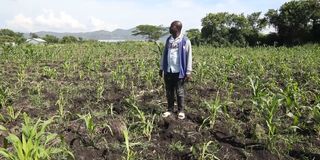
As dusk approaches in Kanyabala village in Homa Bay, maize farmer Delafiled Odoyo arms himself with a slingshot and a bright torch.
Mr Odoyo, whose livelihood depends entirely on his land, has been forced to reverse his rhythm of life, mostly sleeping during the day and standing guard at night.
“I have been camping in the farm at night to protect my crops from destruction. This is a practice we are forced into, simply to safeguard our source of income,” he says.
In villages lying within three kilometres of the lakeshore, sleep is often sacrificed. Farmers keep nocturnal watch over their fields, guarding against destruction that descends under the cover of darkness. At critical stages of crop development, they leave their homes at dusk and camp in their farms, driven by a single hope, to secure a harvest worth the season’s toil.
Farmers asses damages caused on their crops near Angalo beach in Homa Bay Town on April 21, 2026. Hippos ate some of the crops planted near the lakeshore.
Photo credit: George Odiwuor | Nation
Invasive hippos wander into farms in search of food, devouring and flattening everything in their path.
“We do not expect anyone to be out after 9pm. You can hear footsteps, whether human or animal, because of the silence,” Mr Odoyo explains.
He has encountered hippos more than once. When he does, he raises an alarm by shouting, screaming and when necessary, using his slingshot in an attempt to drive the animal away.
“The hippos are not eager to meet humans either. They may attack or flee. Either way, you must be ready to defend yourself,” he says.
Maxwell Otoyi, another farmer, observes that hippos rarely approach when people gather in numbers.
“My farm has been invaded at least seven times. The destruction usually happens when no one is guarding it,” he says.
Desperation has driven many to improvised defences with barbed wire, thorns and nails scattered along entry points. In some areas, trenches are dug in an attempt to halt the animals’ advance.
But still, the hippos persist in finding their way through barriers, as though guided by instinct and hunger.
For residents of Kanyabala, the toll is not only physical but financial.
Henry Owino, another farmer, notes that successful maize production demands costly inputs such as fertiliser, certified seeds, tractor hire and labour for weeding.
“Each step drains our pockets. We expect to recover our investment at harvest, but under the current situation, we are staring at losses,” he says.
Frustration is also directed at the response from authorities. Farmers claim that calls to the Kenya Wildlife Service (KWS) often yield little timely assistance.
“By the time rangers arrive, the hippos have already retreated to the lake. We are told to call and even take photographs as evidence, but in such moments, people are thinking about their safety, not procedures,” Mr Owino explains.
Beyond the destruction of crops lies a deeper fear, the threat to human life. Residents warn that a face-to-face encounter with a feeding hippo can easily turn fatal.
Homa Bay County Kenya Wildlife Service Warden Jackson Kibor speaks to journalists at his office on April 21, 2026. He told farmers whose crops have been destroyed by wild animals to report to the wildlife agency for necessary assistance.
Photo credit: George Odiwuor | Nation
According to officials from the Kenya Wildlife Service (KWS), April marks the peak of these invasions.
County KWS warden Jackson Kibor acknowledges the situation in Rachuonyo North and Homa Bay sub-county, maintaining that officers respond whenever alerts are raised.
“This is the peak season for crop destruction by wild animals since the crops are tender, green, and irresistibly appealing to the animals. However, we are working with farmers to reduce invasions. It is a short period, and the numbers will eventually decline,” he says.
Data from KWS indicates that up to 40 cases of human-wildlife conflict are reported in the county each month, with hippos and monkeys among the most destructive.
Mr Kibor urges farmers to report sightings promptly, noting that trained rangers can safely scare away the animals, often by firing shots into the air.
He also advises farmers to remain on elevated ground while guarding their crops and to dig trenches at least two metres deep around their farms.
“You cannot simply scare a hippo and expect it to disappear. Preventive measures are essential,” he says.
Maize production ought to be among the simplest expressions of agriculture. It involves land preparation, sowing, fertiliser application, weeding and, at last, harvesting. It is a near-universal script in the pursuit of sustainable food production.
Ordinarily, once these stages are complete, farmers retreat to their homes and entrust the fields to time and nature, allowing the crop to mature over the course of five months.