Premium
Still unbowed: Celebrating Wangari Maathai's legacy
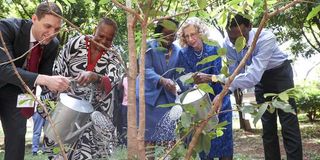
From left Andreas Bjelland Eriksen, Norwegian Minister of Climate and Environment,Wanjira Mathai, daughter of Nobel Laureate Wangari Mathai and Managing Director for Africa and Global Partnerships at the World Resources Institute,Cabinet Secretary (CS) for Environment, Climate Change, and Forestry in Kenya is Dr. Deborah Mlongo Barasa,Inger Andersen, UNEP Executive Director and Clive Donnley Omondi, Global Coordinator for the Children and Youth Major Group to the UN Environment Program during UNEA-7 at UN Headquarters on December 10,2025.Photo|Sila Kiplagat
What you need to know:
- The Nobel Committee awarded her “for her contribution to sustainable development, democracy and peace."
- She was the first Kenyan, African woman and environmentalist to win a Nobel Peace Prize.
Prof Wangari Maathai was in her hometown in Nyeri, Central Kenya when she got a call from Harald Dalen, a former Norwegian ambassador to Kenya.
The year was 2004.
It was a call that would be an imprint of a number of firsts. First Kenyan, African woman and environmentalist to win a Nobel Peace Prize.
The Nobel Committee awarded her “for her contribution to sustainable development, democracy and peace."
Wangari charted a new path for the Nobel Awards, especially on a peace prize, breaking the initial idea of Alfred Nobel, who wished that the award go to a person who "shall have done the most or the best work for fraternity between nations, for the abolition or reduction of standing armies and for the holding and promotion of peace congresses."
Two decades later, Kenya and the world is still inspired by Wangari Maathai’s award and the work that she did for the environment.
She remains unbowed, even in death.
On the sidelines of the seventh United Nations Environment Assembly (UNEA 7), delegates commemorated 21 years since she got the world’s top prize of USD 1.36 million (about Sh175 million).
It was not your usual event where people sit in air-conditioned rooms and listen to long speeches. It was simple, and as natural as Wangari could have loved it to be.
Standing under a planted forested area at the United Nations complex, delegates, accompanied by Wangari’s eldest daughter, Wanjira Mathai, shared snippets of the great work that she did.
It was a full-circle moment. Wanjira stood between Norwegian Minister of Climate and Environment, Andreas Bjelland Eriksen, and the United Nations’ Environment Programme Executive Director, Inger Andersen. Environment, Climate Change and Forestry Minister Deborah Barasa also tagged along.
On the same day, December 10, Oslo City Hall in Norway hosted the award ceremony for this year’s winners of the Nobel Prizes.
A tree that Wangari planted more than 20 years ago still stands tall. It is a Java plum tree (or zambarau in Swahili), scientifically known as Syzygium cumini.
It was the second tree that she had planted after winning the award. She planted the first tree –a Nandi flame tree, in her home town on the day that the announcement was made.
“That’s the way I do things when I want to celebrate, I plant a tree,” a post by the Greenbelt movement in 2017 rehashed her words.
“I got an indigenous tree, called Nandi Flame, it has these beautiful red flowers. When it is in flower it is like it is in flame,” she added.
In her autobiography, Unbowed, Wangari shares details of how her idea to plant so many trees, is inspired by the small beginning of a spring and how it ends up being a big river that pours into a lake and then an ocean. In the 70s, she knew that her calling was to plant as many trees as possible, and inspire people to take care of the environment.
Her idea at the time was to solve problems by using nature positively. One of the teething issues at the time was unemployment, so she created a company to help young people and infused an element of tree planting in it. She called it Envirocare Limited. Her strategy did not work long enough but she was not a person who gives up easily. Like a spring, she kept doing small things that led to the now big Greenbelt movement that inspired people globally to take care of the environment.
Also read:
While commemorating her day, Climate Action meets Susan Wanjohi, a gardener who has worked at the United Nations for more than two decades. She was quite new at the UN complex when she was called to help Wangari Maathai plant a tree, four days after she was announced as the Nobel Peace Prize winner.
She remembers Wangari being flanked by 15 other people, mostly dignitaries, then working at the UN.
Understanding peace
Susan remembers her for portraying a humble mien.
“When we gave her a spade to use during the tree planting exercise. She refused. She used her hands and carefully unwrapped the tree seedling and planted it. I washed her hands,” she says.
“I was so happy. I had only seen her on the television. She told us to love the soil,” she says.
That one moment inspired her love for nature and she gives it her all when it comes to taking care of the trees, flowers that she plants.
Wanjira tells Climate Action that her mum’s award was groundbreaking in every way.
“It was not the usual Nobel Peace Prize that was directly related to stopping conflict. This was a deeper understanding of peace. The fact that the environment is related to peace. That if we destroy the environment, we create a real fertile ground for conflict,” she adds
She says that her mother’s award was a real classic Nobel thing that they do; to challenge the understanding and our monotony towards the understanding of peace.
“Today, nobody asks about the link between the environment and peace is…it is obvious.We talk about peace every single day when it comes to resources, water, forest destruction, you name it,” she says.
“The destruction of the environment is essentially our own destruction,”
She says that a lot has changed in the environment and climate change space in the last two decades.
In 2004 for instance, the world did not have the Paris Agreement, a global deal that came about in Paris at the 21st Conference of the Parties (COP21) in 2015.
Countries agreed to cut greenhouse gas emissions to keep global warming "well below 2 degrees Celsius" and ideally to 1.5°C above pre-industrial levels. Since then, countries set goals called Nationally Determined Contributions (NDCs), to act as scorecards for how they are implementing the clauses of the Paris Agreement.
Wanjira is inspired by the inclusion of other institutions like the World Health Organization at Climate conferences.
“This is a clear understanding of the integrated nature, and the fact that when you destabilise the environment, you destabilise so many other parts,” she says.
She is happy that the science of attribution to most climate events is now very clear. There is a clear understanding that our life support system is at risk. Globally, this science is referenced in the Intergovernmental Panel on Climate Change (IPCC).
“If my mother were to come back today, she would be so proud. Proud of the fact that nobody is waiting for her to come and save us,” she says.
“She was fighting what seemed like a solo battle. It was very scary, but she left a legacy that today, there is an army of Wangari Maathais* waiting to protect the environment,” she adds. Clive Donnley Omondi, Global Coordinator for the Children and Youth Major Group to UNEP, said during the commemorations that young people must follow in the steps of Wangari Maathai.
“We are calling world leaders to commit to the new multilateralism that protects people and the world and a renewed commitment where we live with Nature,” he says.
[email protected]