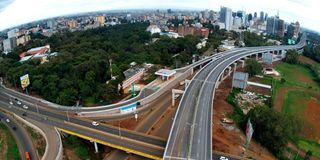
Nairobi Expressway along Waiyaki Way, Westlands.
This week we marked the UN World Sustainable Transport Day, celebrated annually to highlight and promote safe, affordable, accessible, efficient, and sustainable transport systems. It emphasises transport’s key role in supporting sustainable development, economic growth, social inclusion, and environmental protection. This year, the theme focuses on the road transport sector in anticipation of the upcoming UN Decade of Sustainable Transport (2026–2035). The day also follows the momentum from COP30 climate conference and underscores practical tools to achieve greener, safer, and more efficient mobility and logistics globally.
When we imagine the daily rhythms of our lives years from now: commuting to work, getting our children to school, visiting friends on the weekend, or traveling to neighbouring counties at the Coast, Rift Valley or highlands to unwind, we resign ourselves to choking air, endless traffic jams, and cities that deprioritise public transport, forcing us into costly, inefficient choices? Or do we dare to envision something different: African cities reborn as walking cities, where clean air fills our lungs, where affordable, reliable public transport connects us all and where shaded boulevards and green corridors invite us to move with ease?
This is the real opportunity before us. To invest in building inclusive cities of the future and breaking free from the trap of car‑dominated, polluted urban spaces and to build people‑centred cities that prioritise health, equity, and resilience. The future of transport in Africa must not be one of congestion and exclusion. We can, if we put our minds to it, invest in cities designed for people, not for vehicles; cities where children can walk safely to school, where elders can access services with dignity, and where communities thrive in spaces that are breathable and connected.
Public health crisis
Transport is essential for our societies. It is how we trade, how we work, how we connect with one another, and how our economies grow. Yet today, the state of transport is deeply troubling. Across African cities, transport pollution is already a public health crisis. It is responsible for thousands of premature deaths each year, rising rates of asthma and respiratory illness among children, and dangerous spikes in cardiovascular disease among adults. Road traffic alone is the dominant source of urban air pollution, with studies showing that fine particulate matter from vehicles is among the leading causes of preventable illness in our rapidly growing cities. And demand is only set to rise. Africa, home to 1.5 billion people, will more than double its population by 2070, with 80 per cent of this growth concentrated in cities.
The exciting opportunity is that the infrastructure our growing cities need to invest in for the next 50 years has not yet been built. That means we can choose to break free from the cycle of polluted, congested, car-dominated urban spaces and instead design healthier, people‑centred cities where clean air, safe streets, and accessible public transport become the foundation for our growth.
Sustainable transport is meant to advance economic and social development to benefit today’s and future generations in a manner that is safe, affordable, accessible and resilient while at the same time minimizing environmental impact.
It was exciting to see the prominence and visibility of the cities agenda at COP30 in Belém rise. It was a breakthrough for cities, sustainable transport, and local climate action. For the first time, a strong majority, about 80 per cent of Nationally Determined Contributions mentioned cities and other local actors as key levers for green growth and transformation. In addition, 11 countries, led by Chile, unveiled a landmark global declaration on transport. In moving towards sustainable transport, local governments will be crucial drivers for change.
Sustainable transport
Multilevel partnerships will connect national and international climate finance in sustainable transport, such as public transit, active mobility, and electrification of fleets. One such partnership is the Coalition of High Ambition Multilevel Partnerships (CHAMP) that was launched two years ago at COP28 in Dubai and advocates for better collaboration between national governments and cities, counties, states and regions to drive climate action at scale. This momentum to also focus on cities as drivers of transformation is welcome, especially for the fastest urbanizing continent in the world.
In Africa, despite our challenges with sustainable transport, there are some shining examples to look to: Ethiopia has emerged as a continental leader, rolling out policies to accelerate the adoption of electric vehicles and investing in charging infrastructure to support a nationwide transition. Kenya too has taken decisive steps, with incentives for electric mobility, commitments to expand renewable energy for transport, and a growing ecosystem of start-ups deploying electric buses and motorcycles across its cities.
These examples show that Africa is not waiting and that progress is underway. With political will, thoughtful planning, and financing, our cities can leapfrog into a future of sustainable, people‑centred mobility, proving that the vision of liveable, breathable African cities is within reach.
Ms Mathai is the MD for Africa & Global Partnerships at the World Resources Institute and Chair of the Wangari Maathai Foundation