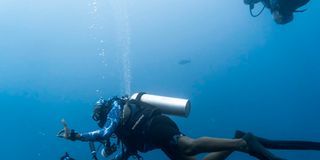
The first thing Anthony Onyango, a conservation visual storyteller, notices underwater is silence, a profound stillness that stands in stark contrast to the world above the waves.
At a glance, the Indian Ocean off Kenya’s coast appears unchanged: clear water, darting schools of fish, and coral structures rising from the seabed. But as he descends, camera in hand, a different story reveals itself in the details. The complexity of these ecosystems becomes undeniable. Where vibrant colour should dominate, there is only a skeletal white. Coral branches that once teemed with life now stand brittle, drained of life.
Here, corals, seagrass beds, and mangroves are intricately intertwined, each supporting countless species and playing a crucial role in sustaining the health of the entire coast.
Anthony Onyango in Budongo Forest, Uganda, during the filming of The Forest Guardian, a documentary celebrating 50 years of restoration.
Photo credit: Pool
Speaking to Climate Action, he describes Kenya’s marine environment as a living mosaic: turtles nest on its sandy shores, humpback whales migrate along the coastline, and the coral gardens of Kisite Mpunguti shimmer with colour.
Yet, beneath this beauty lies a deepening crisis.
“Some sections are still healthy,” Onyango notes, “others are completely bleached. You do not need a thermometer to know something is wrong.”
Across Kenya’s coastline, coral bleaching, driven by rising sea temperatures linked to climate change,is rapidly altering marine ecosystems that sustain fisheries, tourism, and coastal communities.
Through his camera lens, Onyango documents this fragile undersea world frame by frame, capturing both its enduring vitality and its visible decline.
Born in Nairobi, he recalls weekends spent trailing behind his father through Nairobi National Park, observing wildlife and trees with the quiet, focused fascination of a child.
He would sketch what he saw on those trips and later share his drawings with classmates at school. For him, these early sketches were more than just a childhood pastime; they were his first attempt to communicate the beauty of the natural world to others. That impulse would later evolve into a career bridging science, documentation, and public understanding.
An octopus settles into the coral, its skin shifting in texture and tone, becoming rock, reef, shadow.
Photo credit: Pool
Those formative experiences nurtured a deep respect for ecosystems and wildlife, a value that his formal education would later reinforce. At All Saints Cathedral School in Nairobi, teachers noticed his growing interest in environmental issues and appointed him environmental prefect, an early role in what would become a lifelong commitment.
The title held little authority, but it came with responsibility; keeping school grounds clean, encouraging tree planting, and fostering care for shared spaces.
His journey continued into secondary school at Mbita High, where environmental degradation was a visible, daily reality. Dust regularly blew into classrooms, and vegetation struggled to survive. Working with a teacher, Onyango helped plant aloe vera around the school compound to stabilise the soil and reduce erosion. Though modest, the effort illustrated a basic truth: ecosystems and human well-being are deeply linked, and small, deliberate actions can create tangible change.
While many of his peers pursued commerce and conventional careers, Onyango chose conservation. He enrolled in a Wildlife Management degree at Moi University, driven by a desire to understand ecosystems more deeply. There, he studied conservation biology, land management, and the complex dynamics of human-wildlife interaction; laying a foundation for his future work.
He later undertook short courses in monitoring and evaluation, gaining analytical tools to assess conservation projects not just by their intentions, but by their measurable impact, outcomes, and long-term sustainability.
Mangrove roots and seagrass captured underwater in Vanga, Kwale County illustrating the interconnected relationship between the two coastal ecosystems.
Photo credit: Pool
In 2015, while working for a Nairobi-based organisation, Onyango began using photography as more than mere documentation. He started treating images as evidence; visual records of environmental pressure and human impact.
One of his earliest assignments took him to River Malagarasi in Tanzania's Kigoma ecosystem, where industrial salt production was altering river flow and degrading the surrounding landscape.
“The camera does not exaggerate. It shows what’s there,” he says.
His major focus was to photograph the restoration efforts alongside affected landscapes, focusing on how extraction reshaped both environment and community.
“That is when I realised images could carry environmental stories further than reports alone,” he says.
Majority of the people are said to confuse between wildlife and conservation photography. Wildlife photography often celebrates beauty while conservation photography interrogates context through asking what threatens that beauty and the ‘why phenomenon.’
Onyango’s work increasingly drew him to marine ecosystems, which have long been remained under-documented despite their vulnerability. Kenya’s coral reefs support fisheries, protect shorelines and anchor coastal economies. They are also among the ecosystems most sensitive to climate change.
Learning underwater photography required his technical training, discipline and huge investment in acquiring equipment. “You don’t improvise in the ocean,” Onyango says. “You prepare.”
In Kisite Mpunguti Marine Park and along the coast in Diani, he has documented coral reefs, fish populations, and sea turtles.
During one dive off Diani Beach, he encountered a group of six turtles within an hour, an extraordinary experience, as he typically records only one turtle per dive.
“Most of the time, I’m fortunate to capture a single turtle per dive,.” Rising sea temperatures have already triggered coral bleaching along sections of the Kenyan coast. Bleaching is a stress response that occurs when prolonged heat causes corals to expel the algae that give them color and energy.
In parts of the North Coast and within some marine protected areas, reefs that once teemed with marine life have turned pale, a visible sign of ecosystems struggling to recover between successive heatwaves. Scientists warn that repeated bleaching reduces coral resilience, slowing recovery and increasing the likelihood of mortality.
The implications stretch far beyond the reef itself. Coral systems act as nurseries for fish stocks, natural barriers against coastal erosion, and a foundation for tourism-dependent economies. As reefs weaken, fish populations decline, shorelines become more vulnerable to storm surges, and livelihoods tied to fishing and tourism face growing uncertainty.
“Climate change is not theoretical underwater. It’s visible,” Onyango says.
When he began his visual storytelling journey, Onyango used pension savings from a previous job to purchase his first photography equipment, investing about Sh400,000. As his work evolved, so did the need for more advanced gear. He eventually spent roughly Sh1.5 million on underwater housings and specialised cameras.
Framed beside a whale shark, Anthony Onyango’s fellow National Geographic Explorer Mogamat Shamier Magmoet surveys the waters of Mafia Island, Tanzania.
Photo credit: Pool
On land, Onyango works with a Canon camera and a 28mm lens. Underwater, the same camera is secured inside a Marilux housing. He avoids unnecessary equipment, prioritising intention over gear.
“Navigating this work also involves securing permits, arranging insurance, planning for safety, and upholding strict ethical responsibilities,” he explains.
Onyango operates through the Tony Wild Foundation, which is registered with the Kenya Film Classification Board, ensuring legal compliance and accountability in his work. Ethics remain central, guiding every decision above and below the water.
When photographing wildlife, he captures animals in their natural state, resisting any temptation to stage or manipulate scenes for dramatic effect. Similarly, his interactions with local communities are grounded in respect and transparency; no individual is posed, coerced, or exploited for an image.
“Animals are photographed in their natural state. Communities are not staged or exploited. Disturbance is minimised,” he explains.
Every effort is made to reduce intrusion, whether quietly observing a turtle nesting along the shore or documenting a community-led mangrove restoration. This disciplined approach ensures the stories he tells reflect reality, preserving both the dignity of the people and the integrity of the ecosystems he aims to protect.
“If the work harms what you are trying to protect, it has no value,” he says. Onyango’s assignments have spanned more than 15 countries across Africa, including Ethiopia, Uganda, Tanzania, Mozambique, South Africa, Ghana, Egypt, and Sierra Leone. He has also filmed marine life in the Maldives.
For him, diving into the ocean has always been a balance of awe and fear. Sharks, often misunderstood and feared,became both a challenge and a fascination.
“There is the wow and then there is the fear factor,” he says, describing his early encounters with these apex predators. He had to confront the instincts and stories ingrained about sharks, learning to see them not as threats, but as essential parts of a living ecosystem.
Underwater, the challenge extends beyond courage. Mastering buoyancy and the technical demands of diving equipment is essential to capturing clear, steady images without disturbing the environment.
Yet, it is precisely this blend of thrill, respect, and technical precision that drives him: the chance to witness and document sharks in their natural habitat, revealing a side of the ocean few have the courage or skill to explore.
Onyango observes that Kenya’s marine life is increasingly pressured by economic interests and industrial expansion along the coast.
“Despite geographic differences, I’ve noticed familiar pressures across ecosystems: industrialisation, extraction, weak regulation, and climate stress.”
He highlights a critical gap in governance: the urgent need to balance development with conservation across all ecosystems. Illegal and large-scale fishing operations are decimating breeding grounds and fragile habitats, threatening both biodiversity and the livelihoods of coastal communities.
“We cannot let greed take over the ecosystems that feed local communities.” He believes that oceans, mangroves, and seagrass beds must be safeguarded in ways that also sustain coastal communities, demonstrating that conservation and development are not opposing goals, but mutually dependent.
“Environmental decline is rarely accidental. It is usually a policy failure.” He explains that while environmental laws exist, enforcement often lags behind the pace of development.
Away from the field, Onyango invests time in education. Through the Tony Wild Foundation, he works with schools to introduce students to conservation and photography, with about 20 schools having participated so far.
“When they see wildlife for the first time and get to interact with the lenses, it changes how they think and perceive the environment and conservation,” he says.
His work has earned recognition both locally and internationally. He has been named an iLCP Emerging League Fellow and a Jackson Wild Scholar, while his films and photography have received multiple awards, including the Eco Warrior Award 2023, the Explorers Club 50 Award 2022, and the Grand Prismatic Award 2021.
Onyango identifies as a conservation photographer, filmmaker, and wildlife ecologist, collaborating with various conservation organisations and serving as an explorer for National Geographic.
His focus, however, is not on creating more photographers, but on nurturing observers — young people who learn to notice the rivers, birds, insects, and trees in their everyday surroundings.
“Not every conservation story is about iconic animals,” Onyango says. “Sometimes it is about what’s disappearing quietly.”
For divers and underwater photographers, the months from December to March offer the clearest and calmest conditions, revealing the full vibrancy of Kenya’s coastal waters.
Yet, each ecosystem, though distinct, remains deeply connected; a reminder that the health of a coral reef or a mangrove forest directly influences the resilience of the entire coastline.