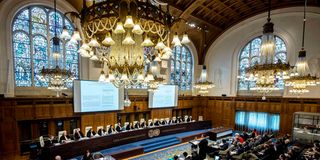
Standing at the Peace Palace in The Hague last July, the International Court of Justice (ICJ) President Yuji Iwasawa did not mince words. Climate change, he told the court, was "an existential problem of planetary proportions that imperils all forms of life and the very health of our planet." He went further: greenhouse gas emissions, he said, are "unequivocally caused by human activities," and a state that fails to take appropriate action to protect the climate system may be committing "an internationally wrongful act."
The ruling was unanimous. It was only the fifth time in the court's nearly 80-year history that all judges agreed. And it set in motion a chain of events that culminated last week when the United Nations General Assembly formally endorsed the opinion and called on states to act on it.
The resolution was adopted with 141 votes in favour, eight against, and 28 abstentions. The United States joined Saudi Arabia, Russia, Israel, Iran, Yemen, Liberia, and Belarus in opposing it.
The vote matters because of what the ICJ opinion said, and what it did not. In a unanimous decision, the 15 judges concluded that the production and consumption of fossil fuels "may constitute an internationally wrongful act attributable to that state." The opinion also says that limiting global warming to 1.5 degrees Celsius should be considered the "primary temperature goal" for nations and, to achieve it, they are obliged to make "adequate contributions." Iwasawa added: "The human right to a clean, healthy and sustainable environment is essential for the enjoyment of other human rights."
On the legal consequences of breaching those obligations, the court ruled unanimously that a breach "constitutes an internationally wrongful act entailing the responsibility of that state."
What the opinion could not do, however, was make governments comply. That gap, between legal clarity and real-world action, is what last Tuesday's UN resolution is trying to close, and what a growing army of lawyers, communities, and civil society groups around the world are trying to fill through the courts.
What the vote means, and what it doesn't
Fenton Lutunatabua, 350.org Pacific and Caribbean lead, called the vote "a critical next stage for an Advisory Opinion that was not meant to sit on a shelf, but to operationalise and rally States under international law." For communities on Pacific frontlines, he said, it was about more than politics.
"Our communities get closer to receiving justice for the suffering the fossil fuel industry has caused, and the havoc wreaked upon our shorelines as we pay with our lives and our pockets to rebuild after yet another cyclone, yet another flood."
Anne Jellema, 350.org executive director, said the resolution "marks a turning point, a clear affirmation that governments are not only morally bound, but legally responsible for protecting people from climate harm," adding that it "strengthens the foundation for accountability, accelerates the shift away from fossil fuels, and sends a powerful signal that the era of impunity is coming to an end."
The harder question is how that translates into action. While not legally binding, the advisory opinion has significant implications for national climate policies and international climate negotiations, and opens new pathways for litigation against governments. The United Nations General Assembly (UNGA) resolution adds political weight, but carries no enforcement mechanism of its own.
At the domestic level, the ruling establishes legal foundations for climate litigation worldwide, enabling courts to cite the ICJ's interpretation of state obligations. This may increase the success rates of domestic climate cases and subject companies to greater legal pressure. The question remains whether this legal clarity can overcome the lack of enforcement mechanisms, transforming moral and legal pressure into accelerated action before it is too late.
The advisory opinion has already been woven into new climate litigation and existing legal cases, and judges are starting to reference it in their rulings.
The ICJ itself was candid about its limits, noting in the opinion that international law "has an important but ultimately limited role in resolving this problem."
"Without doubt, this vote is an important and historic political signal that governments are prepared to respond to the legal clarity the ICJ advisory opinion provided. It also means that major emitters, and particularly historic emitters, can no longer ignore the world's highest court when it comes to the harms caused by climate change," said Tasneem Essop, executive director of Climate Action Network International.
"The challenge now is transforming legal obligations into real action consistent with Equity, Common But Differentiated Responsibilities and Respective Capabilities, and the protection of human rights. The real test starts now, and we will be watching whether this political commitment translates into the action the law demands," she added.
The politics of COP30 late last year demonstrated exactly what that test looks like in practice. Saudi Arabia, representing the Arab Group, described any inclusion of the ICJ advisory opinion in negotiating text as a "deep, deep, deep red line," and the opinion did not appear in the final agreed text of that session.
The pushback: legislating away accountability
The same week that 141 governments voted to endorse climate accountability in New York, others were moving in the opposite direction at home.
In the United States, Republican lawmakers introduced the Stop Climate Shakedowns Act of 2026, a bill that, if passed, would prohibit retroactive climate liability lawsuits, dismiss all pending suits on the date of enactment, void state energy penalty laws, and assert that only the federal government has authority to regulate greenhouse gas emissions. "It would strip cities and local governments of legal pathways to hold energy companies liable for climate-related costs," environmental activists said.
The legislative push follows executive action that has already tested the courts. In April 2025, following a meeting with oil executives at the White House, President Trump issued an executive order directing the Attorney General to prevent states from holding the fossil fuel industry accountable. The Department of Justice then sued New York and Vermont over their climate superfund laws, and brought unusual suits against Michigan and Hawaii seeking to pre-emptively block them from suing oil and gas companies. Those suits have since been dismissed.
US courts have been slowed by obstruction and procedural gridlock amidst an intensifying political backlash against climate action, including direct federal efforts to block state-level accountability laws and lawsuits.
In July 2025, the Federal Court in Australia ruled in Pabai v Commonwealth that: "the government did not owe a duty of care to the people of the Torres Strait Islands to protect them from the impacts of climate change."
The lead applicants, two elders of the Gudamlulgal Nation, had argued "the government was legally obligated to set emissions targets in line with the best available science." An appeal was filed with the Full Federal Court in November 2025, with legal observers expecting the ICJ advisory opinion, delivered after the original Pabai judgment, to be cited in its support.
At the same time, Australia's reform package for its federal environment laws, a set of seven bills totalling nearly 600 pages passed in late 2025, contains no requirement to factor climate impacts into decision-making on fossil fuel project approvals. Critics argue this is not a shield but an exposure.
"By approving projects without climate assessments, the government may be setting itself up for the very lawsuits it appears to be trying to avoid," critics argued.
Africa's legal momentum on climate is quieter than what happens in The Hague or Washington, but no less consequential for the communities involved. The picture emerges from two major tracking reports published in the second half of 2025.
The first is Climate Change in the Courtroom: Trends, Impacts and Emerging Lessons, published in October 2025 by UNEP in cooperation with the Sabin Centre for Climate Change Law at Columbia Law School. It is the fourth in a series launched in 2017 and is the most comprehensive global survey of climate
"Climate litigation has evolved into a powerful global tool for advancing climate action and accountability," UNEP Executive Director Inger Andersen said about the findings.
By June 30, 2025, the report had recorded 3,099 climate-related cases filed across 55 national jurisdictions and 24 international or regional courts, tribunals, or quasi-judicial bodies. It identified five climate cases filed in Kenya, signalling what the report called growing environmental activism and judicial engagement in the region.
The second is the Global Trends in Climate Change Litigation: 2025 Snapshot, published in June 2025 by the Grantham Research Institute on Climate Change and the Environment at the London School of Economics. Now in its seventh year, the snapshot tracks annual developments and emerging patterns. According to its databases, between 2015 and 2024, 276 climate-related cases reached apex courts, supreme and constitutional courts, globally.
"Governments and companies are increasingly having to consider the legal ramifications of pushing ahead with oil or gas projects, as they risk being dragged through the courts," said Catherine Higham, senior policy fellow at the Grantham Research Institute. The snapshot found that over 80 per cent of 2024 case filings can be considered strategic, and that more than 80 per cent of cases reaching apex courts involve government defendants, though cases against corporate defendants appear to have a higher overall success rate.
Together, these two reports paint a picture of a field that has grown from fewer than 900 cases in 2017 to over 3,000 today, with the Global South, including Africa, beginning to close the gap.
In Kenya, In January 2025, the Environment and Land Court in Isiolo delivered judgment in a case brought by 165 pastoralists from Chari and Cherab Wards in Isiolo County against a conservation organisation. Three judges ruled that two of organisation's largest wildlife conservancies "had been established unconstitutionally, on unregistered community land without proper consultation, without the consent of the communities living there, and in violation of constitutional principles on land rights."
At the heart of the dispute was a soil carbon offset project described as among the world's largest of its kind.
The second case was decided in Nakuru in March. The Environment and Land Court set aside a tribunal decision and cancelled the environmental licence of Sosian Energy Limited, which had been granted a geothermal prospecting licence inside the Menengai Caldera in February 2021. The court found that the company had failed to carry out adequate public participation. It directed Sosian to undertake a new comprehensive environmental and social impact assessment, with the full involvement of affected communities.
Dale Onyango, an advocate of the High Court of Kenya who worked on the Sosian case with Natural Justice, framed the ruling as being about process, not opposition to development.
"The essence of the case is not opposition to development but rather a call for careful consideration of the statutory process and compliance. Ultimately, the goal is to achieve a win-win scenario for both developers and, most importantly, the local community," he said.
Both cases point to a pattern. Africa is witnessing a surge in climate litigation amid its deadliest climate disasters, with 14 of the continent's 23 documented lawsuits filed between 2021 and 2025. Some 74 per cent of African climate lawsuits between 2011 and 2025 target the energy, oil and gas sectors.
What the UN vote means for Kenya
The endorsement of the ICJ opinion by 141 governments converts what was a judicial ruling into a formal political commitment by the majority of the world's states, including Kenya itself, which voted in favour.
Kenya's 2010 Constitution already contains a right to a clean and healthy environment under Article 42. The ICJ opinion is expected to influence future domestic and international climate litigation and provide new leverage to vulnerable states seeking accountability and climate justice.
Most African legal systems have a limited appetite for climate litigation due to few precedents, procedural backlogs, and insufficient capacity. The vote does not fix those structural problems. But it does make it harder for any government in the region, Kenya included, to argue that climate obligations are someone else's problem or that the science remains contested.
Africa's own court enters the picture
In May 2025, the Pan African Lawyers Union, supported by civil society organisations including the African Climate Platform, Natural Justice, Resilient40, and the Environmental Lawyers Collective for Africa, filed a petition before the African Court on Human and Peoples' Rights requesting an advisory opinion on the human rights obligations of African states in the context of climate change.
The petition focuses on the African Charter on Human and Peoples' Rights, something that sets it apart from other advisory opinion requests on climate change. It also frames the question through the lens of historical injustice. The petition details Africa's vulnerability to the climate crisis and the historical inequities, including colonialism, that have contributed to it.
The African Court's opinion, when it comes, is expected to provide critical regional legal guidance for future litigation and advocacy on climate justice, corporate accountability, and just energy transitions.
Human Rights Watch, which submitted an amicus brief to the court, has called on it to clarify that states parties to the African Charter have binding obligations to protect people displaced by climate change, including through rights-respecting planned relocation as a last resort.