When the rains fail, people move: Inside East Africa's climate migration crisis
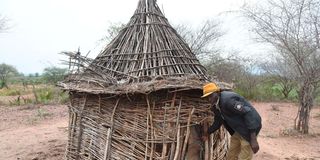
Sammy Samal, a resident of Tiaty in Baringo County, stands outside an abandoned house belonging to Losiwareng Akoripere in Natirira Village on February 23, 2026. Losiwareng is among residents who fled to West Pokot County with their families and livestock in August last year in search of pasture and water due to drought.

What you need to know:
- For many, moving is no longer a choice; it is the only way to survive.
Nzioka Wambua has spent the past four years watching other people's animals arrive in his county, and watching his own county's animals disappear.
As Tana River's director for Livestock, Wambua has a front-row seat to something that does not show up cleanly in any single statistic. Pastoralist herders from neighbouring counties keep pushing their livestock into Tana River, chasing water and pasture that used to be more predictable. It is an old pattern, one that has shaped life in this part of Kenya for generations. But the ground underneath it has shifted, and Tana River has absorbed the consequences.
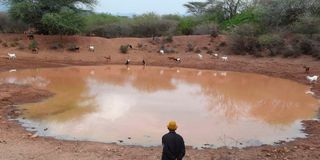
Members of public and goats at Apole Dam in Natirira Village, Tiaty, Baringo County on February 23. Several families have fled to West Pokot County together with their livestock in search of pasture and water due to drought.


"We have lost livestock, which is 80 per cent of our livelihood, as a result of lost resources like water as a result of soil erosion," Wambua said.
It is a blunt number, and Wambua is careful about how he explains it. The losses are not really about one bad season. They are about four years of repeated, unpredictable movement into the county, soil that keeps eroding, and water sources that keep shrinking. The result, he said, is that pastoralism itself is losing ground as a way of life. "Many people are now moving from rural areas and now are settling in towns because they have exhausted their pastoral resources," he said.
Tana River is a small, specific place to start a much larger story. Hundreds of kilometres away, in Arba Minch, southern Ethiopia, a room full of officials and researchers from across the Horn of Africa spent days recently trying to make sense of exactly the pattern Wambua is describing on the ground: drought and flood no longer arriving as isolated disasters but as a rolling condition that is quietly redrawing how people in this region live and move.
"Eighty per cent of Asal areas are suffering from lack of water, so when climate change adds to these factors, it becomes unbearable to communities. The scale of the problem is very huge given the level of impact on our natural climate characteristics," Prof Mekuria Argaw told the gathering.
Mekuria's argument, in essence, is that climate change did not invent migration in the Horn of Africa. People here have always moved, following water, markets, safety. What has changed is the pressure underneath every decision to stay or leave.
Kenya's last few years make that case almost too well. Between 2020 and 2022, the country went through five consecutive failed rainy seasons, one of the worst droughts on record. Then the weather flipped hard. In 2024, heavy rains and flooding tore across the country, and by the middle of that year OCHA and the humanitarian analysis group ACAPS reported that 42 of Kenya's 47 counties had been affected, more than 260 people killed, and over 280,000 people displaced.
By the end of the year, the Internal Displacement Monitoring Centre's tally for disaster-related displacement across Kenya in 2024 had climbed to roughly 314,000.
The conflict
What gets lost in the numbers is the shape of the experience for the people living through it. A family flees a flood. They go home. The next flood takes the same home again. They move a second time. Researchers who study this now describe climate change less as a single trigger and more as a driver, something that multiplies existing pressure rather than creating a new one from scratch. "The impacts of climate change on environment and livelihood and how that triggers, amplifies conflict at community level needs to be shared and understood by communities and policy makers," Mekuria said.
That conflict dimension is not abstract either. When water access gets restricted in a community, disputes over what remains can follow, and those disputes can be enough to push people out. Climate stress in the Horn now sits next to economic, political and security stress, feeding into the same decisions rather than sitting apart from them.
You can see it in specific places. Pastoralists in Tiaty, in Baringo County, and in Tana River itself are visibly walking away from pastoralism after losing livestock to successive droughts. Farmers in the Rift region whose crops keep failing are shifting into other work, some leaving the area entirely. In Elgeyo Marakwet, families whose homes have been wrecked more than once by floods and mudslides linked to land degradation have started drifting toward nearby towns looking for something more stable.
Kenya's position in all this is unusual. It is simultaneously a place people leave, a place people arrive, and a place people pass through. It hosts refugees and migrants from across the region, draws people from neighbouring countries for work and trade, and functions as a major transit corridor through the Horn. When drought grinds down pastoral livelihoods in Ethiopia or Somalia, people often move toward wherever water, pasture, markets, aid or jobs can be found, and that is frequently Kenya. When a route like South Sudan's closes because of conflict, Kenya becomes the fallback. Inside the country's own borders, when rural livelihoods give out, families drift toward cities, and some eventually
join broader regional or international migration routes. What emerges is not a single road out, but a shifting web of them.
Behind all of this sits a demographic wave that has not fully arrived yet. The United Nations projects Africa's population, currently around 1.4 billion, will reach close to 2.5 billion by 2050, roughly a quarter of the world's population.
"The population will double for many of the African countries by 2050, that means migration is inevitable and the serious impacts of climate change," Mekuria said.
That does not mean every additional person becomes a migrant. It means more people exposed to climate-linked livelihood shocks, more competition for land, water and housing, and more people crowding into cities whose infrastructure is often just as exposed to climate extremes as the rural areas people are leaving behind.
There is a stubborn myth worth clearing up here too: that Africa's migration story runs mainly towards Europe. It mostly does not. A recent African Union study built with IOM data, reported in regional media, found that close to 70 per cent of African migrants relocate to neighbouring countries rather than making the journey north. The same reporting cited IOM figures putting the number of Africans living in another African country at around 21 million, up from about 18 million in 2015. Kenya shows up regularly among the continent's top destination countries in that kind of data, partly because it draws workers, refugees, students, traders and family members from across the region, even as it doubles as a transit point for people headed further afield. Exact rankings shift depending on whether a dataset counts refugees and asylum seekers, so it is a pattern more than a fixed scoreboard.
If you want to see where this pattern has already played out at scale, look to the Lake Chad Basin, shared by Cameroon, Chad, Niger and Nigeria. The lake itself has shrunk dramatically over six decades, and a 2023 report by the humanitarian group Refugees International found that the combined pressure of vanishing water and land, layered on top of the Boko Haram insurgency, had displaced around three million people across the basin, with another 11 million in need of humanitarian help. "For too long, insufficient attention has been paid to how climate change fuels violence and displacement," the report's lead author, Alexandra Lamarche, told the Associated Press. IOM's own tracking in the basin has separately logged millions of displaced people across Nigeria, Chad, Cameroon and Niger's Diffa region, a crisis officials there describe as driven jointly by conflict and environmental collapse, not one or the other.
Further east, the Horn tells a similar story. By the end of 2024, Ethiopia was hosting roughly 757,000 internally displaced people and Somalia more than 733,000, according to IOM's Global Report on Internal Displacement, much of it tangled up in drought and conflict acting on each other rather than separately.
It was that tangle, more than any single hazard, that experts in Arba Minch kept circling back to.
"Climate mobility cannot be managed effectively by one country acting alone. Changing environmental conditions can alter pastoral routes across borders. The region therefore needs policies that recognise the reality of cross-border ecosystems and cross-border livelihoods," Mekuria said.
The meeting's conclusion was that governments in the region need to stop treating migration as a purely emergency response and start building policy frameworks built specifically around climate mobility. That runs into a legal problem nobody in the region has fully solved. A person displaced primarily by drought or flooding does not automatically become a refugee under the 1951 Refugee Convention just by crossing a border. That is not the same as saying climate-displaced people have no rights, but it does expose a real gap between the legal categories governments have and the messier way people are actually moving. IOM has argued for years that broader migration and mobility frameworks are needed to capture movement the 1951 Convention was never designed to cover.