Thousands of pastoralists across Kenya's Arid and Semi-Arid Lands (Asals) are watching their grazing lands disappear, squeezed by climate change, population growth and expanding human settlement. The result is a slow decline of livestock production, food security and a way of life that has sustained communities for generations.
The pressure is not new, but it is accelerating. According to the National Drought Management Authority, Kenya's 23 Asal counties have faced persistent drought over the past decade, worsened by land degradation and the spread of invasive plant species. The 2020 to 2022 drought was among the most severe in decades, driven by five consecutive failed or below-average rainy seasons, and by late 2022 more than 4.35 million people faced acute food insecurity and needed urgent humanitarian assistance.
That crisis was the backdrop for a national conference in Kajiado County marking the UN's 2026 International Year of Rangelands and Pastoralists, which drew representatives from Asal counties. Pastoralists there described rangelands shrinking at an alarming rate.
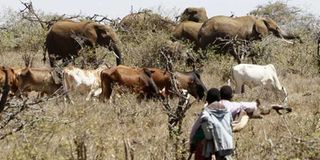
AP officers guard animals at Isiolo Stadium on October 18, 2016. On January 12, 2017, herders were attacked at the Meru/Isiolo border and 400 animals stolen by bandits suspected to be from Isiolo.
Photo credit: Nation Media Group
"Invasion of weeds has greatly reduced pasture in our range lands," said John Leshore, from Kajiado West Sub-County. "Human activities, especially farming and settlement in the indigenous range lands, has taken a toll on pastoralists."
Leshore pointed to erratic rainfall and the invasion of Ipomea and Mathenge trees as major setbacks, and said the Amboseli ecosystem, on the slopes of Mount Kilimanjaro, has absorbed the brunt of human activity that has blocked wildlife migration corridors and shrunk natural rangeland.
Rangeland, the open grassland and shrubland too dry or rocky for crop farming, is the backbone of the pastoral economy. Kenya has an estimated 8.8 million people who identify as pastoralists, managing roughly 70 per cent of the country's cattle, 100 per cent of its camels, and the large majority of its sheep and goats.
The Kajiado conference was held ahead of the global commemoration in Ulaanbaatar, Mongolia, where UNCCD COP17 ran from August 17 to 28, 2026, under the theme "Restoring Land, Restoring Hope." Mongolia originally proposed the International Year of Rangelands and Pastoralists to the UN, which is part of why the two events landed in the same country this year.
In response to the shrinking rangeland, many Kajiado herders are returning to traditional management alongside modern practice: rotational grazing through olopololi systems, community-led conservancy zoning, resting depleted pastures, and native grass seed banking run by local women. The county government has introduced a grass reseeding programme aimed at reclaiming degraded land.
Benson Amuchung, from Baringo County, said three invasive weed species have taken over rangeland in his area as climate effects intensify in an already hot county.
"Pastoralism is no more tenable," he said. "It faces a myriad of challenges. In our county we have human settlements in highlands that used to be grazing areas."
Fatima Dulo, from Garissa County, said rangelands across the Asals face compounding threats from climate change, recurrent drought, overgrazing and land fragmentation. She called for immediate mitigation, including meat and milk value addition.
A carcass of a cow in Garissa. The Kenya Meat Commission is buying animals from pastoralists to save them losses as animals continue to die due to drought. Photo/William Oeri
"Unpredictable rainfall patterns, prolonged dry seasons and frequent droughts dry up water points and kill pasture," she said. "In our county we have witnessed high concentrations of livestock on fragile dryland soils, causing severe compaction, soil erosion and loss of nutritious grass species."
Livestock Principal Secretary Jonathan Mueke, the event's chief guest, said rangelands function as both food and nutrition sources and economic engines supporting livestock production and trade. He said the International Year of Rangelands and Pastoralists gave Kenya an opportunity to renew its commitment to protecting these ecosystems while improving the livelihoods of the communities that have managed them sustainably for generations. He said the government aimed to build a coordinated national position ahead of the Mongolia commemoration.
Farayi Constance Zimudzi, representing the Food and Agriculture Organization, said roughly 80 per cent of Kenya's land area is arid or semi-arid, supporting millions of pastoralists and agro-pastoralists whose livelihoods depend on healthy ecosystems. She said the pressures facing that ecosystem, climate change, drought, degradation, competing land uses and shrinking grazing resources, require coordinated action, stronger policy, more investment and genuine participation from pastoral communities themselves.