Where does Kenya’s wastewater go when 84 per cent lack sewer connections?
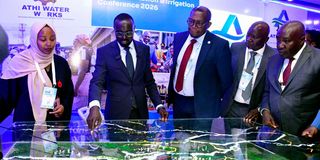
From left: Guyatu Halkano of Athi Water Works Development Agency (AWWDA), Cabinet Secretary for Water, Sanitation and Irrigation Eric Mugaa, Nation Media Group Mananing Director and CEO Geoffrey Odundo, AWWDA CEO Eng. Joseph Kamau and State Department for Water and Sanitation Principal Secretary Julius Korir at AWWDA stand during the Water Sanitation and Irrigation Conference in Nairobi on October 22, 2026.

Wastewater from homes and institutions is threatening rivers, underground water sources and food safety in Kenya.
Stakeholders in the water, sanitation and irrigation sectors have raised concerns over legal gaps and weak wastewater treatment systems.
Speaking at the second edition of the Water, Sanitation and Irrigation Conference on Friday, October 23, 2026, Alex Manyasi, Policy Engagement Manager at the African Population and Health Research Centre, explained that the Water Act needs to be reviewed to cover on-site sanitation, which the current law largely overlooks.

“The Water Act currently has focused largely on sewerage,” he said.
He warned that poor waste management, particularly outside sewer networks, risks contaminating rivers and groundwater and threatening public health.
“That is where most of the waste ends up seeping,” Mr Manyasi noted, “either in the rivers or underground.”
The 2024-2025 Joint Annual Sector (the Water Services Regulatory Board and the Kenya WASH) Report by the Ministry of Water and Sanitation, 16 per cent of the population is connected to sewerage systems and six per cent still practice open defecation.
Mr Manyasi questioned where waste ends up in a country where sewerage coverage was reported at only 16 per cent.
“So where is the 84 per cent of the waste going?” he asked.
He cited cases of women using sewage-contaminated water to irrigate downstream crops, allowing pollutants to enter the food chain and contribute to Kenya’s disease burden.
“If we make sure that no waste ends up in the waterways,” he explained, “then we will have automatically ensured that no one uses that contaminated water that ends up in our food systems.”
The sanitation concerns emerged alongside questions over the efficiency of water distribution, with nearly half of treated water failing to generate revenue for providers.
The report also said non-revenue water rose from 43 per cent to 48 per cent.
Donald Murgor, the Chairperson of the Water Resources Authority board, questioned why the proportion appeared to be rising instead of declining.
“Why is non-revenue water rising instead of declining?” Mr Murgor asked. “We should not be losing this important resource.”
According to him, the losses mean that billions of shillings invested in dams and water distribution infrastructure do not necessarily translate into reliable supplies at household level.
“The whole idea is that this water should reach the common mwananchi.” He said. “If we are harvesting water in dams and distributing, and yet it is not reaching the homes of Kenyans, then we are doing a disservice to Kenyans.”
He called for the upgrading of distribution infrastructure, including a shift from conventional PVC pipes to modern systems capable of delivering water more efficiently.
Mr Manyasi said reducing the losses could help utilities recover resources for expanding access instead of relying entirely on additional funding.
“If we cut non-revenue water by half,” he said, “we should be able to get more money to expand services and reach more people.”
CPA James Mburu, the Acting Chief Executive Officer of the Water Resources Authority, said water availability per person was also declining, falling from 647 cubic metres annually in 1992 to 452 cubic metres in 2022.
The figure is projected to decline further to 235 cubic metres by 2030.
“To achieve a water-secure country, we must protect,” he urged, “restore and conserve our catchments.”
He identified riverbank encroachment, climate change and catchment degradation as challenges requiring stronger protection and nature-based solutions.
“Better monitoring of water abstraction is also necessary.” CPA Mburu emphasized.
He further added that smart meters installed at abstraction points could help regulators monitor withdrawals in real time and investigate discrepancies between the amount extracted and what reaches consumers.
Illegal boreholes pose another challenge because authorities cannot accurately determine total groundwater abstraction when some extraction points remain unlicensed.
“Inadequate monitoring could leave cities vulnerable to shortages,” Mr Manyasi warned.
He also questioned why rainwater was often channelled away through drainage systems instead of being used to replenish underground aquifers.
The domestic concerns are shaping Kenya’s preparations for the United Nations Water Conference scheduled for Abu Dhabi in December, where the country intends to present a common position on water security and sanitation.
“We are using today’s conference to address gaps in the water sector,” My Murgor eplained, “and agree on a unified national position for presentation at the UN Water Conference in Abu Dhabi.”
The discussions come as the sector seeks substantial investment to expand water supply, improve sanitation and build infrastructure resilient to climate change.
Joel Wamalwa, CEO of the Lake Victoria North Water Works Development Agency, said achieving universal water coverage would require about Sh995 billion from different financing sources.
“The country needed bankable projects capable of attracting investors,” Mr Wamalwa said, “while addressing unequal access to water across counties.”
He also called for reforms in utility management, bulk water supply and distribution efficiency, proposing that non-revenue water be reduced from more than 40 per cent to 25 per cent.
Willis Ombai, the CEO of the Water Sector Trust Fund, said the sector needed investment-oriented financing, including blended finance, development finance and results-based financing.
“We must have a clear track to realise the money for water projects,” he said.
Mr Wamalwa said investment decisions must consider the social value of water projects while ensuring that infrastructure can be sustained financially.
“Water projects are more attractive for a social aspect than a business aspect,” he said, “we need smart metering, leakage tracking and climate-resilient infrastructure.
The State Department for Irrigation said project preparation and financial structuring would be critical in attracting investment into irrigation, which can support food production and employment.
Florence Ndai, deputy director for irrigation sector development coordination, said irrigation should be viewed as a commercial activity as well as a means of improving food security.
“Project structuring is key to making projects bankable,” she said.
She said investors needed clarity on when projects would begin generating returns and how those returns would be sustained.
Ms Ndai said developers needed to demonstrate clear revenue streams and consider credit-enhancement mechanisms to protect investments where production fails.
The competing water demands make catchment protection and equitable allocation central to the sector’s plans.
“Environmental needs should receive priority in water allocation,” CPA Mburu said, “followed by domestic consumption and other authorised uses.”