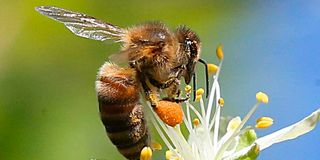
As the globe warms, Kenya’s insects are fighting for survival. At the heart of this crisis are bees, which play a crucial role in sustaining ecosystems, food systems, and livelihoods.
A new study examining more than 2,000 insect species across Kenya and Peru has found that nearly 70 percent of tropical insects are already living at the edge of their heat tolerance, with little capacity to adapt further.
Kim Holzmann, a postdoctoral researcher at the University of Würzburg, and her team found that many insects, including bees, are already operating near their thermal limits.
“We looked at a wide variety of insects, such as flies, bees, beetles, butterflies, and grasshoppers. Many are likely to face dangerous levels of heat stress,” the report notes.
Bees, producers of one of the world’s most beloved sweeteners, honey, are not only vulnerable to rising temperatures; their challenges are compounded by habitat loss. Deforestation, the conversion of agricultural land and rangelands into real estate, and the excessive use of farm chemicals are all intensifying the threat to their survival.
These are concerns that deeply trouble Christopher Nzuki, CEO of The Hive Limited and one of the leading voices in Kenya’s apiculture sector. He warns that despite bees’ immense contribution to humanity, their value remains underappreciated.
“When I see a bee, I see life itself. Even the water on the table has its roots in the work of bees. Rivers depend on forests, forests depend on seeds, and seeds depend on pollination. That chain leads back to bees,” he says.
Nzuki explains that without bees, the consequences would extend far beyond honey production. Water systems would collapse as forests decline, food production would shrink due to poor pollination, and industries such as textiles would suffer from reduced cotton production.
“The business of pollination belongs to bees. Without them, we would lack food, clothing, and even water security,” he adds.
Mr Nzuki notes that cutting down even a single tree can have devastating effects. “Every tree removed is a lost feeding station for bees. When we destroy ecosystems, we force bees to migrate or perish.”
Apart from habitat loss, bees are also facing threats from unsafe pesticide use, diseases, and changing weather patterns. Poor farming practices, particularly the misuse of chemicals, have been linked to declining bee populations and reduced honey quality.
According to Nzuki, this has a direct impact on agriculture. “Crop production depends on pollination. When pollination is poor, yields drop and quality declines. That affects farmers’ incomes and food security,” he explains.
His sentiments are echoed by the Principal Secretary for Livestock Development, Jonathan Mueke, who says Kenya is deliberately positioning apiculture as a key driver of economic growth, food security, and environmental sustainability.
“Bees are the backbone of global food systems. Over 75 per cent of crops that produce fruits and seeds depend on pollination,” says Mueke.
In Kenya, the sector presents a significant opportunity. Annual honey production currently stands at about 19,000 metric tonnes against a demand of over 43,000 metric tonnes, leaving a substantial deficit. The country has the potential to produce up to 100,000 metric tonnes annually.
“This gap is not a challenge; it is an opportunity,” Mueke notes, adding that it represents a multi-billion-shilling industry that can transform rural livelihoods.
The sector already supports more than 200,000 households, with nearly 80 per cent of production coming from ASAL regions.
However, PS Mueke warns that the threats facing bees must be urgently addressed. “Climate change, habitat loss, and unsafe pesticide use are putting immense pressure on bee populations. Protecting them is not optional; it is essential,” he emphasises.
A colony of bees around the queen.
Photo credit: Pool I Nation Media Group
In tropical regions like Africa, where temperatures are already high, even slight increases could prove fatal. Extreme heat can kill insects within seconds, while prolonged exposure to lower levels of heat stress can reduce reproduction and lead to population decline.
Insects make up about 90 per cent of all animal species on the planet, most of them found in the tropics—the regions around the equator. They form the foundation of ecosystems, playing essential roles in pollination, soil health, and food chains. The loss of bees and other pollinators would not only disrupt ecosystems but also threaten agriculture and human survival.
However, according to Mueke, efforts are underway to strengthen the sector through partnerships with organisations such as the Food and Agriculture Organization (FAO), capacity-building programmes, and improved market systems.
Bridging the honey gap in Kenya, Nzuki says his company, The Hive Limited, is supporting farmers across the apiculture value chain by conducting feasibility studies, supplying modern beehives, installing them, and training farmers on best practices.
“We also provide ongoing technical support, helping farmers manage colonies and harvest sustainably,” he says. Farmers are trained on safe pesticide use, pest management, and the importance of maintaining floral diversity.
Currently, The Hive Limited works with about 15,000 farmers across the country, in regions including Turkana, Wajir, Mandera, Machakos, Kitui, Makueni, Tana River, and the coastal belt.