A lush green fruit farm with rows of trees bearing golden mangoes and other fruits like hidden treasures welcomes you to Vincent Sibilo’s farm in Kamoskoi village, Baringo South.
Juicy apples peek out from behind clusters of leaves, and bright orange citrus fruits add splashes of colour, thanks to the incredible transformation that the farmer has brought about on his two-acre plot.
The air is thick with the sweet, earthy scent of ripening fruit and damp soil. It's truly a marvel and a testament to the farmer’s vision because just beyond its borders lies a stark, parched landscape that makes this leafy haven seem like a mirage.
Sibilo started fruit farming in 2013 and registered his farm as Kamoskoi Integrated Organic Farm (KIO) in 2017. As well as planting different varieties of mango, orange, papaya and banana, he also cultivates maize and cassava and practises fish farming.
He said that what motivated him to start the bee business in 2017 was that the bee population in the region had diminished due to environmental pollution, and that there was a need to rear bees.
He also said that his fruit farm was a good home for the bees because they could find flowers there.
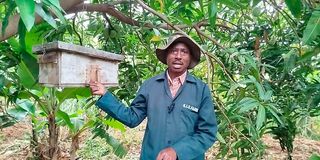
“I started selling bees in 2017, setting up five catcher boxes on my farm. During the dry season, this semi-arid area is very dry, and there are very few bees because they cannot find flowers. I realised that this was a unique opportunity because I already had a successful organic farm and the bees could find food even during the dry season, as I have access to water and my farm remains green,” said Mr Sibilo.
He said that when fruit is overripe, the bees feed on it, meaning that nothing on the organic farm goes to waste because everything depends on each other. For instance, without bees, there would be no pollination, and the bees would also starve.
"I was also inspired by the fact that the bee population in this region was dwindling due to environmental pollution caused by the excessive use of chemicals by farmers practising irrigated agriculture, which scares away and kills the bees. I realised that there were fewer bees than in previous years, so I saw this as an opportunity to start a business, as some farmers had lots of beehives with no bees,” he added.
After setting up the catcher boxes, the bees started to flock in, prompting him to decide to sell the bees to farmers to make a living.
Vincent Sibilo at his farm in Kamoskoi village, Baringo South, on January 18, 2026.
Photo credit: Florah Koech | Nation Media Group
“As I said, my farm is organic and natural. We don't use any chemicals, so it's a good environment for bees to thrive in. The honey I produce on my farm is organic as well,” he added.
According to the farmer, he sells the bees depending on how many are caught in the catcher boxes. For instance, if the catcher box is Langstroth, he transfers the bees to a similar beehive to avoid confusing them and causing them to disappear due to the change of environment.
“The catcher box should match the beehive that the bees will be transferred to after they have matured. For example, when I sell bees in a Langstroth catcher box, I make sure that the farmer I am selling them to has a Langstroth beehive, and I usually train them on how to prepare the beehive in anticipation of receiving the bees. The business thrived,” said the farmer.
He said that he started by selling to farmers in Kamoskoi and Loboi villages, and gradually expanded his bee-selling venture to other areas and regions.
“When I sell bees, I take the catcher boxes to the buyer's farm and leave them there for three to four days to acclimatise before transferring them to the beehive. During this time, I also ensure that the bees do not leave the hive, as this would result in a loss for the buyer. It would be unwise for me to supply bees that later leave the hive,” he explained.
The farmer sells the bees at different rates depending on the distance travelled and the type of beehive. The bees are also sold in colonies.
“In any family of bees, there is a queen, and they multiply owing to the good environment. After a few days, there are so many bees in the catcher boxes. The bigger the catcher box, the longer it takes for the bees to mature for sale, and vice versa. Small catcher boxes take three weeks for the bees to be ready for sale,” said Sibilo.
“Prices depend on the distance. If it is a long distance, the price will be relatively high, ranging from Sh10,000 and above. For local supply, I sell them at Sh4,000 per catcher box. The type of beehive also affects the selling price; for example, Langstroth hives produce a lot of honey, so the price is high,” he added.
The father of five noted that, since starting the business, he has earned more than Sh200,000 from selling bees, with more than 20 catcher boxes on his farm.
"Apart from selling bees, I catch them here and take them to my new apiary, which has more than ten beehives. My goal is to have more than 100 beehives in the future so that, in addition to selling bees to other farmers, I can also produce honey,” the farmer noted.
He added that when transferring bees, one must have the right gear and knowledge to take the necessary precautions when handling the catcher boxes.
“When I transfer the bees from the catcher box to the beehive, I make sure that I am wearing the correct protective clothing. I also make sure that I put them back where they were to avoid disturbing them,” he noted.
One of the challenges he faces is that some local farmers use pesticides on their farms. When the bees smell the pesticides, they abandon the beehives.
“During the rainy season, the bees also flee to other areas to avoid the cold. Bees can also become aggressive and bite animals or people in the area. Some people can also invade the farm and steal or destroy the catcher boxes,” he said.
He said that the KIO farm is known locally and internationally, which has led to him hosting visitors and farmers from far and wide.
“When I started the farm 13 years ago, it was only known locally, but after registering it four years later, a lot of people came here to benchmark. The first visitors were from the Ethiopian government in 2015, who came to learn about my work. In 2016, I also participated in an exchange programme, visiting their country. Farming has taken me places,” said Sibilo.
In 2018, he had the opportunity to tour Europe after hosting foreign visitors on his farm.
The farmer has won several accolades, including a 2019 award from the Baringo County government for being a food security champion and a climate-smart farmer doing something unique in the region.
“In 2020, several farmers from Tiaty, Turkana and Makueni visited my farm for benchmarking. In 2022, I hosted the national celebration of World Food Day here on my farm, and I sell a lot of farming ideas online,” he noted.
He also advised farmers to look for enquiries before venturing into the business to ensure they are doing the right thing.
“If you want to start a business, you can come here for benchmarking, and I will show you how to do it properly. You can have the beehives, but you won't be able to keep the bees. I do charge for this service because nothing is free,” Sibilo noted.
“We need more farmers in this region who can run this kind of business so that we can supply bees to other farmers and achieve our goal of becoming the best honey producers. You can also bring your beehive to this organic farm, where your supply will meet your demand,” he added.