Wife’s death from cancer fuels Kiambu farmer’s push for pesticide-free food
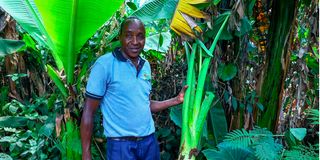
Agroecologist Paul Mwaniki Kihara displays a freshly harvested arrowroot from his farm in Githunguri Sub-County, Kiambu County, on November 3, 2026.

On a small farm in Githunguri, Kiambu County, old car tyres, broken washing basins, sacks, shopping baskets, and gumboots are filled with soil and growing vegetables.
Paul Mwaniki has set up six vertical gardens and other planting spaces on his land. He says they produce about four kilogrammes of vegetables a day, sold at Sh50 per kilogramme. His seven-member household eats from the farm and sells the surplus.
“If you do not have money to buy vertical gardens, which are very expensive, you can use locally available materials. You can use old bottles, wood, car tyres and even containers that would otherwise be thrown away or burnt. Put soil in them and plant your vegetables,” he told Climate Action.


He says the approach works well for urban and peri-urban households that have no conventional farming land but want to grow food for their families. His farm doubles as a learning centre for them.
Farming with what is at hand
Mwaniki practises agroecology, an approach that applies ecological principles to food production and works with nature rather than against it. It brings together crops, trees, livestock, soil management, biodiversity and water conservation, and also considers farmers’ knowledge, access to resources and nutrition.
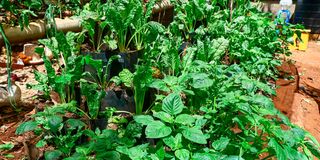
Leafy vegetables thrive in a vertical bag-gardening system at agroecologist Paul Mwaniki Kihara’s farm in Githunguri Sub-County, Kiambu County, on November 3, 2026.
Unlike conventional systems that lean heavily on synthetic fertilisers and pesticides, it encourages farmers to use local resources, recycle organic waste and cut dependence on costly inputs.
On his farm, that means indigenous vegetables such as amaranth (terere), black nightshade (managu/sucha), spider plant (saga) and cowpea leaves (kunde), alongside spinach, sukuma wiki, cabbages, pepper, dragon fruit and thorn melon.
He improves soil fertility with compost and livestock manure, mixing animal waste with dry and green material before applying it. For pests, he prepares mixtures from aloe vera, garlic, pepper and pawpaw leaves. Mexican marigold (mũbangi in Kikuyu) and other indigenous plants are planted among the vegetables to repel pests.
“When somebody practises agroecology at home, they know the food they are eating is fresh from the farm. We also train farmers on using organic pesticides made from aloe vera, garlic, pepper, papaya leaves and even rabbit urine,” he says.
He also keeps dairy goats, ducks and chickens. The goats give about four litres of milk a day. Two litres are sold at Sh150 per litre and the rest is drunk at home.
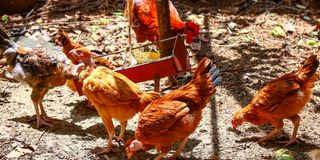
Hens feed at agroecologist Paul Mwaniki Kihara’s farm in Githunguri Sub-County, Kiambu County, on November 3, 2026.
To cut feed costs, he grows fodder trees, among them Calliandra and Gliricidia. Their leaves are harvested, dried and ground at a posho mill into feed. The trees also fix nitrogen in the soil and serve as farm boundaries, windbreaks and fencing material.
“The trees also offer other benefits, including farm boundaries, windbreaks and materials for fencing,” he says. Integrating trees, he adds, lets farmers make productive use of limited land while improving the environment.
Rainwater harvesting systems on his rooftops store water for dry periods, when access to water can limit household food production. He also keeps bees, which bring in income from honey and pollinate his crops.
“When we are doing agroecology, we cannot sit back and say God will do everything without taking action. We must embrace climate-smart agriculture. Without a strong foundation, there is no food security,” he says.
What changed his mind
Mwaniki says his shift away from conventional farming began in 2017, when his first wife died of cancer.
“One of the key factors that made me start encouraging our community and other farmers to practise organic farming was my experience in 2017. My first wife died from Cancer. After she was examined by specialists, I was informed that she had been exposed to pesticides for a long time,” he explains.
Agroecologist Paul Mwaniki Kihara displays a freshly harvested arrowroot from his farm in Githunguri Sub-County, Kiambu County, on November 3, 2026.
The loss pushed him to start practising agroecology on his own farm and to share what he learned with other households in Githunguri and neighbouring areas.
Training women and youth
Women and youth groups make up a large part of his training work. He says he favours working with women because of their central role in household food preparation and nutrition. He encourages families to understand where their food comes from, how it is produced and why balanced diets matter.
Mwaniki is a trained Usawa Captain under The Institute of Social Accountability (TISA), which works with farmers on gender-transformative approaches in agri-food systems. The programme focuses on four value chains: dairy, poultry, avocado and bananas. Usawa Captains act as community ambassadors, sharing information and encouraging practices that improve livelihoods and promote gender equality.
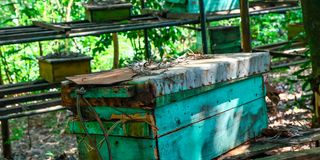
Beehives at agroecologist Paul Mwaniki Kihara’s farm in Githunguri Sub-County, Kiambu County, on November 3, 2026.
He also works with United Daughters of Greatness, a group of young mothers from Githunguri who quit alcohol and drug abuse and now practise climate-smart agriculture. Together they reach farmers and households with information on sustainable agriculture, food production and climate resilience.
His work has drawn visitors and partners. In 2023, he says, he hosted a delegation from different countries interested in the practical interventions being made at community level, facilitated through the Kenya Forest Service office in Githunguri.
He also hosted the Netherlands Deputy Ambassador to Kenya and his delegation.
“Following the engagement, a partnership involving Trees for Kenya introduced a carbon credit project that has created opportunities for farmers in our community,” Mwaniki says.
The young people he mentored
His mentorship of young people has grown into an organised initiative. Stanley Kihara, project manager at Agritech Empowerment Network Kenya (AEN Kenya), credits Mwaniki with shaping their path into conservation and sustainable agriculture.
Kihara says they began as a group of young people interested in climate change, environmental conservation and agroforestry. At the time he was working with an organisation involved in sustainable agriculture when they met Mwaniki, who took them through different farming practices.
“He has been our mentor for a very long time. We started as just a group of youths, and when we met him, we were passionate about environmental conservation, climate change and sustainable agriculture,” Kihara told Climate Action.
The group formed the Africa Food Forest Foundation in 2017, a community-based organisation with about 16 members in Githunguri. In 2023 it became AEN Kenya, a registered NGO. It is now running a carbon project in Kiambu, with plans to extend to Murang’a and Nyeri counties. The initiative targets more than 7,000 farmers across about 40,000 hectares.
The group concentrates on indigenous and fruit trees, alongside nitrogen-fixing species such as Calliandra, Gliricidia and Leucaena, which improve soil fertility, provide fodder and serve as windbreaks and boundaries. Kihara says members now train other farmers themselves.
“We want farmers, particularly young people, to take charge and start practising agroecological methods. One of the methods Mwaniki taught us is agroforestry, where you integrate crops with trees,” he urges.
A regional nomination
Mwaniki’s work has now earned him a nomination for the East African Business Golden Mega Award, in a category recognising men who advocate gender-transformative approaches in agri-food systems through agroecology. The competition has 71 categories, with nominees from Kenya, Uganda, Tanzania, Rwanda, Nigeria and Colombia, among others.
He says the nomination follows years of voluntary work training farmers, particularly women and young people. “I do not take the award nomination lightly.
Whatever we do, God has a reward. I have been working in the community since 2009, and in 2026, I feel that God has answered my prayers,” he says.
His work was also acknowledged a few days ago at the launch of Kiambu County’s agroecology policy. Deputy Governor Dr Rose Kirika presented him with a copy of the policy and encouraged him to serve as its flag bearer.
Follow our WhatsApp channel for breaking news updates and more stories like this.


