Hundreds of learners previously displaced by banditry attacks and floods in Baringo South are struggling to access quality education as the schools hosting them grapple with overcrowding, crumbling infrastructure and a severe shortage of basic amenities.
The worsening crisis has alarmed local leaders and residents, who are now calling for urgent State intervention warning that schools in the region have reached breaking point. Continued neglect, they say, threatens not only academic performance but also the safety and wellbeing of children already traumatised by years of insecurity and displacement.
Among the hardest hit are Sabor Secondary School and Kimorok, Arabal, Kasiela and Noosukro primary schools. In some of these institutions, learners attend classes under trees, while others sleep in overcrowded iron-sheet dormitories.
At Sabor Secondary School now a refuge for learners displaced by banditry attacks in neighbouring villages, congestion and inadequate facilities have pushed the institution beyond its limits.
A girls dormitory at Sabor Secondary School in Baringo South. The iron-sheet structure is congested and the students share beds.
Photo credit: Florah Koech | Nation Media Group
According to Board chairperson Ms Sarah Taiwa, the school is currently hosting about 230 students, including many who fled insecurity in villages around Kimalel, Kimorok, Koriema and Sabor.
Despite steady improvement in academic performance she said learners continue to study and live in harsh and unsafe conditions.
“Our school was identified to host learners previously affected by insecurity who sought refuge in villages around Kimalel, Kimorok, Koriema and Sabor. Although performance has steadily improved, the students are learning and living in deplorable conditions,” said Ms Taiwa.
Students are now sharing beds in temporary iron-sheet dormitories while classrooms, sanitation facilities and furniture remain grossly inadequate for the growing population.
A persistent water shortage has further deepened the crisis, forcing learners to trek long distances to seasonal streams especially during dry spells in search of water.
“We appeal to the government to help us construct modern classrooms and dormitories and also sink a borehole. Learners waste valuable study time searching for water,” Ms Taiwa said.
Residents say the school has effectively become a rescue centre for children displaced by banditry and conflict.
Mr Justine Chebii, a local resident, urged the government to urgently expand the institution’s infrastructure to accommodate the rising number of learners seeking refuge there.
“This school has accommodated many children previously affected by banditry, but the facilities are overstretched and dilapidated. More classrooms and dormitories are urgently needed,” he said.
Another resident, Mr Mark Kebenei, called on the Ministry of Education to prioritise schools in regions affected by insecurity and climate-related disasters such as flooding.
“We are appealing for urgent support to expand facilities at Sabor Secondary and rebuild schools destroyed by banditry and floods. Children in these areas deserve the same learning opportunities as those in other parts of the country,” he said.
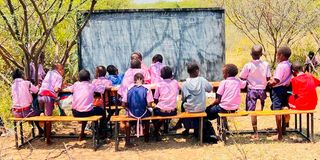
Noosukro Primary School in Baringo South, on the shores of Lake Baringo, has been swallowed by rising water levels, forcing learners to study under trees.
Photo credit: Florah Koech | Nation Media Group
Several other schools in the region still bear the scars of years of insecurity, despite relative calm returning to parts of the area.
At Arabal Primary School, armed bandits reportedly vandalised classrooms, stole more than 14 solar panels and destroyed the school’s charging system after residents fled repeated attacks.
Some classrooms were allegedly turned into cowsheds by raiders while books in the library were destroyed after the facility was broken into.
Ng’elecha Primary School suffered a similar fate with structures flattened after armed raiders reportedly occupied the deserted institution for years.
Although calm is gradually returning to some villages and displaced families are beginning to resettle, many schools remain in ruins.
Mr Kebenei said institutions such as Arabal, Chemorong’ion and Kasiela primary schools are still operating in severely deteriorated conditions.
The education crisis has been further worsened by rising water levels in Lake Baringo which have submerged several schools in flood-prone areas.
At Noosukro Primary School, more than 90 pupils have been learning under trees since September last year after floodwaters swallowed the entire institution.
A parent Jones Lekatai said lake levels began rising steadily in July following heavy long rains, eventually submerging classrooms, teachers’ houses, latrines and the playground.
“All the school structures are now nearly 300 metres inside the lake, and even the rooftops are almost covered by water. We salvaged desks and books and moved them to Noosukro dispensary, where the children are now learning under trees,” he said.
School chairman Philemon Lemira said the institution has repeatedly been displaced by floods over the years, forcing learners to relocate whenever water levels rise.
“In 2020, the same thing happened and learners had to study under trees. Despite being among the worst affected schools, we were not included in the government relocation programme. We are appealing to the State to relocate and rebuild the school on higher ground,” he said.
A woman arranging her clothes at Kapindasum Health Center on March 20, 2026.Dozens of families that had been displaced by bandit attacks returned to their desolate villages after normalcy returned, only to find their houses vandalised and torched by armed criminals, forcing them to crowd at the incomplete health facility.
Photo credit: Florah Koech | Nation Media Group
He added that learning is frequently disrupted by rain and strong winds from the lake, forcing pupils to seek shelter inside a nearby dispensary.
Locals warn that unless urgent intervention is taken, children in the troubled region risk falling further behind academically due to the combined effects of insecurity, displacement and climate-related disasters.
They are calling on both national and county governments, development partners and humanitarian agencies to urgently rebuild damaged schools, improve infrastructure and relocate flood-prone institutions to safer ground.