The silence at Nginyang’ Livestock Market in Tiaty Central, Baringo County, is as loud as the losses it has left behind.
For a month now, the once-bustling marketplace, where thousands of goats, cattle and camels changed hands every Monday, has stood deserted. Its closure was triggered by an ongoing security operation to flush out armed criminals and seize illegal firearms.
In its wake, more than Sh40 million in livestock sales has evaporated, dealing a heavy blow to Baringo County’s economic lifeline.
County officials say the devolved unit has also lost over Sh800,000 in revenue during the same period, exposing the fragile balance between security interventions and livelihoods in Kenya’s arid regions.
It is one of 32 livestock trading hubs in Baringo and among the most lucrative, anchoring an economy where pastoralism is the backbone of survival.
On a typical market day, over 2,000 goats, alongside cattle and camels, are traded, generating more than Sh10 million in sales and about Sh200,000 in county revenue.
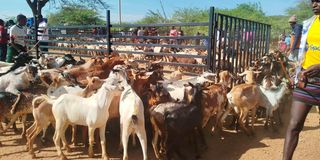
A trader loading a goat he had bought at Nginyang' market, Tiaty to a lorry on December 15, 2025. The facility has remained shut since February after it was closed due to the ongoing security operation targeting to recover illegal guns and apprehend suspected criminals.
Photo credit: Florah Koech | Nation
“In a week, we collect more than Sh10 million from livestock sales. Over the one month the market has been closed, we have lost more than Sh40 million in sales and Sh800,000 in revenue,” said County Director of Revenue Sammy Kibor.
Annually, the market accounts for more than Sh120 million in livestock sales and over Sh9 million in county earnings.
The closure has fractured an entire value chain. Transporters, butchers, brokers and small-scale traders who rely on the weekly rhythm of the market are now stranded.
With no alternative hub of comparable scale nearby, many are forced to travel long distances at higher costs or suspend operations altogether.
There are also growing fears that the absence of a regulated marketplace could push desperate farmers into informal and illegal trading channels, potentially undermining both security efforts and county revenue collection.
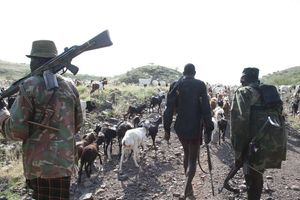
Residents recall the day the market fell silent after armed security officers, backed by armoured vehicles, descended on the area and ordered an immediate evacuation.
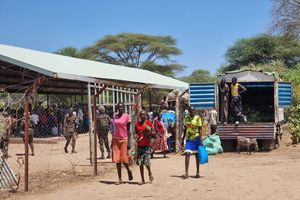
Traders selling their goats at the Nginyang' livestock market in Tiaty on December 15, 2025.
Photo credit: Florah Koech | Nation
“Since then, no trader has returned. We suspect criminals being pursued were hiding among traders. The government was right to target criminals and seize illegal firearms in banditry-prone areas, but closing a livestock market that sustains the community is a major setback. The closure has damaged the local economy,” said Mr Yuda Losutan, a resident of Nginyang’ village.
For communities already grappling with harsh climatic conditions, the shutdown has cut off a critical lifeline.
“We depend entirely on livestock to feed our families, pay school fees and survive. Now we have nowhere to sell. At this rate, we risk starvation,” Mr Losutan said.
Traders from outside the county are equally affected. Mr Enosh Osoro, who travels from Kisii to buy livestock in bulk, says the closure has crippled his business.
“This is the largest livestock market in the region. When it closes, everything stops. On the day of the shutdown, some traders lost animals in the chaos. Others had deals collapse, and many are yet to recover,” he said.
Women, who form a significant portion of small-scale traders, have been disproportionately hit. Many rely on the market to sell goods and support their households.
“This market sustains families. When it closes, the losses are not just financial; they are social. Women cannot provide for their homes,” said market chairperson Priscah Atolim.
County Livestock Director Richard Bundotich estimates that farmers typically sell about 4,000 goats, 100 cattle and 30 camels weekly at Nginyang’, earning roughly Sh10 million.
Goats being sold at the Nginyang' livestock market in Tiaty on December 15, 2025.
Photo credit: Florah Koech | Nation
The ripple effect of losing such a market is immense in a county that supplies over 70 per cent of Kenya’s beef.
Yet even as frustrations mount, there is cautious acceptance of the need for security.
“We want peace. Disarmament is necessary,” said Tiaty Central Sub-county Administrator Moses Akeno. “But we hope the market will reopen once order is restored.”
Residents and leaders are now calling for a middle ground—one that allows security operations to continue without paralysing economic activity. Proposals for a phased reopening under tight surveillance are gaining traction, though no timeline has been given.
Until then, Nginyang’ remains a stark symbol of the cost of insecurity: a quiet market, empty pockets, and a community waiting—uncertain—for normalcy to return.