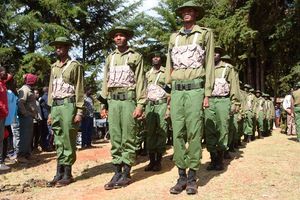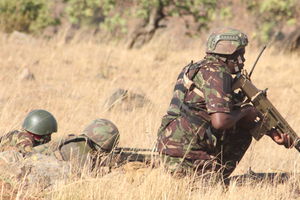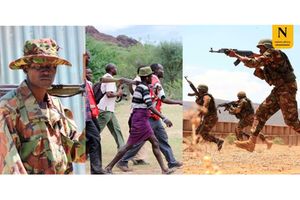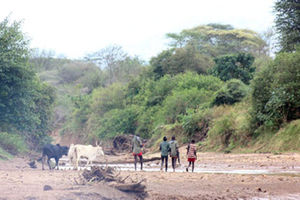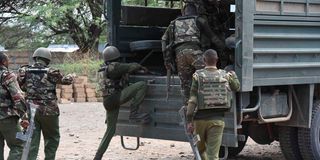
Police from the Rapid Deployment Unit who responded to an attack by bandits at banditry in Baringo North, Baringo County on March 17, 2023.

Early this year, incessant flare-ups erupted in the insecurity-prone Kerio Valley, leading to the killing of more than 22 people in Baringo and Elgeyo Marakwet counties.
The runaway insecurity also led to the loss of livelihoods and the displacement of hundreds of people from their homes after they fled to safer areas for fear of more attacks.
Among those killed was a Catholic priest, Allois Cheruiyot Bett, who was shot dead in Kabartile village in insecure Tot in Kerio Valley.

The late Father Allois Cheruiyot Bett.
According to police, the cleric, attached to St Mathias Mulumba Church in Tot Parish, was accosted and fatally shot by armed assailants.
The incident happened when the priest was on his daily Jumuiya service in the village, and as he was returning to the parish headquarters in Tot, he was accosted by unknown armed criminals who shot him dead on the spot.
The incident happened barely a week after two non-locals—a mechanic and a worker at a construction site—were shot dead in two different incidents in Tot and Chesongoch areas.
The killings sparked a mass exodus of non-locals working in the area, who seemed to be targeted by armed criminals on suspicion that they were spying on them and giving information to relevant authorities.
Following the flare-ups, development works—including the Maron-Sobow and Ketut-Mokoro water projects and the Mulwaber irrigation project—were paralysed as workers, most of whom were non-locals, fled for their lives.
The flare-ups forced the State to impose a dusk-to-dawn curfew as part of the measures to arrest the armed attackers wreaking havoc and restore sanity.
The government also deployed the military and the General Service Unit (GSU) to aid in security operations in the affected areas, supplemented by a multi-agency team.
More than 17 people in Baringo North, among them a Tiaty chief, Victor Sebei, were also shot dead, and scores of others left nursing gunshot injuries.
On April 28, two people also lost their lives in another incident when armed criminals attacked a convoy at Sibilo Lions junction, which was being escorted by security officers attached to the Rapid Deployment Unit (RDU) while heading to Chemolingot in Tiaty to Marigat town in the neighbouring Baringo South Sub-county.

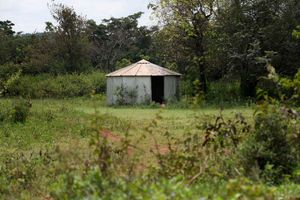
Deserted Centre-One trading centre in Mochongoi, Baringo County, which has been frequently attacked by bandits.
The incident happened barely a week after two people—a lorry driver and a trader—were shot dead and another seriously wounded after they were ambushed in a bandit attack in Loberer along the same road.
Following the resurgence of attacks in the region, the State put in place a raft of measures to tame the insecurity menace, among them an intelligence-led security operation conducted by a multi-agency team to arrest the perpetrators and seize illegal guns in the hands of civilians.
For six months now, uneasy calm is slowly returning to the insecurity-prone area that had earned the name “valley of death” due to incessant flare-ups, with residents beginning to go about their normal activities—thanks to the security operation rolled out by the government to restore order.
Over the years, the State used to roll out forceful disarmament exercises in the banditry-prone North Rift, but despite the deployment of multi-agency teams to disarm civilians, the gun mop-up rarely bore fruit because more attacks were reported and communities continued to smuggle illegal guns.
Security experts had also warned that the State could not achieve its target of gun seizure without mapping out target areas, recommending a change of tactic and a marshal plan in the affected villages.
This year, the government resorted to changing tactic in restoring sanity in the insecurity-prone villages and opted for an intelligence-led operation where they targeted suspected criminals instead of entire communities.

Interior CS Kipchumba Murkomen (right), Rift Valley Regional Commissioner Abdi Hassan (left) and other security chiefs at a Kampi Samaki Hotel in Baringo where a security meeting was to be held on May 2, 2025.
On a tour to Marigat and Kabarnet towns in Baringo County a month ago, Interior CS Kipchumba Murkomen indicated that through the mechanisms put in place by the government, sanity had been restored in the troubled Kerio Valley.
According to the CS, more than 600 illegal guns have been voluntarily surrendered by locals in Kerio Valley, with 300 of them from Baringo County.
“Some counties in the North Rift were ungovernable courtesy of the archaic stock theft and banditry, but because of the efforts put in by the State, normalcy has been restored in the affected villages,” said CS Murkomen at the time.
“We will make sure that all guns in the hands of civilians are seized so that locals live in peace. We will also not compromise with political leaders who sabotage the process. There will be no public participation in matters of gun seizure or any negotiation whatsoever. The operation shall be intelligence-led,” added the CS.
Elgeyo Marakwet County Police Commander Peter Mulinge said they rolled out an intelligence-led operation targeting suspected criminals, who were required to surrender the illegal arms in their possession.
“The operation was successful because we took time to map out the affected areas and to identify the suspected armed criminals instead of targeting the entire community. We managed to arrest a number of them, who voluntarily surrendered the illegal guns they were holding, and the county and national government helped them get alternative livelihoods,” said Mr Mulinge.
“We also engaged the community so they could assist us with information on what was happening in the villages. We guaranteed the locals their safety once they surrendered the illegal guns, and the tactic worked because we managed to recover more than 300 guns in a span of three months and arrest more than 20 suspects linked to the incessant attacks that have led to loss of lives, property and livelihoods,” he added.
Rebuilding lives
He confirmed that sanity has been restored in the once-troubled area and locals are going on with their daily activities. With the assistance of national government officers, including chiefs, they were able to carry out peace meetings in the region and sensitise locals on the importance of peace-building.
The multi-agency team carrying out security operations in the banditry-prone areas, supplemented by national police reservists, managed to flush out armed criminals and secure the places—a move that restored sanity and prompted displaced locals to return home.
In March last year, for instance, the multi-agency security team carrying out operations in Baringo County bombed the volatile Tandare Valley, one of the areas mapped out as a bandit hideout in Baringo South.
According to Baringo County Police Commander Julius Kiragu, with the assistance of the multi-agency team, they also carried out aerial surveillance which helped trace areas where armed attackers hid.
Colonel (Rtd) Moses Kwonyike, who served as a military advisor and head of the United Nations African Mission in Darfur, said the government got it right this time by changing tact in peace-building in the war-torn North Rift.
“The government has now succeeded in combating insecurity in the North Rift because the security operation they carried out was intelligence-led — a bottom-up approach. This surprised everybody because the government did their assignment well; they targeted the perpetrators and knew how many guns they had and where they were hiding,” said Col (Rtd) Kwonyike.
He said that in the past, culprits often escaped the police dragnet because they collaborated with chiefs, but this time, the State also compelled chiefs to produce suspects and guns.

Security officers along Loruk- Chemolingot road with dozens of livestock they recovered at Lemuyek Hill in Tiaty on April 10, 2023 following a raid by bandits at the porous Ng'aratuko village in Baringo North. There are a few police posts and camps in remote parts of the region, mainly at the sub-county headquarters, which means bandits have a field day in the border villages of Baringo South and Baringo North.
“That was the best approach to a successful disarmament exercise. In the past, the State rushed to roll out operations without gathering enough information on where the guns were or who possessed them. This time, the State even knew who had stolen livestock the previous day, and they went for them,” said the ex-soldier, who has long opposed forceful disarmament.
David Cheserek, a local from Tot, lauded the ongoing operation, saying they can now go about their daily activities without fear of attacks by criminals.
“During the flare-ups that claimed the life of a Catholic priest, we could barely sleep because armed attackers roamed the villages. The intensive patrols and operations that saw the arrest of notorious suspects restored calm… some schools that had closed have resumed, and non-locals who had fled have also returned,” said Mr Cheserek.
“We appeal to the government to seize all illegal guns in the affected villages to tame perennial bandit attacks and stock theft once and for all. The proliferation of arms in this region is the biggest impediment to peaceful co-existence among neighbouring communities,” he added.
Esther Pkemoi, another local from the insecurity-prone Chesongoch village, said the resurgence of attacks had dealt a big blow to development in the area, as residents could not engage in meaningful activities for fear of being attacked by armed criminals.
“When flare-ups erupted early this year, we fled to safer areas for fear of our lives, a situation that paralysed learning and normal activities. I am a farmer, and I had to leave my three-acre maize farm under irrigation in ruins. We thank God that after the arrest of the suspects, normalcy has returned and we can now live without fear,” said Ms Pkemoi.
Richard Chepchomei from the insecurity-prone Chemoe village in Baringo North also said the State’s approach in targeting criminals and seizing illegal guns was the best, as opposed to targeting the entire community as in the past.
“The criminals used to ridicule us because when they heard of an impending disarmament, they would flee to far-flung villages where they could not be traced, leaving innocent civilians—including women and children—to suffer in the hands of security officers. This time, the bandits were smoked out of their hideouts and had to surrender the illegal guns,” said Mr Chepchomei.
Follow our WhatsApp channel for breaking news updates and more stories like this.