From the road, it looked like an ordinary family home.
But when police arrived at the compound in Kaprogonya village on the outskirts of Kabarnet town on Monday afternoon, they found a home protected by layers of walls, gates and guard dogs. Hidden beneath its bathroom was an underground chamber containing more than 1,000 litres of a substance suspected to be ethanol.
The operation was triggered by intelligence about a suspected illicit alcohol dealer popularly known as Targok.
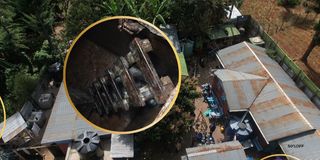
One of the many gates at the house of a suspected notorious dealer commonly referred to as Targok after police and local administration raided the house in Kaprogonya, on the outskirts of Kabarnet town on September 14,2026.
Photo credit: Florah Koech | Nation
By the time Baringo Central Deputy County Commissioner Joseph Ng’eny, accompanied by sub-County Police Commander Robert Odongo, police officers and chiefs, reached the compound, the suspected dealer had disappeared.
Police believe she spotted their vehicle approaching and escaped through one of several exits within the compound.
On a chopping board were freshly cut tomatoes and onions, while cooking oil sat beside a gas cooker and peeled potatoes lay in a basin, an ordinary domestic scene moment before police began searching the property.
But the officers had come looking for something else. They had intelligence that the suspected dealer was hiding illicit liquor and chemicals in an underground chamber somewhere inside the compound.
For nearly two hours, officers searched room after room. They tapped floors with metal objects, listening for the tell-tale sound of a hollow space beneath them.
A toilet serving as a bunker which was discovered following a police raid at the house of a suspected notorious brewer and dealer in Kaprogonya, on the outskirts of Kabarnet town in Baringo Central on September 14, 2026.
Photo credit: Florah Koech | Nation
Inside a bathroom, officers noticed a section of tiled floor that did not quite look right. Beneath it was a concealed manhole.
What appeared to be part of the bathroom was, in fact, the entrance to an underground bunker. A ladder led into the chamber, where officers found more than 40 containers, each holding 25 litres of a substance suspected to be ethanol. The estimated haul was more than 1,000 litres.
The underground chamber had been constructed like a septic tank, with its entrance covered in tiles to make it appear like an ordinary section of the bathroom.
For police, the discovery explained why previous attempts to catch the suspected dealer with illicit liquor had yielded little. The operation, they said, was not simply taking place inside a residential house. It had been concealed behind walls, gates, guard dogs and an underground store.
“At first look, you may think that this is a residential house, but when we entered, we realised it was an industry for brewing illegal liquor,” said Mr Ng’eny.
He said police had received intelligence on how the operation was conducted and where the liquor and chemicals were concealed.
“Without the intelligence, we could not have found the bunker because it had been concealed with tiles to look like a bathroom,” he said.
Police also recovered plastic bags containing processed liquor, which they said was allegedly sold to customers through a small opening in one of the perimeter walls.
A home built to keep outsiders out
The compound's security appeared designed to make it difficult for outsiders to establish what was happening behind the walls. The main gate was firmly locked, while a roughly three-metre concrete perimeter wall surrounded the property.
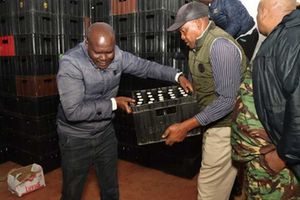
Baringo Central Deputy County Commissioner Joseph Ng'eny displays some of the illegal liquor recovered during a raid at the house of a notorious brewer 'Targok' at Kaprogonya on the outskirts of Kabarnet town, Baringo Central on September 14, 2026.
Photo credit: Florah Koech | Nation
Beyond the first barrier were more gates leading further into the compound. Guard dogs were kept in a pen near the entrance, while another fence surrounded the main house.
The most elaborate concealment, however, was beneath it. Some of the containers recovered from the compound were labelled as wood preservatives, while others were marked as battery acid.
Police said the substances would be taken to the Government Chemist for analysis to establish exactly what they contained.
Mr Ng’eny described the chemicals as dangerous and urged residents, chiefs and village elders to provide information on people involved in the manufacture and distribution of illicit alcohol.
He said police would also investigate the source and transportation of the chemicals, including claims that some had been brought from a neighbouring country through Eldoret.
A sharp knife was also recovered beneath a pillow in one of the rooms, where police suspect someone guarding the consignment may have been sleeping. But the main target of the operation was nowhere to be found. She had escaped.
For residents of Kaprogonya, however, the significance of the raid goes beyond the hidden bunker, the suspected ethanol and the elaborate security around the compound.
They say the discovery has brought back memories of years of deaths and social problems they associate with the illicit liquor trade.
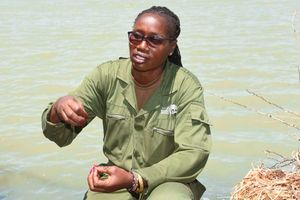
Ms Jane Legek said her own family had paid a heavy price. Her grandmother had nine sons. Eight are now dead, and she attributes their deaths to consumption of illicit liquor.
“My grandmother had nine sons. All of them, except one, have died after consuming the same liquor over the years. Only one is remaining. My brothers have also died, and now our children are also trooping to the house for the same liquor. Where are we heading?” she asked.
Ms Legek said residents had complained about the trade for years but that the business continued. She said previous arrests had done little to stop it because the liquor and chemicals were often hidden before officers arrived.
Monday's raid, she said, gave residents hope that the source of the problem could finally be exposed. But she said the consequences extended beyond deaths.
The presence of drunkards along the nearby river had also raised concerns over the safety of school-going children, particularly girls. The stretch of the river has acquired an unofficial name among locals – ‘Ward Four’ - because of the number of drinkers who gather there after buying the liquor.
“Some end up dying along the river after collapsing; that is why it has been christened ‘Ward Four’ by locals. It has even affected the security of our school-going children. Our girls are not safe because drunkards line up along the river. It is that bad,” she said.
Some of the illegal liquor recovered during a raid at the house of a notorious brewer 'Targok' at Kaprogonya on the outskirts of Kabarnet town, Baringo Central on September 14, 2026.
Ms Legek recalled the death of a relative who, she said, collapsed and died after taking the liquor near the area. She also claimed that the suspected dealer did not consume the same liquor, alleging that people were used to taste it before it was sold.
Police said the operation was intelligence-led and that efforts to arrest the suspected dealer would continue.
Kabarnet Ward MCA Ernest Kibet said the raid had exposed the sophisticated lengths to which illicit alcohol dealers could go to conceal their businesses.
“You think you are in a house, yet you are in a safe house for illicit alcohol, with a bunker storing some of the most lethal ingredients,” said Kibet.
He said police had previously arrested the suspected dealer but struggled to find the exhibits. The discovery of the underground chamber, he said, had changed that.
For investigators, the challenge now extends beyond the hidden bunker. They must establish exactly what was stored underground, where the chemicals came from, how they entered the country if the claims of cross-border sourcing are established, and who else was involved in the alleged manufacture and distribution of the illicit alcohol.