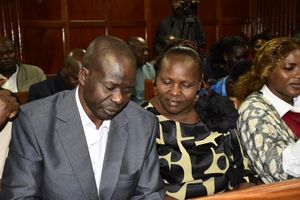
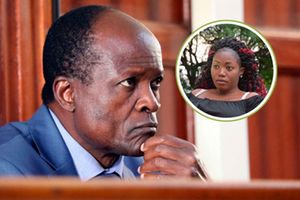
Former Migori governor Okoth Obado arrived at the High Court in Milimani on Wednesday in a heavily guarded prison van as the judge heard competing pleas over his sentence for Sharon Otieno’s murder.
After almost two months at Kamiti Prison, Obado sat in the dock with his co-convicts, Michael Juma Oyamo and Caspal Ojwang Obiero, appearing composed but worried as three prison wardens stood nearby in the packed courtroom.
The sentencing hearing was marked by an unusual mixture of quiet composure, biblical appeals, courtroom confusion and raw anger as both defence, prosecution and Sharon’s parents delivered sharply different messages to the judge.
The prosecution called 42 witnesses and relied largely on circumstantial evidence, with the court finding an unbroken chain linking the men to the killing.
But Wednesday’s hearing was less about the evidence that secured the convictions than the personal circumstances, family pain and competing requests the judge must consider before sentencing.
In a courtroom united by grief but divided over punishment, Sharon’s mother pleaded for mercy for Obado while her father struggled to contain his anger towards Oyamo and Obiero, whom he said were the last men to see his daughter.
Obado, seated as the first accused, wore a dark blue suit, a cream shirt and a blue, striped multi-coloured tie. He occasionally scratched his face and bald head while following the proceedings. At intervals, the three accused exchanged brief words, their interactions lasting only moments.
Former Migori Governor Okoth Obado at the Milimani High Court ahead of his mitigation and sentencing hearing.
Photo credit: Billy Ogada| Nation Media Group
The court heard that prison conditions had been harsh, with one defence advocate saying inmates slept on the floor and that his client’s health had also suffered. The submission offered a stark contrast to Obado’s former life as a governor, now replaced by custody, prison wardens and the uncertainty of sentencing.
The courtroom was full. Police officers struggled to control relatives and members of the public within and outside the courtroom, while the accused remained under the watch of wardens.
Obado’s arrival in a prison vehicle underlined the change from his ten years as a county governor to his present position as a convicted prisoner awaiting sentence.
The hearing was briefly disrupted when Sharon’s father, Douglas Zakaria Otieno, asked to address the court in Dholuo. The court had to look for an interpreter, and confusion followed as parts of the father’s remarks were translated into Kiswahili and English.
Sharon Otieno's father, Douglas Otieno, addresses court.
Photo credit: Billy Ogada | Nation Media Group
The confusion deepened as members of the public murmured that Mr Otieno’s submissions were being misinterpreted, forcing the court to pause as the Dholuo interpretation became difficult to follow. Against his wish to address the court in his mother tongue, Mr Otieno eventually switched to English to ensure his message was clearly understood.
Sharon’s mother, Melida Auma, urged the court to spare Obado a death or life sentence. She invoked biblical accounts of reconciliation, referring to Genesis 13:7 and Luke 23, and said the two families had forgiven him after his relatives sought forgiveness.
“We have forgiven him,” she said, explaining that Obado’s relationship with Sharon and his continued support for the family had shaped their position.
Sharon Otieno's parents: Don't crucify Obado
She said Sharon left three children whose welfare remained a daily burden. “Please do not crucify Governor Obado in this case,” she pleaded. A custodial sentence, she added, would feel like “another death in my family”.
Ms Auma said Obado, 54, had been prevented from reaching the family during the trial because of bail restrictions, but his relatives later initiated reconciliation.
Sharon Otieno's mother, Melida Auma, makes her submissions in court.
Photo credit: Billy Ogada| Nation Media Group
Her plea for a non-custodial sentence or leniency drew protests from some civil society activists in court, who objected to the family’s call for mercy.
Her husband, Mr Otieno, offered a sharply different emotional account. Speaking first in Dholuo and later in English, he said he had attended the trial for nine years and remained deeply bitter towards Oyamo and Obiero.
“These are the two people who met my daughter last,” he said, accusing one of providing the vehicle and the other of handing Sharon to her killers. He then said: “If I could be a wild dog today, I would bite and maul them down to the point of licking their blood.”
The statement left him struggling to continue. His eyes filled with tears, and he eventually returned to his seat, supporting his head with one hand. Ms Auma reacted by repeatedly sipping water from a bottle.
Former Migori Governor Okoth Obado being escorted back to the cells at the Milimani Law Courts after mitigation and sentencing hearing of his murder case.
Photo credit: Billy Ogada| Nation Media Group
The Director of Public Prosecutions opposed treating the parents’ views as decisive. Prosecutor Wangui Gichuhi said their views deserved consideration but sentencing remained a judicial function.
The offence, she said, was against the State, the community and public confidence, and punishment should reflect its gravity and deter similar crimes.
Defence lawyers urged the court to consider restorative justice, the children’s welfare, reconciliation and the men’s status as first offenders.
Obado’s lawyers cited his health, including shoulder, spinal and hypertension conditions, his 88 days in custody since trial, and his compliance with bail terms.
They proposed a three-year non-custodial sentence supported by structured restitution for Sharon’s children and family.
Lawyers for Oyamo and Obiero also sought probation or non-custodial terms, citing community support, family responsibilities, remorse, reconciliation efforts and time already spent in custody.
Justice Githua said she would consider all submissions, including the parents’ views, before ruling on sentence on November 27, 2026, at 10.30am.