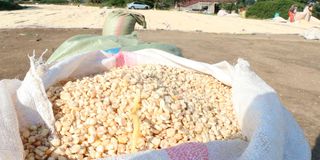
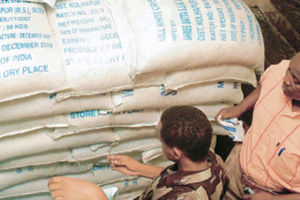
Against the backdrop of maize crop failure in the Rift Valley, the government has further lowered the cost of fertiliser and certified maize seeds in a move aimed at cushioning farmers from mounting losses and encouraging them to return to production.
The subsidy on certified maize seeds, which targets 40 million kilogrammes, will cost the government Sh6 billion, while the Ministry of Agriculture has not yet disclosed the cost of the new fertiliser subsidy.
Farmers will now buy a 50-kilogramme bag of fertiliser for Sh2,000, down from Sh2,500, representing a Sh500 reduction.
The price of certified maize seeds has also been cut by half, with a kilogramme retailing at Sh150, down from Sh300. The government will meet the difference under a raft of new subsidy measures.
This means a two-kilogramme packet of certified maize seed will cost Sh300 down from Sh600, while a 10-kilogramme bag will retail at Sh1,500, compared with the current Sh3,000. A 25-kilogramme bag will cost Sh3,750, down from Sh7,500.
President William Ruto announced the new measures during his tour of the Coast region, saying his administration was keen to ease the burden on farmers who have suffered losses following poor weather.
“My administration moved from subsidising consumption to subsidising production through lowering the cost of inputs, thus backing up farmers to produce more in a move that would strengthen food security in the country,” Dr Ruto said in Taita Taveta County.
Dr Ruto said the new prices would take effect in September and would apply at designated outlets, including the National Cereals and Produce Board (NCPB).
Agriculture and Livestock Development Cabinet Secretary Mutahi Kagwe.
Photo credit: File | Nation Media Group
Agriculture Cabinet Secretary Mutahi Kagwe said the maize seed intervention targets 40 million kilogrammes, translating into an estimated Sh6 billion government subsidy.
Kenya Seed Company produces approximately 36 million kilogrammes of certified maize seed annually, against a national demand of 40 million kilogrammes, with the shortfall supplied by private-sector producers.
The latest intervention comes after the government spent Sh78.79 billion on subsidised fertiliser since the programme was introduced in 2022. During the period, 33.55 million 50-kilogramme bags were distributed to about 1.98 million farmers.
Mr Kagwe said a 50-kilogramme bag of fertiliser retailed at approximately Sh7,500 in 2022 before the National Fertiliser Subsidy Programme reduced the price to Sh2,500.
The latest Sh500 reduction brings the price to Sh2,000, meaning the cost of fertiliser has fallen by 73 per cent since 2022.
“Since 2022, approximately 33.5 million bags of subsidised fertiliser have been distributed, reaching about 1.98 million farmers, with government support amounting to approximately Sh78.79 billion,” Mr Kagwe said.
A farm worker cutting maize stalks ready for harvest in Katakala area of Narok West constituency, Narok county in this photo taken on July 22, 2026.
Photo credit: Vitalis Kimutai | Nation
Government statistics show that annual maize production increased from 34.3 million 90-kilogramme bags in 2022 to 73 million bags in 2025. In volume terms, production rose from 3.087 billion kilogrammes of maize grain to 6.57 billion kilogrammes.
The government had earlier projected that maize production would hit 77 million bags this year. However, uneven rainfall distribution has left some of the country’s major maize-growing areas facing crop failure, threatening the projected output.
Mr Kagwe said increased maize production over the past four years had contributed to a 66.5 per cent reduction in maize imports.
“At the heart of this intervention is a simple principle: a farmer who lost his crop to drought must not also lose the ability to plant the next crop because fertiliser and seeds are beyond reach,” Mr Kagwe said.
He added: “The government will continue supporting farmers to recover from drought, lower their cost of production and return to their farms, while investing in irrigation, water harvesting and other climate-smart interventions to strengthen Kenya’s resilience to changing weather patterns.”
The intervention comes as maize farmers in the North Rift, the country’s largest maize-producing region, grapple with crop failure caused by prolonged dry conditions. Some farmers are considering uprooting or cutting down their crops and using them as livestock feed.
In the South Rift, however, maize brokers have pitched tents to take advantage of the ongoing harvest, although farmers in Narok and Nakuru counties are also reporting lower production.
The government has deployed a team of experts to the Rift Valley to assess the impact of drought on maize production and help determine the volumes that may need to be imported to bridge any supply gap.
Director-General of the Kenya Agricultural and Livestock Research Organization (KALRO), Dr Patrick Ketiem, attributed the crop failure to disease, pests and poor rainfall.
“Most of the regions have had crop failure due to depressed rainfall, which will affect production in the current season,” Dr Ketiem said in Naivasha last week.
Kenya imports maize mainly from Uganda and Tanzania, as well as other member states of the Common Market for Eastern and Southern Africa (Comesa). Alternative sources have traditionally included Mexico, Argentina, Brazil and the United States.
The NCPB has opened a purchasing window for maize and made its stores available for drying and storage by cooperative societies and individual farmers who are not ready to sell immediately.
However, farmers in the South Rift say the prices offered by brokers remain too low to cover their costs.
“Brokers are offering between Sh3,700 and Sh4,600 depending on the location and whether they come to collect the maize from the farm or whether we take it to local trading centres,” said Mr Peter Kibor, a farmer in Narok North.
Mr Kibor planted 50 acres of maize but said production was lower than last year, leaving him facing reduced earnings.
“The only remedy is to dry the maize and keep it in our stores until such a time that the prices have risen to a reasonable level and one that can allow us to recoup part of the investment we put into the business,” he said.
The middlemen buy maize in bulk from farmers before supplying it to millers across the country. Although the NCPB offers drying and storage facilities, some farmers have opted to sun-dry their maize to avoid additional costs.
A withered maize plantation in Uasin Gishu County on August 3, 2026.
Photo credit: Jared Nyataya | Nation Media Group
Ms Betty Birir, a farmer in Narok South, said farmers were counting losses because of low prices despite strong demand for maize.
She said most farmers were reluctant to sell, hoping prices would rise in the coming months.
“We are hoping that the government will review the prices upwards from the Sh3,960 offered by the National Cereals and Produce Board before importing the cereals to bridge the supply gap,” Ms Birir said.
Mr David Kamau, a farmer in Njoro, Nakuru County, said the government should raise the price to at least Sh5,600 to cushion farmers against losses amid changing supply and demand dynamics.
“The South Rift, it appears, will be the saviour for the country in maize production as the crop has failed in the North Rift region,” Mr Kamau said.
In the North Rift counties of Uasin Gishu, Nandi, Trans Nzoia, West Pokot and Elgeyo Marakwet, farmers have reported stunted maize growth after rainfall failed at a critical stage of crop development.
The South Rift planting season typically runs from December to February, while planting in the North Rift begins between April and May, creating different production cycles across the two regions.