Coastal floods displace hundreds as Tana River and Lamu brace for more water
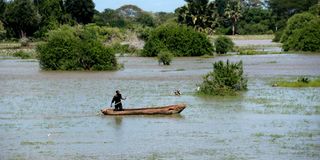
A local peddles through a flooded homestead along the Garsen- Witu Road in Tana River County in this photo taken on May 14, 2026.

Torrential rainfall along Kenya’s coastline has triggered severe flooding in Tana River and Lamu counties, leaving hundreds of families displaced and thousands more facing a mounting humanitarian crisis.
According to the Kenya Red Cross Society (KRCS), Tana Delta Sub-County is the worst hit after the Tulu and Minjila dams overflowed, sending water directly into surrounding villages and residential homes.
"Some 302 households have been displaced and a further 3,156 households affected," KRCS confirmed in a public update, adding that early flooding had also begun submerging residential properties in neighbouring Lamu County, specifically across Hindi and Witu.


Emergency operations mounted by national and county authorities, alongside humanitarian partners, have so far delivered food rations, tarpaulins and blankets to 175 of the 302 displaced families. KRCS stated that response teams remained deployed on the ground to assess evolving needs and reach the remaining 127 families as relentless rains persisted.
The crisis follows stark warnings issued by Tana River Governor Dhadho Godhana, who cautioned residents in flood-prone zones to evacuate immediately or risk being stranded.
Governor Godhana revealed that the county administration had spent the past two months distributing construction materials, including iron sheets, timber and nails, to facilitate relocation to higher ground, but several communities had resisted moving.
"They are still down there waiting for the floods so that we can go and rescue them using boats," Governor Godhana warned during a recent summit.
"Woe unto you; we will not take even a single boat to rescue those caught in the floods. It is up to you."
The operational strain on the Tana catchment area is expected to worsen as heavy rainfall upstream across Mount Kenya and the Aberdare Range swells the Tana River and the Seven Forks dam cascade.
Water, Sanitation and Irrigation Cabinet Secretary Eric Mugaa warned downstream residents in Tana River and Garissa counties that controlled spillage from the Seven Forks reservoirs was inevitable once capacity limits were reached.
He said spillage was necessary because it protected the dams from being swept away.
"What causes flooding is that the watercourse downstream is too narrow to accommodate the volume. Once the water breaks the banks, it goes anywhere," he added.
Mr Mugaa urged low-lying coastal and basin communities to move to higher ground immediately to prevent loss of life as excess reservoir releases reached downstream channels.
This comes as regional leaders and humanitarian partners gather in Mombasa for the ministerial segment of the Second Eastern Africa Dialogue Platform on Anticipatory Action (EADP2), which aims to shift the Greater Horn of Africa from reactive disaster management to pre-disaster intervention.
The high-level meeting, attended by environment, humanitarian and disaster management ministers from Kenya, South Sudan, Uganda, Somalia, Sudan and Djibouti, focused on establishing binding political commitments to fund and execute humanitarian relief before extreme weather events strike.
The Intergovernmental Authority on Development (IGAD) Executive Secretary, Dr Workneh Gebeyehu, emphasised that early warning forecasts were no longer sufficient without pre-arranged financing and immediate action.
"Over the past two days, our deliberations have reinforced a fundamental message: we must move from predicting disasters to preventing their impacts. Early warning is essential, but it is not enough. We must ensure that forecasts trigger timely action and that financing is available before disasters strike," the IGAD Executive Secretary stated.
Environment, Climate Change and Forestry Cabinet Secretary Deborah Mlongo urged delegates to shift from responding to disasters after they occur to acting before their impacts escalate, especially during periods of climate change.
Ms Mlongo said Eastern Africa faced recurrent droughts, floods, disease outbreaks, conflicts and other transboundary hazards that had caused loss of lives, damaged livelihoods, disrupted essential services, including healthcare, and reversed development gains.
“So anticipatory action is critical. Forecasting and early warnings are also very valuable if or only when they lead to timely decisions and practical interventions,” said the CS.
The regional dialogue comes at a critical juncture for Eastern Africa, where recurring cycles of severe drought and catastrophic flooding regularly devastate livelihoods, displace millions and strain national budgets.
The delegates stressed the need to connect short-term early interventions with long-term resilience and infrastructure planning.
IGAD reaffirmed its commitment to supporting member states through climate forecasting, early warning networks, technical expertise and continuous regional advocacy to mobilise climate finance at an appropriate scale.
Follow our WhatsApp channel for breaking news updates and more stories like this.