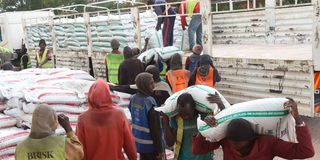
Small-scale farmers in the North Rift region are being forced to buy fertiliser at nearly double government prices as the shortage of subsidised supplies through the National Cereals and Produce Board (NCPB) persists across key maize-growing counties.
Calcium Ammonium Nitrate (CAN) fertiliser under the government subsidy programme is meant to retail at Sh1,950 per 90-kilogram bag. However, it remains unavailable in many NCPB depots, leaving farmers to rely on private dealers charging about Sh2,800 per bag.
NCPB has attributed the shortage to high seasonal demand, insisting that distribution is ongoing across its depots.
“What is happening is that there is high demand for top-dressing fertiliser, but distribution is underway in our depots across the country,” said NCPB communications manager Mr Titus Maiyo.
A crane loads Calcium, Ammonium Nitrate fertiliser from a ship onto a truck at the Port of Mombasa. In agriculture, ammonium nitrate fertiliser is applied in granule form and quickly dissolves under moisture.
Photo credit: File | Nation Media Group
The acute shortage of subsidised top-dressing fertiliser has raised fresh concern among farmers already struggling with high production costs this planting season, forcing many to turn to private dealers amid the sharp price gap.
“We fail to understand why the government makes last-minute rushes to avail low-cost fertiliser, resulting in some farmers not benefiting from the scheme and contributing to low yield,” Kenya Farmers Association (KFA) Director Kipkorir Menjo said at a farmers’ meeting in Eldoret.
“The NCPB is calling on farmers to be patient as the distribution exercise continues,” he said.
The latest shortage revives concerns over recurring breakdowns in the government’s fertiliser subsidy programme and the recurrent NCPB distribution gaps, particularly in the North Rift, Kenya’s main maize-producing region.
With the shortage persisting, pressure is now mounting on NCPB to explain the recurring failure to ensure the timely availability of subsidised fertiliser, especially in high-demand agricultural zones.
Farmers warn that unless distribution improves, the price gap between subsidised and commercial fertiliser could continue to erode productivity in the North Rift maize belt and negatively impact the country’s food security.
Farmers in the region have previously raised alarms over delayed deliveries during the planting window, with reports of empty or understocked NCPB depots at critical periods. The disruptions have heightened fears that timing gaps in distribution may undermine maize yields in the country’s grain basket.
Kenya requires about 650,000 tonnes of fertiliser annually, but the supply chain has remained vulnerable to both global shocks and logistical inefficiencies.
Questions have also been raised about who benefits most from the subsidy programme amid equity concerns over the government subsidy system.
The Ministry of Agriculture has previously acknowledged that global supply chain disruptions due to the conflict in the Middle East have affected fertiliser availability.
Agriculture Principal Secretary Paul Kiprono Rono recently cited instability in key shipping routes, including the Hormuz Strait, which has forced importers to reroute vessels via longer passages through South Africa, delaying deliveries.
The Strait of Hormuz is a narrow and strategic shipping channel between Iran and the Arabian Peninsula that connects the Persian Gulf to the Arabian Sea, and is a key global route for oil and cargo shipments. Any instability along the corridor disrupts international shipping schedules and delays imports such as fertiliser bound for Kenya.
“The conflict has forced shippers to divert to long safe routes through South Africa, which has delayed the arrival of imported fertiliser,” he said during a farmers’ meeting in Kapsabet.
Farmers arrive to collect subsidised fertiliser from the National Cereals and Produce Board (NCPB) store in Kapenguria on March 31, 2025.
Photo credit: Oscar Kakai | Nation
Most of Kenya’s fertiliser is imported through the Port of Mombasa from suppliers in the Middle East and North Africa, including Saudi Arabia, the United Arab Emirates, Qatar and Oman.
Concerns over fairness in distribution have also been raised in policy circles. A 2025 Kenya Economic Update by the World Bank found that fertiliser subsidies tend to disproportionately benefit medium and large-scale farmers, often leaving smallholders who form the majority at a disadvantage.
The report warned that the system can “excessively benefit medium-sized and large-scale farmers and crowd out private investment in the purchase and distribution of fertiliser.”
In 2024, Kenya imported fertiliser worth $99.39 million (Sh12.8 billion) from Saudi Arabia alone, while in 2021 imports reached 792,670 metric tonnes from multiple regions, including Russia and North Africa.
The market is dominated by global players such as Russia’s PhosAgro, Saudi Arabia’s Ma’aden and Morocco’s OCP Africa, the world’s largest phosphate fertiliser producer.