Nearly a month into their strike, Kenya's nurses say they can see the finish line, even if they are not there yet.
Union leaders now say there has been slight progress on some of their demands, but they are refusing to call off the strike until every issue is resolved.
Kenya National Union of Nurses (KNUN) Secretary-General Seth Panyako told Nation that at an informal meeting with Mombasa Governor Abdulswamad Nassir, they agreed to form a committee, drawn from both the Council of Governors and the union, to handle the stalemate over Career Guidelines.
"We have set that aside already," Panyako said.
Their other sticking point, the delayed absorption of Universal Healthcare (UHC) staff, has also seen some movement. Panyako said he would take President William Ruto's word as a promise to resolve the issue by absorbing the workers into the National Government, should the governors continue dragging their feet. At last week's Health Summit, Ruto promised to determine the fate of UHC workers by the end of this week.
"What we are left with now as the main thing is the collective bargaining agreement (CBA)," Panyako said.
Kenya National Union of Nurses Secretary-General Seth Panyako.
Photo credit: Lucy Wanjiru | Nation Media Group
The Intergovernmental Budget and Economic Council met yesterday and is expected to meet with the National Treasury, and Panyako said the union would be watching closely for the outcome. He hinted at a possible meeting with the Council of Governors (COG) on Wednesday, adding that the union remains hopeful.
"Hope is a must. There is no way we can continue to be out and have people suffering over issues that have spanned more than ten years. We are looking forward to having an amicable solution before Friday," he said.
He accused the government of dragging its feet on the CBA, dismissing it as an old, unimplemented agreement it is not obligated to honour.
"The courts will not stand in our way. They have been used since 2016 till date. This has been a routine, to conspire with the SRC and COG to block us from getting our rights. If they want to take me to jail, they should tell me which one. I am ready. I will not call it off. We cannot strike for the same thing for more than ten years," he said.
At a recent meeting with Governor Nassir, who chairs the COG's Health Committee, the nurses and the union leadership failed to reach an agreement on the way forward. Panyako clarified that the ongoing strike is a national dispute and has nothing to do with Mombasa County, which he said had met its obligations to nurses.
"We want to make it very clear that the strike that is ongoing has nothing to do with Mombasa County. It is purely a national issue," he said.
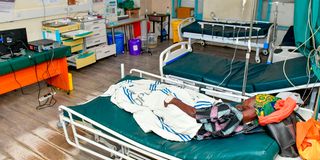
The nationwide strike, now in its fourth week since it began on July 29, 2026, has disrupted services at public health facilities across the country, with women and children bearing the brunt.
Nurses dancing outside Afya House in Nairobi on July 30, 2026 during the Kenya National Union of Nurses workers protests demanding the implementation of their Collective Bargaining Agreement (CBA) and calling on the Council of Governors (CoG) to sign and honor the negotiated deal.
Photo credit: Evans Habil| Nation Media Group
In the South Rift, the worst-hit facilities are Narok County Referral Hospital, Nakuru County Referral and Teaching Hospital, Kericho County Referral Hospital and Longisa County Referral Hospital.
In Meru and Tharaka Nithi counties, patients needing inpatient care have turned to private and mission hospitals as the strike in Meru enters its fourth week. Nurses in both counties downed their tools on July 29, though those in Tharaka Nithi resumed work earlier this month, citing court orders.
Officials of the Kenya National Union of Nurses and Midwives (KNUNM) in Meru have defied those court orders, vowing that their members will not return to work until the national government meets their demands. KNUNM Meru branch chairman Bakari Munoru said nurses there had joined their colleagues countrywide in demanding implementation of the 2017 Collective Bargaining Agreement, the approved Scheme of Service, and the employment of UHC health workers.
Public hospitals in Meru discharged patients ahead of the strike and have since stopped all admissions. Nurses in neighbouring Isiolo County, however, did not join the strike.
Kenya National Union of Nurses maintains it will not call off members’ strike
In Homa Bay, newborns and children under five are bearing the brunt of the disruption, with some missing crucial vaccinations. From birth through their early years, children need a series of vaccines to build immunity against life-threatening diseases, and the strike has interrupted that schedule, raising fears of outbreaks of vaccine-preventable illnesses in the county.
The county health department is particularly worried about polio and tuberculosis, prevented by the BCG vaccine given at birth, along with diphtheria, tetanus and pertussis, covered by the pentavalent and booster doses. Children are also vaccinated against hepatitis B, Haemophilus influenzae type b (Hib), pneumococcal disease, rotavirus, measles and rubella.
A nurse gesturing next to a banner at the entrance of Afya House in Nairobi on July 30,2026 during the Kenya National Union of Nurses workers protests demanding the implementation of their Collective Bargaining Agreement (CBA) and calling on the Council of Governors (CoG) to sign and honor the negotiated deal.
Photo credit: Evans Habil| Nation Media Group
While some women have turned to private facilities, others have gone without care altogether after the public hospitals they relied on shut their doors, and some mothers have missed their children's due vaccinations entirely.
To limit the risk of outbreaks, the health department is running medical outreaches in affected communities, targeting mothers with young children. Kenya Expanded Programme on Immunisation County Coordinator Justus Ocholla said the exercise is being carried out through a mobile clinic.
"We are using the Beyond Zero mobile clinic to reach communities where women have not taken their children for immunisation. The programme is not as effective as it should be, because we go to one place at a time, and not all women bring their children in," Ocholla said.
Health officials have also warned of a possible rise in childbirth complications the longer the strike drags on. KNUNM Executive Secretary Emmadick Okeyo said fewer women are now seeking skilled delivery in hospitals, a trend he warned could push up newborn and maternal deaths.
"Several women are going for deliveries by traditional birth attendants after hospitals were closed. This can lead to deaths, as the attendants are not trained to handle emergencies and do not have the right tools for delivery," Okeyo said.
Women who deliver in hospital are usually given mosquito nets to guard against malaria, and with more mothers turning to unskilled birth attendants, both they and their new-borns risk missing out.
"The rainy season is coming, and malaria prevalence will increase, considering that women are not getting mosquito nets. Paediatric wards in hospitals are also closed, and private facilities are overwhelmed," Okeyo said.
Patients at the Kisii Teaching and Referral Hospital (KTRH) have largely been left to fend for themselves, with about 200 nurses staying away despite threats of dismissal from Governor Simba Arati. A spot check at KTRH on Tuesday found deserted wards and long queues, with only a handful of clinical officers and casual workers struggling to keep up. Relatives were seen stepping in to care for their loved ones, while others sought clearance to buy medication and get treatment from private hospitals.
For one nurse at a dispensary in Nyaribari Chache, who asked not to be named for fear of victimisation, the strike has deepened an already painful personal crisis.
"I was supposed to take my daughter to Rongo University for admission on Monday. I have not received my July salary, and I do not know how I will admit her. We are in a meeting with other nurses here in Kisii Town, urging our members to stay put," he told Nation .
Kenya National Union of Nurses workers protest in Nairobi on July 30, 2026, demanding the implementation of their Collective Bargaining Agreement (CBA) and calling on the Council of Governors (CoG) to sign and honor the negotiated deal.
Photo credit: Evans Habil| Nation Media Group
Nurses in Kisii accuse the county government of failing to pay their salaries and remit statutory deductions, even as neighbouring Nyamira County confirms its workers have been fully paid. Governor Arati has threatened to sack those who fail to report back to work, but the nurses remain defiant, saying they will not budge until their outstanding dues are cleared.
In Kisumu, the strike has pushed Jaramogi Oginga Odinga Teaching and Referral Hospital (JOOTRH) beyond capacity, with the maternity ward bearing the brunt as more women seek care there. The pressure is especially acute in maternity, where two women are sharing single beds due to a shortage of space, leaving health workers struggling to give everyone adequate care.
A health worker at the facility, who asked not to be named, said the hospital had a duty to admit and attend to women seeking maternity care, and that turning them away was not an option, given the risk to the lives of mothers and newborns.
The strain has also hit women needing urgent postnatal care. Jane Auma, who gave birth a week ago, was forced to seek treatment at JOOTRH after developing bleeding, only to find the maternity ward full.
"I was to be admitted, but the beds were full. Women were sleeping two per bed. So doctors said they could not send the women away," Auma said.
In Mombasa, though, Panyako had only praise, commending the county government for keeping up with nurses' salaries and union dues, and for rolling out competitive promotions. While some counties owe up to five months in union dues, he said Mombasa had paid its dues, including July salaries, making it one of only 14 counties to do so. Mombasa was also the first county to begin paying some of the allowances the union is pushing for nationally.
"Mombasa is among the counties that actually run our union. We thank Mombasa County for that. It is the only county that was first to pay these allowances KNUN is fighting for," Panyako said.
Governor Nassir said the county would continue engaging with nurses' representatives as part of efforts to resolve issues affecting the health sector.
"Mombasa continues to lead the country in staff welfare matters. We continue to dialogue as the Council of Governors, alongside the National Government, with KNUN and Midwives on national issues," he said.
Reporting by Hellen Shikanda, Vitalis Kimutai, David Muchui, George Odiwuor, Wycliffe Nyaberi, Domnic Ombok and Brian Ocharo