Ruto health forum: A system that works, but for whom?
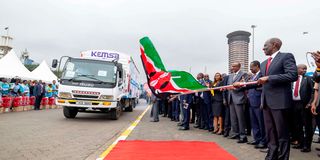
President William Ruto flags off the distribution of Healthcare kits to various counties during the Kenya Health Summit 2026 at the Kenyatta International Conference Centre, Nairobi, on August 18.

What you need to know:
- As the president spoke, nurses, clinical officers, laboratory officers and public health officers were still at home waiting for their grievances to be heard.
- We reported drug shortages and vaccine stock‑outs, but the President confirmed Kemsa’s earlier statement that it has raised its fill rate from 40 per cent to about 91 per cent.
- There were mixed reactions to the conduct of the town hall, with some saying the president did not give Kenyans a chance to ask questions.
President William Ruto led the country in a town hall on Tuesday night, a capstone to the first day of the Kenya Health Summit, which ended yesterday.
It was the first event of its kind in the country, and citizens expected the president to answer questions about the health system.
Before the event, the moderator opened by outlining the promises made by the Kenya Kwanza government, giving a snapshot of its scorecard and inviting candid discussion on the state of healthcare.
The move away from the defunct National Hospital Insurance Fund (NHIF) took centre stage, with President Ruto saying the Social Health Authority (SHA) has delivered and that it works.
In his opening remarks, the president said he had promised to create a health system that works for every Kenyan.
“We have a system that works,” he said.
Our analysis shows that two years after the president took office, intern doctors staged a 56‑day strike over delayed appointment letters after graduation. They also demanded implementation of the 2017 collective bargaining agreement and comprehensive cover. Services were disrupted, and patients missed out on quality care.
Clinical officers and Universal Health Workers also carried out a series of industrial actions.
As the president spoke from the podium in the Tsavo Ballroom at the Kenyatta International Convention Centre, nurses, clinical officers, laboratory officers and public health officers were still at home waiting for their grievances to be heard.
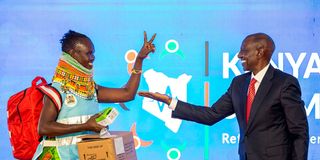
President William Ruto presents Healthcare assistant devices to Mrs Cellina Losike - CHP from Lodwar County during the Kenya Health Summit 2026 at the Kenyatta International Conference Centre, Nairobi on August 18.
We reported drug shortages and vaccine stock‑outs, but the President confirmed Kemsa’s earlier statement that it has raised its fill rate from 40 per cent to about 91 per cent, meaning nine out of every ten requests from health facilities are fulfilled.
The President reminded the audience that he had promised his government would employ community health promoters (CHPs). Before 2022, these workers were known as community health volunteers. The president changed both their name and their terms. In 2024, Parliament approved a bill that, for the first time, recognised pay for community health promoters. In most counties, they now receive a stipend partly paid by the national government and partly by the county government.
At the town hall, Ruto said that by Monday, August 24, all CHPs will be fully covered under the SHA. When asked why he has not yet fulfilled the promise to provide diapers to mothers after childbirth, as pledged in the UDA manifesto during his presidential campaign, he said plans are underway.
“We have already put the mechanism in place. We have already changed the way our Linda Jamii operates. The Linda Mama programme focused on the mother alone; today, the Linda Jamii focuses on the mother, child and household,” he said.
Linda Mama was a free maternity service which included benefits such as antenatal care and outpatient care for infants up to nine months.
A 2023 study in Springer Nature’s European Journal of Health Economics analysed a decade of the Linda Mama programme and found an increase in skilled deliveries and a steady reduction in under‑five mortality over ten years.
However, the latest State of Devolution report by the Council of Governors shows a fall in skilled deliveries of 23 per cent, from 709,281 to 543,237, and a 19 per cent drop in fourth antenatal care (ANC) visits, from 459,489 to 368,585.
Although the president says Linda Jamii is a new version of Linda Mama with additional benefits, this contradicts his opening address on Tuesday.
“Serious nations do not start every five years again. Governments will change, but a Kenyan’s right to healthcare cannot change with them. We can improve what we inherit and correct what does not work, but we cannot tear down progress without an answer for what comes next,” he said.
President William Ruto flags off the distribution of Healthcare kits to various counties during the Kenya Health Summit 2026 at the Kenyatta International Conference Centre, Nairobi, on August 18.
The president added that during the Linda Mama era, the payout for a normal delivery was Sh2,500 and that the SHA has quadrupled that amount.
Our fact‑check shows that in 2015, NHIF increased the payout for a normal delivery to hospitals from Sh6,000 to Sh10,000, and for a caesarean section from Sh18,000 to Sh30,000. SHA now pays the same amount for caesarean sections.
For the first time, the government has launched an ambulance dispatch centre. The president said a beneficiary in an emergency will not need insurance; the government will cover all costs.
“By the time I complete my first term, I will have discharged all commitments I made. On that list, I will be ready for the exam next year; my target is to get to 100 per cent,” he assured.
President Ruto criticised headlines that insinuated the digital health system cost Sh104.8 billion, and singled out coverage by Nation Media Group, People Daily and Africa Uncensored. He said those reports were misleading and sought to set the record straight.
He clarified that the system was not bought outright but operates under a lease‑style contract, and that Kenyans pay only five per cent for the service.
“Facts are stubborn, and reality is different from what is said. We did not buy the system,” he said.
He added that this five per cent charge is lower than the 17 per cent management cost NHIF recorded in 2022.
“We said that we are not going to spend more than five per cent of the resources we collect from the people of Kenya. These management costs include payment for the digital platform that we are using,” he said.
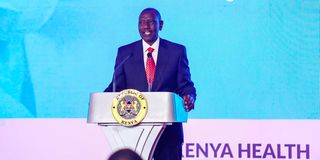
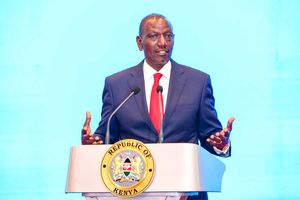
President William Ruto speaks during the Kenya Health Summit 2026 at the Kenyatta International Convention Centre (KICC) in Nairobi on August 18, 2026.
He explained that hospitals do not pay any private entity; they only pay the Digital Health Authority (DHA).
“The money paid to the DHA is provided for in law. Facilities pay two per cent, with a maximum of Sh5,000 per claim,” he said.
DHA chief executive Anthony Lenaiyara said that so far, only about Sh500,000 million has been paid for the digital system by the SHA.
“Every active member of SHA pays Sh25 per year for this technology,” he clarified.
In a separate interview posted earlier this year, Health Cabinet Secretary Aden Duale said the Sh104 billion is not paid by the government.
“The system that we use is based on a contract that the Government of Kenya has signed. The system that we use, the one that runs healthcare from identification, applications owned by doctors and the citizens, there are about 38 systems. Kenyans pay a fee under the Digital Health Agency, and it was passed by Parliament. The contract was signed in September 2024,” said Duale.
There were mixed reactions to the conduct of the town hall, with some saying the president did not give Kenyans a chance to ask questions. Nation also noted that the president often asked the questions himself, directing them to specific government officials and chief executives of private facilities.
A social media user who attended the event posted: “Yesterday, what we witnessed at the Presidential Town Hall at KICC was an invitation to be a Churchill Show live audience. We were told we were being invited to ask questions and get answers. In reality, only one person raised their hand and got the opportunity to ask a question.”
The Chief Officer for Citizen Engagement and Customer Service in Nairobi County, Geoffrey Mosiria, also criticised the town hall.
“I want to tell you what no one else will. When a patient is referred from Level 2 to 3, to 4, to 5, to 6… when they get to the outpatient department, they are asked to pay out of pocket. I know people will not tell you this, but I will say it on behalf of Nairobians,” he said.
“SHA started well, and people would walk in and out without paying. For civil servants, it is working very well, but for the common citizen it works well only at lower levels,” he added.
Follow ourWhatsApp channel for breaking news updates and more stories like this