Rising legal disputes between some counties and their respective county Public service boards (CPSBs) are becoming a cause for concern for senators over their growing cost, administrative disruption and impact on service.
The Senate’s Committee on Devolution and Intergovernmental Relations fears that these clashes are no longer about governance, but power, warning that egos and turf wars are taking precedence over service delivery, as counties spend millions on costly litigation while critical human resource functions such as hiring, promotions and staffing stall.
Yesterday, the committee’s chairperson, Senator Mohamed Abass, confirmed that they are handling four cases involving Garissa, Trans Nzoia, Mandera and Machakos counties.
He said the Garissa case was raised by Senator Abdul Haji in a statement regarding alleged interference by the Executive in the operations of the board.
It was reported that Governor Nathif Jama influenced the appointment of more than 30 chief officers, despite interviews conducted by the county’s board.
Garissa Senator Abdulkadir Mohamed Haji.
Photo credit: Dennis Onsongo | Nation Media Group
On Monday, the committee visited Trans Nzoia County, where Governor George Natembeya is embroiled in a feud with the outgoing board led by former chairperson Peter Wamoto. The session, chaired by Senator Margaret Kamar, noted that many of the disputes could be resolved outside the courts, potentially saving public funds.
“It cannot be that all these governors are wrong. We need amendments to guide proper relationships between county organs. We are concerned about the financial burden of litigation because public money is being wasted in courts,” Prof Kamar said.
The committee’s visit came against the backdrop of a bitter power struggle between Mr Natembeya and the board, which escalated last month when the governor ordered the immediate closure of the board’s offices.
In a communication dated February 16, the governor accused the board of gross misconduct, rogue operations and deliberate disruption of his administration’s human resource plans. He suspended the board’s operations until March 2, citing improper conduct, unlawful recruitment and actions that had, in his view, “severely disoriented” county government operations.
The move came just days before the board’s tenure officially ended on February 28, heightening tensions over control of county human resources.
The Nation established that the closure was the culmination of a long-running dispute over authority in hiring, promotions and staffing within the county government.
Prof Kamar criticised the Trans Nzoia County Assembly for failing to guide the resolution of the dispute, accusing it of contributing to the standoff.
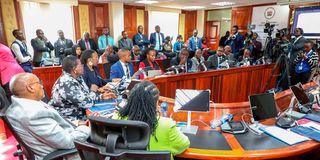
The Senate Committee on Devolution and Intergovernmental Relations, chaired by Mohamed Abass, during a session at County Hall, Nairobi, on Thursday, February 26, 2026.
Photo credit: Dennis Onsongo | Nation
She said that the Senate committee would table a report recommending measures to strengthen intergovernmental relations.
Kisii Senator Richard Onyonka noted that ongoing legal challenges and governance disputes are affecting county operations and undermining devolution.
“It is a worrying trend. We need to balance these issues so they do not all end up in court,” he said. “The issues presented to us have been overtaken by events, but we need to streamline how county governments can function effectively.”
He further revealed that counties such as Lamu and Machakos have experienced conflicts between the executive and CPSBs over the conversion of long-serving casual workers, some of whom have worked for over seven years, into permanent and pensionable terms. Similar issues have also affected Trans Nzoia and Mandera counties.
“We have issues everywhere, but we intervene so that county governments can function effectively,” Mr Onyonka said.
The senators underscored the need for legal amendments to enable a more cordial and functional relationship between governors and the employment boards.
“These boards serve a six-year term and sometimes governors inherit boards over which they have little influence in employment matters. This often strains relationships due to political interference. It is an issue that must be resolved to support devolution,” Mr Onyonka added.
According to governance expert David Ngugi, the frequent conflicts often stem from governors’ desire to appoint loyalists or overturn hiring decisions made by previous administrations.
“We have seen messy fallouts that compromise service delivery in devolved units. These are often attempts by governors to control the hiring process,” he said.
Lawyer Steve Kabita noted that such standoffs are frequently driven by efforts to ensure that boards align with new administrations.
“New governors often accuse inherited boards of padding the payroll with ghost workers. The central battle, however, is over control of key appointments such as chief officers and directors,” Mr Kabita said.
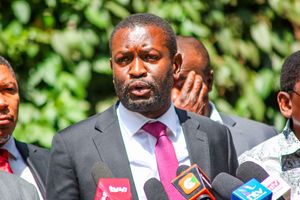
Trans-Nzoia County Governor George Natembeya.
Photo credit: Dennis Onsongo | Nation Media Group
A proposed law amendment by Mr Haji seeks to reduce the term of CPSBs from six years to five, aligning it with electoral cycles. The proposal has received support from the Council of Governors, which argues that it could help reduce recurring conflicts.
“County public service boards sometimes become an impediment to governors in carrying out their duties. Under current laws, governors are often forced into expensive settlements to remove board members. This is a major expense for counties,” said Migori Governor Ochillo Ayacko during a recent appearance before the Senate committee.
However, Devolution Principal Secretary Michael Lenasalon warned that the amendment could concentrate power in the hands of governors.
Meanwhile, a member of the CPSBs National Consultative Forum, speaking anonymously due to the sensitivity of the matter, argued that the real solution lies in strengthening the independence of the boards.
“The governor should not be the appointing authority for CPSBs. Stronger laws are needed to limit executive influence, as many governors seek to control board activities and appoint loyalists. Simply aligning terms with electoral cycles is not a solution,” the official said.
Several counties, including Kakamega, Kitui, Nyandarua, Laikipia, Meru, Machakos, Migori and Vihiga have previously experienced similar standoffs. In December 2023, the Employment and Labour Relations Court stopped Kakamega Governor Fernandes Barasa from dismissing members of the CPSB after four out of six of them had been removed by the county assembly.
In 2024, the Meru CPSB Chief Executive Officer sued over alleged unlawful dismissal and illegal appointments by the then-governor.